When we go to work, whether we clock in online or go in person, we expect our employers to treat us with professionalism, respect, and equality. Unfortunately, even in our modern age, this isn’t always the case, and employers may treat their employees in unfair ways based on outdated beliefs and biases. Shockingly, in the fiscal year of 2021, over 18,000 sex discrimination charges were filed with the EEOC. Such charges made up more than 30 percent of that year’s cases—consistent with percentages since 1997.
This isn’t to say every charge claimants filed went in favor of the victim, as employment and discrimination laws are both very complex. Cases can be difficult to prove without the right knowledge, which means that learning how to prove gender discrimination in the workplace is critical to receiving justice.
Before we can discuss what is necessary to prove gender discrimination, we must first understand what it is. Gender and sex are two different things, both scientifically and in terms of the law. You may hear sex discrimination and gender discrimination used interchangeably, but they are not the same thing. Sex-based discrimination is an umbrella term that encompasses discrimination against sexual orientation, pregnancy status, and gender identity.
For the purposes of this article, we will discuss gender discrimination as it pertains to transgender and cisgender individuals. Keep in mind that you can experience gender discrimination based on the gender someone sees you as and not necessarily how you identify.
When it comes to domination cases, courts will accept two types of evidence: direct and indirect. When attempting to prove your case, as we will discuss, you can use either form of evidence to prove your points. You can also use these forms of evidence to prove a pattern or practice.
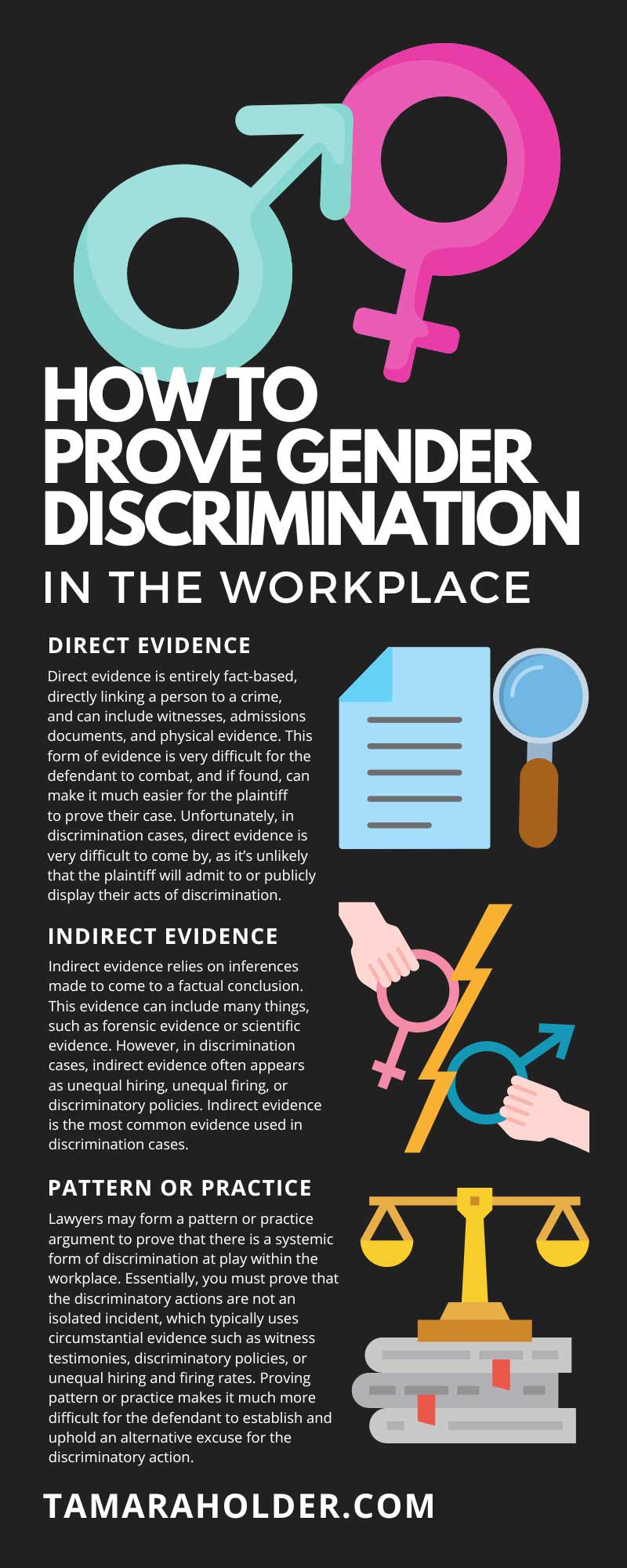
Direct evidence is entirely fact-based, directly linking a person to a crime, and can include witnesses, admissions documents, and physical evidence. This form of evidence is very difficult for the defendant to combat, and if found, can make it much easier for the plaintiff to prove their case. Unfortunately, in discrimination cases, direct evidence is very difficult to come by, as it’s unlikely that the plaintiff will admit to or publicly display their acts of discrimination.
Indirect evidence relies on inferences made to come to a factual conclusion. This evidence can include many things, such as forensic evidence or scientific evidence. However, in discrimination cases, indirect evidence often appears as unequal hiring, unequal firing, or discriminatory policies. Indirect evidence is the most common evidence used in discrimination cases.
Lawyers may form a pattern or practice argument to prove that there is a systemic form of discrimination at play within the workplace. Essentially, you must prove that the discriminatory actions are not an isolated incident, which typically uses circumstantial evidence such as witness testimonies, discriminatory policies, or unequal hiring and firing rates. Proving pattern or practice makes it much more difficult for the defendant to establish and uphold an alternative excuse for the discriminatory action.
To prove that gender discrimination occurred in the workplace, you must first establish a prima facie case of discrimination. This translates to “at first sight” and is used in law to establish whether a case should proceed to trial. To establish a prima facie case for discrimination, the plaintiff must prove the four requirements below.
The plaintiff’s first job is to prove that they are a member of a protected class. People belonging to protected classes receive special protections that make discrimination against them illegal. In accordance with Title VII, it is illegal to discriminate against someone based on their sex, sexual orientation, gender, religion, origin, race, color, age, disability, or pregnancy status. For cisgender people, proving this is relatively easy, but for transgender people, proving their gender is a subject of contention. It is incredibly important for transgender individuals to receive legal representation from lawyers that actively support trans people.
Once you prove that you are part of a protected class, you must then prove that you suffered a negative or adverse action. If you believe that your supervisor denied you a promotion, undercompensated you, or wrongfully terminated you, you must prove that this action occurred and it adversely affected you. The impact can be emotional, physical, psychological, or even financial.
Even if you have been in your position for some time, you still have to prove that you were qualified for the job and met expectations. You must show that you met all the requirements stated in your employee contract. If you don’t, then you cannot establish a prima facie discrimination case. For example, if you were supposed to make a certain amount of sales per month and consistently underperformed, you did not meet your role’s requirements. In this situation, your case will not go to trial.
If your employer terminated you, demoted you, or denied you benefits, you must prove that others experienced dissimilar treatment despite meeting the same requirements as you. For example, if the employer fires a trans woman and replaces her with a cisgender man with the same qualifications, she can further prove discrimination.
Once you establish a prima facie case of discretion, the burden of proof then shifts to the defendant. The defendant will likely state that they had an alternative reason for taking the adverse action. For instance, they could claim that it was because of consistent tardiness, inappropriate workplace behavior, or underperformance. The burden of proof then switches back to the plaintiff, who must demonstrate pretext. Essentially, the plaintiff will call into question the validity and logic behind the defendant’s reason, and if the court finds the reason invalid, the burden of proof shifts back. This back and forth can go on for quite some time.
If you believe that you’ve been a victim of gender discrimination, you’re not alone—there are people that care and are willing to give you the legal representation you need. Gender discrimination lawyer Tamara Holder is dedicated to getting justice for victims and will use her years of knowledge to get you the compensation you deserve.
When most people think of workplace discrimination, they think of unequal pay between genders, employer retaliation, or even racial discrimination. For some, it may be odd to think of being passed over for a promotion as workplace discrimination, but in certain situations, it's absolutely possible. If your employer rejected you for a promotion you were qualified for and you suspect the rejection may be for the wrong reasons, you may be a victim of discrimination. If you're unsure or need help determining if it's time to take legal action, you should review what promotion discrimination is and how to tell if you're a victim of it.
This is a common employment law question that doesn't have a straight answer. Being passed over for a promotion is legally actionable under certain circumstances. However, the law has certain safeguards in place to ensure false discrimination cases don't crop up left and right, and, initially, the burden of proof falls upon the plaintiff. You can't take legal action for not receiving a promotion unless you first file a discrimination charge with the EEOC.
If you don't have the right grounds to begin a case, and the agency finds nothing during the initial investigation, you'll receive a "Dismissal and Notice of Rights." This means you have the right to sue, but the EEOC won't seek litigation, which can end up being a complete waste of time.
Before you can take legal action for promotion discrimination, it's important to understand what promotion discrimination is and how to tell if you're a victim in the eyes of the law. Promotion discrimination means that an employee was passed over for a promotion or raise because they are part of a protected class. Keep in mind that at-will states are not exempt from this, and they cannot engage in any form of workplace discrimination.
Needless to say, employers can refuse to promote you for completely legal reasons, and scorned employees can't pursue legal action for just any reason. A lack of promotion also does not automatically mean that your employer did so for illegitimate reasons. Ultimately, your employment contract should state what qualifications you need to meet to qualify for a promotion. If you don't meet the necessary qualifications and thus were not promoted, the situation likely does not qualify as promotion discrimination. That being said, your employer can state you did not meet requirements simply to establish a false pretense, which they can use in court to dispute your discrimination claim.
As mentioned, for the court to consider a lack of promotion a form of discrimination, you must first be part of a protected class or have a protected characteristic. Title VII of the Civil Rights Act put laws in place that make it illegal for employers to discriminate against employees if they fall into one of these protected groups. It is illegal for an employer to discriminate against someone based on their sex, sexual orientation, gender, gender identity, race, color, ethnicity, religion, disability, pregnancy status, age, or genetic information. If your employer denied you a promotion because you belong to one of these protected classes, the law would consider that promotion discrimination.
However, being part of a protected class and being denied a promotion doesn't automatically make the action promotion discrimination. Again, if you are not qualified for the position, your employer does not have to promote you. However, if you are qualified for the position and your employer still denies you a promotion, there may be alternative and potentially unlawful factors at play.
Say that you are part of a protected class, you are qualified for a position, and your employer still refuses to promote you. Does this automatically mean you're a victim of employment discrimination? Not necessarily. Your employer may still have a good reason for not promoting you. Another person may have been more qualified, or it's possible that there weren't enough open positions.
In these cases, it's important to speak with your employer about their reason for not promoting you. In discrimination cases, it's usually easy for the employee to tell when their employer is giving them poor excuses. Asking for clarification or reasoning will quickly cause a lie or bad excuse to crumble.
Again, it's possible that your employer is feeding you a good excuse to make sure you don't file a claim. If you're unsure whether your employer's reasoning is valid, pay attention to who ends up getting the promotion. Is it someone of the same protected class? Were they just as qualified as you? If the person that received the promotion is underqualified and is of an entirely different protected class, there's a good chance your employer refused to promote you for an unlawful reason.
If you believe that you're a victim of promotion discrimination, your first step should be to contact an employment lawyer and file a claim with the EEOC. An assigned agent will investigate the case and determine whether a violation of the law occurred. During this time, it is important to stay in close contact with your lawyer, document what you can, and continue doing your job as you normally would. If you lash out or do your job poorly out of anger, your employer could use your bad behavior as justification for not promoting you.
If the agent finds that there was a violation of employment law, they'll likely reach out to your employer to reach a settlement. If your employer refuses to settle, the case will go to a legal staff who will file a suit. Alternatively, if the agent does not find an employment violation, you will receive a "Dismissal and Notice of Rights" letter, allowing you to sue without the backing of the EEOC.
Now that you know how to tell if you've been a victim of promotion discrimination, it's time to ask the final question—will you take legal action? All forms of workplace discrimination are part of a larger systemic issue that plagues workplaces across America, and it needs to be dealt with. However, employment law is complex, and victims can't fight these cases on their own. Contact workplace discrimination lawyer Tamara N Holder today and get the justice you deserve.

Regardless of where someone works, their position, or how much money they make, every employee deserves to be treated with professionalism, respect, and fairness. However, in some workplaces, disrespect and cruelty run rampant. Lack of respect can turn into unfair treatment, which can become unlawful discrimination. To understand what is considered legally actionable, let’s take a look at what is considered unfair treatment in the workplace.
Unfair treatment is unkind, inequitable, or improper treatment of an employee, either by another employee or by upper management. Unfair treatment can range from cruelly worded emails or rude comments to being left out of meetings or fired for the wrong reasons. This can reduce productivity and team morale, often leading to upticks in resignation and difficulty retaining employees. Ultimately, unfair treatment creates what is known as a toxic work environment—but what can employees do?
The problem is that unfair treatment in the workplace is not considered illegal on its own. A colleague or an employer may be unkind to you, but that does not make it illegal or actionable. For unfair treatment to be considered illegal, it must create a hostile work environment rather than a toxic one. When unfair treatment crosses that line, it becomes unlawful treatment.
For a workplace environment to be considered hostile, the situation must consist of:
To clarify, let’s look at two examples of a similar nature that constitute two different environments.
Sarah is Paul’s supervisor, and Sarah doesn’t like Paul. She accidentally sends an email to him that was meant for someone else. It states that she wishes he would quit, that he does a terrible job, and that he just isn’t smart. She apologizes for the incident, and upper management follows through with the correct punitive action once reported.
Sarah is Paul’s supervisor, and Paul is a Black man. Sarah accidentally sends him an email meant for someone else making derogatory comments about Black people. Paul reports the incident, but upper management doesn’t do anything. Sarah, encouraged by their lack of action, continues her discriminatory behavior and feels more confident saying these things outright.
For those who are in a toxic work environment and are experiencing unfair treatment, it is best to either report the situation to HR or find another job. For those experiencing unlawful treatment and struggling to work and function in a hostile environment, hiring a work environment lawyer should be your immediate next step. You should never be made to feel afraid, depressed, or anxious for fear of cruel treatment, and legal action is the best way to protect yourself and future employees.
Employment discrimination isn’t easy to prove in court, as evidence can be difficult to come by. Additionally, it’s hard to prove someone’s true intentions. Fortunately, it’s not impossible to prove, and you can support your case if you know what to look for. Let’s review what evidence is needed in court to prove workplace discrimination in order to help you get the compensation you deserve.
Direct evidence is very difficult to come by when proving workplace discrimination. It directly links a person to a crime, so in this case, it could be a document, email, or recording of a person stating who they discriminated against and why. Direct evidence essentially leaves no room for interpretation or doubt. For example, if you came across an email that reads, “I fired this person because I don’t want old people working for my company,” that would be direct evidence proving that age discrimination in the workplace occurred. It is highly unlikely that someone will admit to this willingly, so this evidence is rare.
Circumstantial evidence proves a fact by inference, while direct evidence proves something with facts. For example, if you wanted to prove it was nighttime using direct evidence, you could simply look outside and point out the night sky. If you wanted to prove the same thing using circumstantial evidence, you would turn off the artificial lights and point to how dark it is in the room, even with windows. The four types of circumstantial evidence are human behavior, direct witnesses, scientific evidence, and physical evidence.
Courts use the McDonnell Douglas framework to analyze circumstantial evidence in discrimination cases. The employee must first prove they are a member of a protected class and qualified for their position. Then, they need to show they suffered adverse employment action and were replaced with a different worker who is not a member of the same protected class—if the employee was fired.
If the employee can prove these things, then the burden of proof shifts to the employer, who must prove the adverse action was for a legitimate reason. If the employer can prove this, the burden of proof shifts back to the employee, who must prove their “legitimate reason” qualifies as a pretext for discrimination. Pretext for discrimination means their reasoning was a cover-up for the truth.
Pattern or practice means the employee must prove the employer, or the business, engages in unfair practices and policies. These policies do not always have to be followed but cannot be an isolated incident. For example, an employer may have a policy against wearing “protective or natural hairstyles,” which would only affect Black people. In pattern or practice, you must gather evidence that other people of the same or different protected classes were affected by these unfair policies, at least sporadically.
Now that you know what evidence is necessary to prove workplace discrimination, don’t let all that weight fall on your shoulders. Let the Law Firm of Tamara N Holder help. We’ll put you in touch with one of our experienced and dedicated workplace discrimination lawyers who will fight hard for you.
Retaliation is the act of harming someone as a form of revenge. With the inherent power imbalance in the employee-employer relationship, employers sometimes unjustly punish workers for invalid and illegal reasons. In turn, many employees fear for the security of their job and, subsequently, their income. If you’re concerned that your employer may be seeking revenge against you, and are worried about losing your livelihood, let’s review how the law protects employees from employer retaliation.
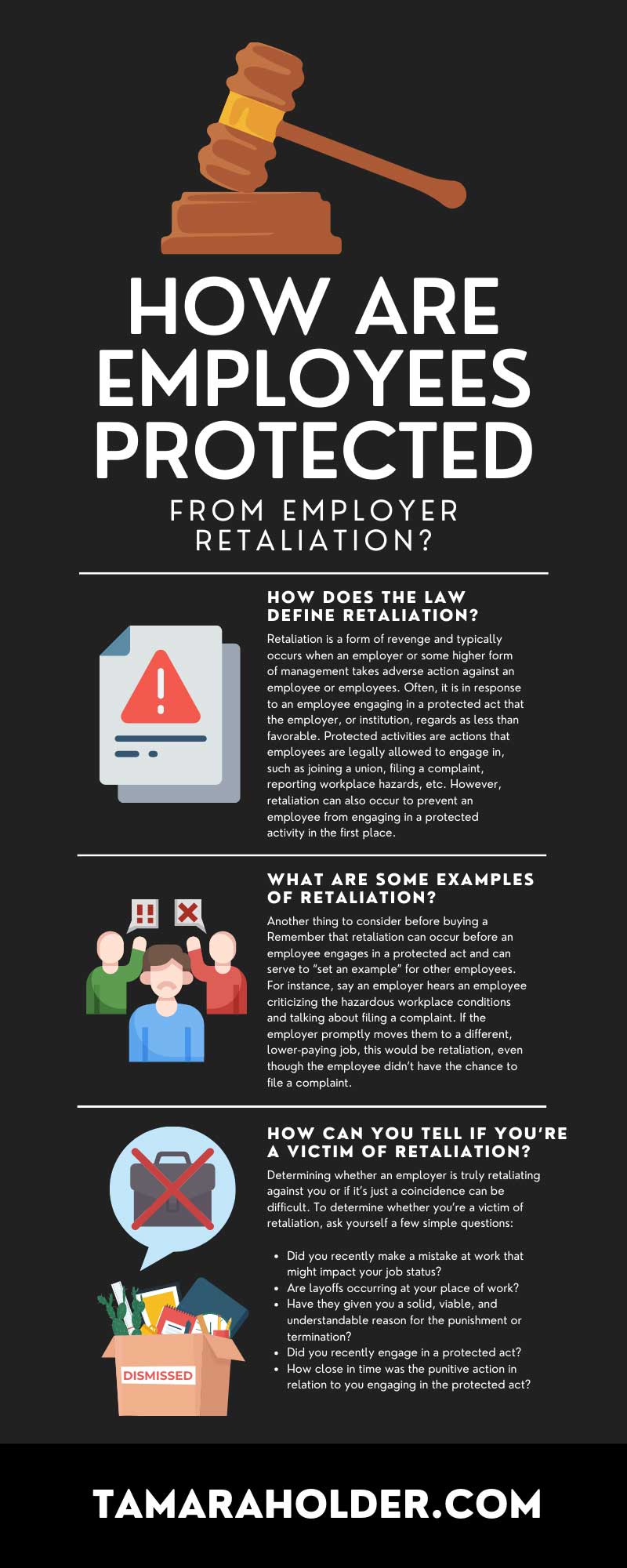
As we stated, retaliation is a form of revenge and typically occurs when an employer or some higher form of management takes adverse action against an employee or employees. Often, it is in response to an employee engaging in a protected act that the employer, or institution, regards as less than favorable. Protected activities are actions that employees are legally allowed to engage in, such as joining a union, filing a complaint, reporting workplace hazards, etc. However, retaliation can also occur to prevent an employee from engaging in a protected activity in the first place.
An employer can retaliate against an employee in several ways, ranging from verbal abuse to reduced hours to termination or anything in between. For example, say an employer sexually harasses an employee, and the employee reports the assault and sues in response. If the employer were to fire the employee for no other reason other than to harm them, this would be considered retaliation.
Remember that retaliation can occur before an employee engages in a protected act and can serve to “set an example” for other employees. For instance, say an employer hears an employee criticizing the hazardous workplace conditions and talking about filing a complaint. If the employer promptly moves them to a different, lower-paying job, this would be retaliation, even though the employee didn’t have the chance to file a complaint.
Determining whether an employer is truly retaliating against you or if it’s just a coincidence can be difficult. To determine whether you’re a victim of retaliation, ask yourself a few simple questions:
If there doesn’t seem to be a good reason as to why your employer punished or fired you, then you may be a victim of retaliation.
Victims of retaliation often experience serious financial loss or emotional turmoil. Due to the impact this can have on a person’s livelihood and mental well-being, there are many laws in place to protect employees. Being familiar and up to date with these laws can give you more confidence as an employee and protect you from the fallout of retaliation.
Title VII of the Civil Rights Act of 1964 protects employees from being discriminated against based on their color, race, origin, sex, religion, pregnancy status, and/or disability. This act also protects an employee’s ability to take legal action against a discriminatory employer. Therefore, it is illegal for an employer to punish an employee for filing a complaint or taking legal recourse.
Laws regarding time off vary depending on your state and employee contract. However, it is not a crime, nor is it punishable, for an employee to ask for time off, as the Family Medical Leave Act protects you.
Say, for example, you request time off to go to the doctor, go through the proper procedure, and get approval for that time off. On the day of, your employer calls you and tells you to come in because they’re short-staffed that day, but you don’t go in because you’re at the doctor’s office. This might upset your employer, but you’re fully within your legal right to do so, and they cannot retaliate against you for this.
A slew of laws articulates precisely what is and isn’t conducive to a safe work environment, from a high-rise construction site to a financial analyst’s office. These laws are in place to keep you safe. The laws may dictate the type of PPE you wear, how your office is set up, and even how much exposure to a material you’re allowed to have. If your employer doesn’t follow these laws and regulations or doesn’t provide a safe work environment, you are allowed to file a complaint under the Occupational Safety Act. For instance, if the only fire escape is broken, and your employer doesn’t take the appropriate action to fix it, your employer cannot legally punish you for filing a complaint.
Again, state laws and your employment contract will affect your area’s minimum wage and how much pay you receive. However, the Fair Labor Standards Act states that it is within your legal rights to report any kind of wage violation, and your employer cannot punish you for doing so. For example, if you are qualified for overtime pay and don’t receive it, or your employer illegally defers your wage, you can report it. Your employer cannot retaliate against you even if it takes money out of their pocket. They are bound by law to pay you for the work that you do and the amount that you agreed upon.
One of the most important rights an employee has is the ability to form a union and fight for better working conditions. The National Labor Retaliation acts protects your right as a US citizen to unionize, ask for better pay and working conditions, engage in collective bargaining, and strike. State laws vary, and in some cases, your employee can terminate you for attending a protest or strike. However, they cannot penalize or fire you for simply joining a union.
Many laws protect employees from employer retaliation, and you should never receive punishment for engaging in a protected act. If you believe your employer has unjustly disciplined, penalized, or terminated you, contact the Law Firm of Tamara N. Holder today. Tamara Holder is a knowledgeable, experienced, and dedicated employment dispute lawyer devoted to representing workers who have received unjust treatment.
John F. Kennedy signed the Equal Pay Act into law on June 10, 1963, in order to amend the Fair Labor Standards Act and end wage discrimination based on sex. Despite its intentions, employers still violate the Equal Pay Act, and women continue to earn less. However, these violations aren’t always as obvious and straightforward as one might think, which makes learning to recognize them all the more critical.
Substantially equal jobs should pay the same, and for jobs to get considered substantially equal, they do not have to be exact copies. Still, they should require a similar level of skill, effort, and responsibility. Many female employees aren’t aware of this fact and go underpaid by their employers simply because of their gender.
In most cases, this likely isn’t because an employer simply decides to pay a female employee less; instead, there are unconscious biases that an employer may have. Even though a woman and a man might work substantially equal jobs, an employer may automatically and unconsciously view a woman as having less experience, education, or seniority. As a result, they may pay a woman less, and though this might be an unconscious practice, it is still illegal.
All too often, women get forced into caregiver roles that can interfere with their level of education and job experience. This severely limits the types of jobs women can apply for and receive, directly impacting their income. As their careers and education advance, so should their titles and overall salary, but this is not always the case. Some employers rely on this past salary information to dictate salary offers despite many states prohibiting this practice. Due to the social factors that impact how women may start their careers, relying on past salary information leads to lower salaries for women when they deserve higher pay.
As mentioned, employers may follow unconscious biases or even biases they are aware of. One factor contributing to unequal pay is how women obtain social currency and how easily they can lose it. To explain, many women do not ask for or get rejected for a raise. In asking for a pay raise, women can come off as “bossy,” “demanding,” “rude,” or “arrogant.” When this occurs, women pay a hefty social price, and due to the expectations of how a woman should act, employers may refuse a well-earned raise or let them go altogether. This gets compounded by the fact that society views women as less competent and incapable of being good leaders.
Ultimately, employers violate the Equal Pay Act by failing to understand society’s impacts on women’s careers and the roles they get forced into. This directly affects how employers see their female employees, thus forming and perpetuating sexist biases and practices. As stated, it is often less of a direct decision and more of a willful ignorance.
If you believe you’ve been a victim of this kind of wage violation, contact the Law Firm of Tamara N. Holder today. We’ll put you in contact with an experienced pay discrimination lawyer so you can receive the compensation you deserve.
In Latin, the phrase quid pro quo translates to “something for something.” To apply a more modern phrase with the same meaning, “you scratch my back, I scratch yours,” would be an apt comparison. However, quid pro quo sexual harassment is never the reciprocal favor these phrases might suggest. In fact, it is an appalling power play that ruins lives and puts fear and anxiety in the hearts of workers everywhere. To help protect and empower you as an employee, let’s examine what you should know about quid pro quo sexual harassment.
Before we can fully understand what quid pro quo sexual harassment is, we first must review what the law defines as sexual harassment. It’s important to understand that the term sexual harassment is very broad and encompasses many types of unwanted sexual attention. Sexual harassment violates civil laws, as it typically occurs in professional settings, such as the workplace. Sexual harassment can include but is not limited to sexual jokes, innuendos, insults, threats, pranks, bribes, videos, and even sexual assault.
While you may get reprimanded or fired for sexual harassment, not all instances are criminal, such as sexual jokes or innuendos. Typically, many policies and rules are in place at work to prevent these things from happening, but they don’t always succeed. There is an inherent power imbalance at work that can turn sexual harassment into quid pro quo harassment.
For most Americans, their job is their livelihood, and even if someone isn’t living paycheck to paycheck, chances are that they can’t afford to lose their job. This is where the power imbalance comes into play. If your boss, employer, or higher-up wants to punish you for the wrong reasons, they can. Of course, it’s illegal, but that doesn’t mean they can’t and won’t do it. How does this fit in with quid pro quo harassment?
The law defines quid pro quo harassment as the act of an authority figure requesting or demanding unwanted sexual favors or acts from a worker in exchange for some benefit. This could be in exchange for money, privileges, a raise, a promotion, etc. What makes this behavior even more appalling is that, as a result, the employee is often afraid to say no or to report the incident for fear of punishment. As mentioned, many Americans can’t afford to lose their jobs, so when it comes down to doing what they say versus losing their jobs, many are often left with no choice.
Unfortunately, quid pro quo sexual harassment can often go unnoticed due to subtlety and lack of reporting—the abuser will likely act in secret to remain out of trouble. This makes it difficult for other employees, managers, and HR to determine what’s happening and pinpoint this sexual harassment. However, there are signs that can help others identify quid pro quo harassment. While some of these signs on their own aren’t immediately indicative of harassment, it’s important to watch out for the following:
If the signs above aren’t enough to help you identify this type of harassment, you aren’t alone. Sometimes, knowing what to look for isn’t enough, and you may have doubts or concerns about what you’re observing. To help, let’s take a look at a few examples.
On the Inside: Christine meets with her boss for a quarterly review, and the results don’t look so good. She’s new and hasn’t been fully trained, so the results are not necessarily out of the norm. Her boss tells her that he can make the review look better if she performs sexual acts for him. She says no, but he threatens to fire her if she doesn’t obey.
On the Outside: Despite Christine’s lack of training, she’s been quickly promoted and seems overwhelmed by all her new responsibilities and tasks. Her boss requests visits with her often and alone. When the two are together in meetings or staff events, Christine avoids him. There are rumors around the office that employees have seen Christine’s boss looking inappropriately at Christine and making rude gestures behind her back.
On the Inside: Mark is a well-trained employee who does his job very well. One day, he makes a small mistake at his job, and his boss calls him into his office to talk about it. His boss says he could be fired for what he did, even though Mark is great at his job and the mistake was minimal. Regardless, his boss only agrees not to let him go if he performs a sexual favor.
On the Outside: Mark’s boss is ice cold toward him, ignores him most days, and says he doesn’t believe Mark is a good employee. Despite this, Mark still has amazing reviews and meets alone with his boss quite often. Other employees have even seen them out in public. Mark maintains that he’s fine, but his once-great work is declining, and he often appears tired or sad.
Even though a sexual encounter may occur between employees, this doesn’t mean that quid pro quo sexual harassment is occurring or that a civil law has been broken. A consensual sexual relationship between two employees, one being superior and the other a subordinate, isn’t harassment if there are no intended or anticipated employment effects. Additionally, sexual harassment can occur, but if there isn’t a “something for something” exchange, it isn’t considered quid pro quo sexual harassment. Conversely, if a “something for something” exchange does occur but is void of a sexual act, it is not quid pro quo sexual harassment but is considered quid pro quo harassment.
The most important thing you need to know about quid pro quo sexual harassment is that it is never the victim’s fault. Claims should always be taken seriously and with respect.
If you believe you’ve been a victim of quid pro quo sexual harassment, know that there are people who care and are willing to represent you with everything they have. Contact sexual harassment lawyer Tamara N. Holder today and make the strides toward justice.

Title VII was passed on Jul 2, 1964, as part of the Civil Rights Act of 1964, which the US Congress enacted to end discrimination in employment, voting processes, and public facilities. To this day, many Americans reap the benefits the foundational Civil Rights Act sowed. Despite this, many people are unsure of what exactly Title VII of the Civil Rights Act does and who it protects.
Title VII is a provision of the Civil Rights Act of 1964, but its specific intention was to outlaw discrimination against certain protected characteristics. Notably, it protects employees from being barred or fired from jobs for discriminatory reasons, even in at-will employment states. Before the Civil Rights Act was passed, employers could fire an employee for virtually any reason, creating a large employment gap among minorities and at-risk groups. Not only is it wrong morally, but the wild-west of employment wasn’t good for the economy. Now, employers are restricted in how they interview applicants, why they can hire or fire an employee, and how they’re supposed to treat them.
In its beginning, Title VII protected employees from being discriminated against on the basis of their age, sex, gender, ability, race, religion, color, and ethnicity. It’s no coincidence that the Civil Rights Movement gained serious traction less than a decade before the act passed. While the Civil Rights Movement was largely motivated and led by Black Americans, the movement aimed to end segregation and discrimination on all fronts.
It is important to note that Title VII only applies to employers with 15 or more employees.
As times and viewpoints have changed, so has Title VII of the Civil Rights Act, and amendments have been made in order to include and protect more people. For example, after The Pregnancy Discrimination Act of 1978 was passed, Title VII was amended to protect pregnant employees. Additionally, the Civil Rights Act of 1991 added provisions to Title VII and expanded women’s rights, allowing them to collect damages for sexual harassment and discrimination.
Why does this all matter? It’s important for employees to know what Title VII of the Civil Rights Act does for them and who it protects. Those without knowledge are at the mercy of those who have it.
While legal protections for LGBTQIA+ members are still limited, people out there are willing to help. If you believe you’ve been discriminated against on the basis of who you choose to love, know that Title VII protects you, and so will we. Contact sexual orientation discrimination lawyer Tamara N Holder today to get the experienced and competent legal representation you deserve.
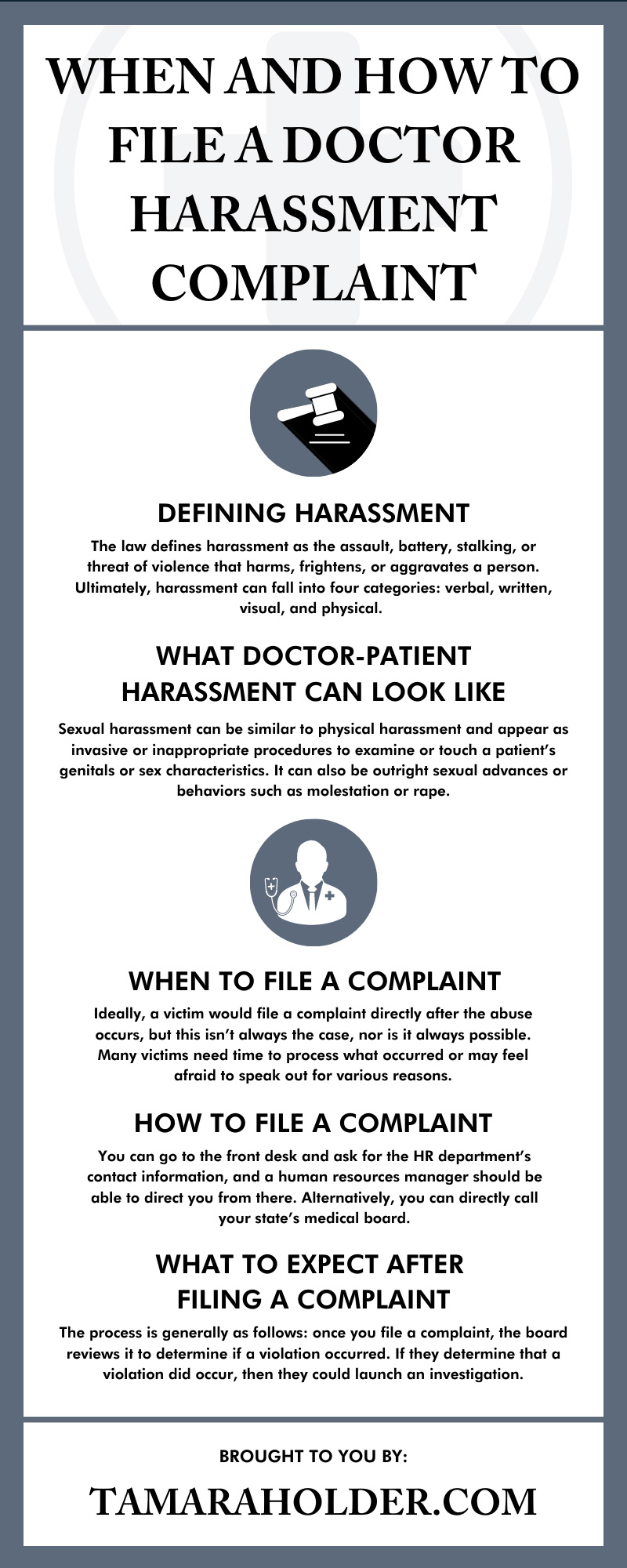
Whether you visit a psychiatrist, neurologist, oncologist, or any other type of doctor, they are all supposed to treat you with respect and dignity. This is because there is an inherent power imbalance in the doctor-patient relationship that makes it easy for a malicious person to manipulate and abuse a patient. Of course, doctors are held to a very high standard and are taught in-depth how to approach, speak, and examine a patient, so they feel safe and cared for. However, doctors are people, and just like people, they can use their power to do bad things. If this happens, they need to be held accountable for their actions. If a medical professional has mistreated or abused you, let’s take a comprehensive look at when and how to file a doctor harassment complaint.
The law defines harassment as the assault, battery, stalking, or threat of violence that harms, frightens, or aggravates a person. Ultimately, harassment can fall into four categories: verbal, written, visual, and physical. In addition, these categories can further divide into various subcategories, such as sexual harassment, psychological harassment, verbal abuse, and more.
If your experiences don’t perfectly fit into or align with any of these categories or subcategories, this does not mean your experiences are invalid or that you shouldn’t report them. Harassment looks incredibly different depending on the victim and the alleged aggressor. Additionally, despite what some people may tell you, harassment of any kind can happen to anyone. While some groups may be more vulnerable, no one should belittle or ignore your experiences.
Again, doctor-patient harassment can look very different based on the situation, but to keep things simple, let’s review some examples of harassment that fall into the four categories. If your doctor insults you, disrespects you, makes inappropriate jokes, or threatens you, these actions can constitute verbal harassment. These very same abusive actions can be in written form, whether it be on your paperwork, chart, or even digitally through a patient portal. Physical and sexual harassment is where things can get a little tricky, as it can take on forms that are much subtler and more insidious.
While a doctor might strike or push a patient, physical abuse a medical professional enacts often doesn’t look that way. Often, this physical abuse looks like unnecessarily holding a patient down, unnecessary or painful procedures, purposefully giving the wrong drugs such as sedatives, or other actions that cause physical harm. Sexual harassment can be similar to physical harassment and appear as invasive or inappropriate procedures to examine or touch a patient’s genitals or sex characteristics. It can also be outright sexual advances or behaviors such as molestation or rape.
Ideally, a victim would file a complaint directly after the abuse occurs, but this isn’t always the case, nor is it always possible. Many victims need time to process what occurred or may feel afraid to speak out for various reasons. These feelings and reservations are perfectly understandable and normal for people who have experienced any kind of harassment. However, a statute of limitations (SOL) determines how long you have to report before you can no longer take legal action or file a complaint.
These SOLs can also vary widely by state. In some areas, you have three to six years from the date of the incident to submit a complaint. On the other hand, some states only give you a year or two to file a lawsuit. While it’s important to take your time and do what you’re comfortable with, it’s also important to be aware of these time frames to make the best decision for yourself.
When you’re ready to file a complaint against your doctor or any other medical professional, you have two choices. You can go to the front desk and ask for the HR department’s contact information, and a human resources manager should be able to direct you from there. Alternatively, you can directly call your state’s medical board.
Much like for SOLs, the process of filing a complaint varies from state to state. Some states allow you to file electronically, others over the phone, or others by mailing a physical document. Ultimately, when you call the medical board, they will be able to tell you exactly, and in detail, what you need to do. You should also expect to provide as many details as you can about what occurred.
Unfortunately, when you file a complaint, it doesn’t guarantee the doctor will face disciplinary action. However, if multiple people file complaints against the same doctor, the board will likely launch an investigation, especially if the complaints are of a similar nature.
The process is generally as follows: once you file a complaint, the board reviews it to determine if a violation occurred. If they determine that a violation did occur, then they could launch an investigation.
Again, though you can’t guarantee an investigation, you can guarantee your complaint will remain completely anonymous. If you wish to know if your complaint triggers an investigation, you will likely have to provide your name, phone number, and address.
For most people, the definition of medical malpractice evokes thoughts of a negligent doctor and a procedure gone awry, but this isn’t always the case. Medical malpractice is a negligent or omitted act that causes injury or harm to a patient. This harm does not have to be the result of a botched surgery. In fact, it doesn’t have to be a physical injury at all. If your doctor damages you emotionally or psychologically, it’s still medical malpractice, as it breaks the code of ethics that they signed when they became a doctor. If you’re the victim of medical malpractice, you should consider going beyond a formal complaint and filing a lawsuit against your doctor to receive the appropriate compensation.
If you have any further questions regarding when and how to file a doctor harassment complaint or are seeking legal representation, contact the Law Firm of Tamara N. Holder today. As an experienced patient rights attorney, you can trust that Tamara Holder will work tirelessly to get you the compensation you deserve.