In an ideal world, everyone would feel completely safe and comfortable going to work, but this isn’t always the case. Typically, when we think of sexual misconduct, we think of a supervisor or coworker being the perpetrator, but what happens when the aggressor is a nonemployee? To help you understand what your employer’s obligations are and what your rights are as an employee, let’s review what third-party sexual misconduct is.
In the eyes of the law, third-party sexual misconduct occurs when a nonemployee of the company sexually harasses an employee. This could be a vendor, a delivery person, a client, or a customer who interacts with the employee and engages in sexual misconduct. The critical distinction is that the employer did not hire the perpetrator, nor are they affiliated with the company. They may provide a service for the company or work with the company in some way, but the courts would still consider this third-party sexual misconduct.
If the person isn’t an employee of your job, is your employer obligated to take any action? If your employer gets made aware of the sexual misconduct, it is up to them to ensure they do not hire that person’s services or they bar the client from returning. If you want to file a complaint, you should take it to your employer, and it is their duty to investigate. However, suppose the employer knew about the incident and took no corrective action, or had reason to believe that investigating the sexual misconduct was a risk. In that case, your employer can get held legally liable.
Now that you know what third-party sexual misconduct is, what should you do next? If you’ve filed a complaint with your employer, they should attempt to separate you from the perpetrator. However, if your employer doesn’t attempt to take corrective action or keep you safe, you should seek legal representation immediately. This is especially pertinent if the perpetrator continues to harass you. In this case, the workplace would become hostile, giving you more ground to take legal action.
If you aren’t sure whether your experience counts as third-party sexual harassment or your employer refuses to take action, contact The Law Firm of Tamara N. Holder today. We’ll put you in contact with our knowledgeable, experienced, and dedicated sexual harassment attorneys so you can get the legal counsel and representation you deserve.
We are seeking information about Dr. Oscar Mendez. Dr. Mendez was suspended from practicing medicine, and then reinstated in 2012. If you were a patient of Dr. Oscar Mendez, please contact us for a confidential call:
312-440-9000
contact@tamaraholder.com
Doctors go through years of rigorous training so that their patients can feel safe and comfortable putting their bodies and health in their hands. This vulnerability and balance of power is something most doctors are careful not to cross.
Some of the situations a patient may find themselves in can feel uncomfortable and vulnerable, which is, unfortunately, part of some scenarios and procedures. But how can you tell when these uncomfortable situations breach the boundary of professionalism? To help you identify what you’re feeling, here are five signs that your doctor is behaving inappropriately.
While there are situations and procedures that may require you to be nude, you should always be able to cover yourself. Additionally, you should never have to undress unnecessarily—follow and trust your gut. If you go into a doctor’s appointment complaining about an ingrown toenail, you wouldn’t expect them to make you remove your pants. Also, you should never have procedures involving genitalia or breasts that are unrelated to what you’re having problems with.
Unfortunately, many patients don’t have the educational background to tell whether a procedure is unnecessary or not. In these cases, ask your doctor what the procedure is for and why. If they give you a vague answer, become irritated, or outright ignore you, this is a cause for serious concern. It’s part of their job to ensure that you’re as comfortable as possible, educated, and informed.
Some fully professional touches may still feel uncomfortable, but they should never make you feel unsafe. Remember that doctors have received training to touch patients in a way that is far from romantic, flirty, or sexual. Furthermore, any touches with the intent to sexually arouse a patient is illegal, unprofessional, and inappropriate.
Unless they are commenting on the appearance of a wound, injury, or site procedure, a doctor should never comment on your appearance. They may compliment a nice shirt or dress, but even in some situations, that can still be inappropriate. Comments about your body of sexual or cruel nature are inappropriate. Long states at your clothed or nude body that are unnecessary to the medical documentation, procedure, or exam are also unacceptable.
The most blaring sign that your doctor is behaving inappropriately is if they attempt to form a romantic relationship. This can start with a doctor trying to become more friendly, asking for your personal social media, or sending you messages unrelated to your medical situation. While you may become close with your doctor and even become friends, it’s wrong for them to pursue an unwanted relationship.
If you or a loved one feel that you have been sexually abused, harassed, or assaulted by a medical professional, contact The Law Firm of Tamara N Holder. We can put you in contact with a patient sexual assault lawyer who will take care of your case and provide you with the representation you deserve.
Remote work is still relatively new for many people, and navigating this new world means encountering many tricky situations, including sexual harassment. Most people may view sexual harassment as involving physical action, but this is not always the case. Many times, sexual harassment in the workplace is verbal or even visual. To help those looking to understand what this may look like for employees, read on to learn about a few different ways sexual harassment can happen in remote work.
Any messages making inappropriate comments about sex, requesting sex, or sexual favors, whether done on work apps, personal phones, or through social media, is sexual harassment. However, inappropriate messages don’t have to include words; they can also be the inappropriate use of emojis to convey these inappropriate messages more subtly. It’s also important to remember that sexual harassment doesn’t always have to be explicitly sexual. It can also take the form of unwanted flirting and romantic advances.
Unwanted digital pornography in the form of images, audio, or video, also counts as sexual harassment. This also includes explicit personal images, memes, or gifs. Additionally, any indecent exposure or shared media over a live meeting is sexual harassment, even if it’s accidental. While it may seem hard to believe, there have been many cases where employees have gotten fired for either dressing inappropriately, accidentally exposing themselves, or unintentionally sharing inappropriate digital media.
Virtual stalking, also known as cyberstalking, is a relatively new term defined as using electronic communication to harass someone, including sexual harassment. Typically, this form of harassment gets used to humiliate someone or coerce them into doing something, often doing so through anonymous accounts. They may attempt to extort sexually explicit videos or images, distribute real or fake photos, and join or follow the same accounts and groups as you long after getting asked to stop. The reason why this is an issue for remote work is that the perpetrator is likely no stranger. While they could be a family member, a friend, or an ex-lover, there’s also a serious probability that the perpetrator is an employee as well.
Knowing the different ways sexual harassment can happen in remote work and learning to identify it can help make remote work a safer place for all employees. And for those who may be victims, remember, if it makes you uncomfortable, don’t wait to say something or report bad behavior. Contact a sexual harassment attorney as soon as possible. They can protect you and give you the best representation possible.
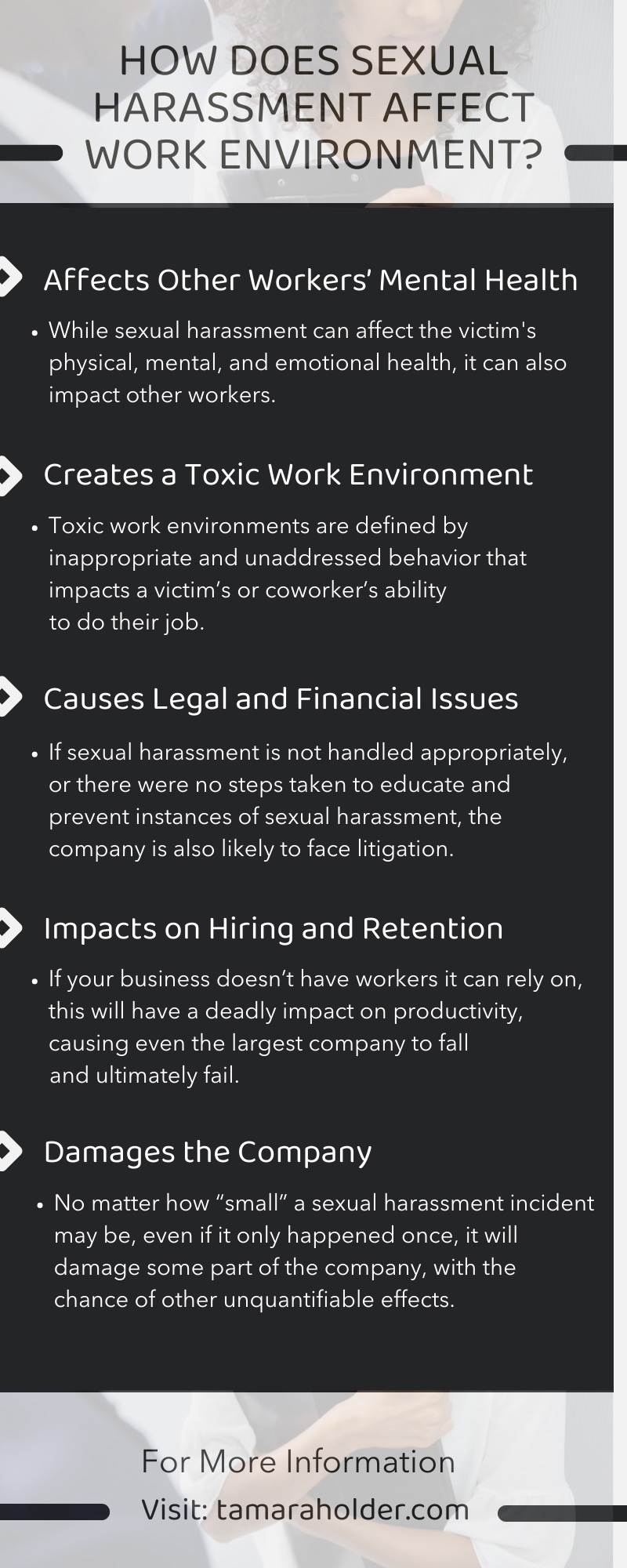
While the most pertinent impact of sexual harassment is how it affects the victim, there are other consequences. And to begin repairing any damage these actions have caused, all of the ripples and effects of sexual harassment must be understood. Only then can true healing and restoration begin, and the proper resources allocated. To further understand how damaging sexual harassment can be, this article will review how sexual harassment affects the work environment.
While sexual harassment can affect the victim's physical, mental, and emotional health, it can also impact other workers. Occasionally, this can cause other workers to experience secondary or vicarious trauma, depending on how close they were to the victim. Secondary trauma can occur when someone is exposed to someone who has been directly traumatized, as they are affected by the stories and descriptions of the victim. Vicarious trauma occurs for similar reasons, but this trauma usually results in a significant worldview shift. For example, an employee may quit their job if they see continuous cases of sexual harassment because they believe or worry that they will become a victim.
Unfortunately, this trauma occurs because the act of sexual harassment can shatter someone’s sense of security and understanding of the world around them. What was once a place of safety and professionalism has been flipped on its head. It can cause others to feel unsafe, and coworkers may begin to lose trust in one another. This can quickly cause a tightly woven team to break down, impacting overall morale, mental health, and productivity.
Toxic work environments are defined by inappropriate and unaddressed behavior that impacts a victim’s or coworker’s ability to do their job. If sexual harassment is left unattended, workers will begin to lose their unity as a team. And as stated previously, many workers may start to feel unsafe, especially if harassment has occurred and was left unaddressed multiple times. It is essential to understand that if meetings, training, and repair aren’t done swiftly, toxic work environments can lead to severe burnout, fatigue, and even physical illnesses. This is because stress can have a powerful impact on the body, and while this may seem like a dramatic statement, nausea, headaches, insomnia, panic attacks, and more are all symptoms of stress.
Unfortunately, sexual harassment is the sort of issue that will snowball, and it will never simply stay isolated to the victim(s). On a surface level, coworkers may be irritable, defensive, depressed, or quick to anger, making them harder to work with and overall teamwork harder to achieve. On a deeper level, workers may feel afraid, unheard, and may even begin to consider quitting. If it reaches this point, employee education on managing stress, learning various coping skills, and genuine team-building activities are necessary. However, it is also essential to understand that regardless of what is done on the employer side of things, employees may choose to leave, which must be respected.
If sexual harassment is not handled appropriately, or there were no steps taken to educate and prevent instances of sexual harassment, the company is also likely to face litigation. These settlements can go up to millions of dollars depending on the extent of the harassment, and smaller companies may not be able to afford such high settlements. These legal issues take away money and resources once allocated to workers and company programs, severely stifling growth and progress. And it is not unheard of for smaller businesses to go bankrupt or close due to a lack of ability to pay legal fees. Additionally, it is not just financial issues that may come because of court proceedings, as the overall company’s name and reputation can take a nosedive.
Even if your company doesn’t face a lawsuit from the victim, the amount of money that must go into healing and repairing the company and its workers can be extensive. Again, this is not always an option for smaller businesses, and a lack of funds will further snowball the situation. While this may sound like an exaggeration, it is not unheard of for a company to go under entirely due to a sexual harassment claim. So, while one incident may seem like “not a big deal” or an unfortunate “coincidence,” it should always be taken seriously and handled with quick action. While it may sound harsh, an aggressor, once convicted, must be punished to the extent of policy to ensure that others don’t think they can get away with similar actions.
If your company name has been damaged, or employers have failed to deal with the situation appropriately, hiring and worker retention can take a serious hit. Worker retention can fall due to workers not wanting to stay at a facility they don’t feel safe in, as is their right. As a result, employee turnover rates can skyrocket, meaning the onboarding process will constantly occur, taking away time and resources from other workers. If retention and turnover rates are not improved, applicants will likely get wind of the situation, and hiring rates can slow or dip. Hiring rates may also fall due to applicants not wanting to be associated with the facility.
If your business doesn’t have workers it can rely on, this will have a deadly impact on productivity, causing even the largest company to fall and ultimately fail. If hiring and retention rates are falling, a business will have to spend a lot of time and money rebranding to save face and cultivate a new image. Some companies have even resorted to changing their name entirely to trick and coerce unaware applicants into working there. However, this is almost always found out and, overall, is not a good idea. If the issue reaches this point, it’s a good idea to start working with a PR agent and do some serious work and reflection on the company policy and environment.
No matter how “small” a sexual harassment incident may be, even if it only happened once, it will damage some part of the company, with the chance of other unquantifiable effects. It’s workers that make a company, facility, or business tick. If they aren’t valued, respected, or protected, they will not want to work there, and the workplace will suffer. That is why it is best to continually encourage and update sexual harassment education training and promote honesty and communication amongst every worker. Not only will this help the company cover its bases, but it will protect its most valued component—the workers.
Knowing exactly how sexual harassment affects the overall work environment and the company arms you with the knowledge to help improve company policy and protect workers. If you or a loved one has been a victim of sexual harassment, or nothing is being done about sexual harassment at your job, there are options. Contact sexual harassment lawyer Tamara N Holder to get the help and legal representation you deserve.
Before beginning, it is essential to note a few things. Firstly, this article will discuss different aspects of sexual assault and may bring up some painful feelings for sexual assault victims and survivors. If at any point you feel uncomfortable, take a break, and come back when you can.
Second, this article will discuss sexual assault as it applies to cisgender and transgender women of all races. Transgender women, especially trans women of color, experience disproportionately high sexual and physical violence rates. Due to the intricacies and importance of intersectionality, it is hard to talk about women facing sexual violence without talking about all women who experience sexual violence.
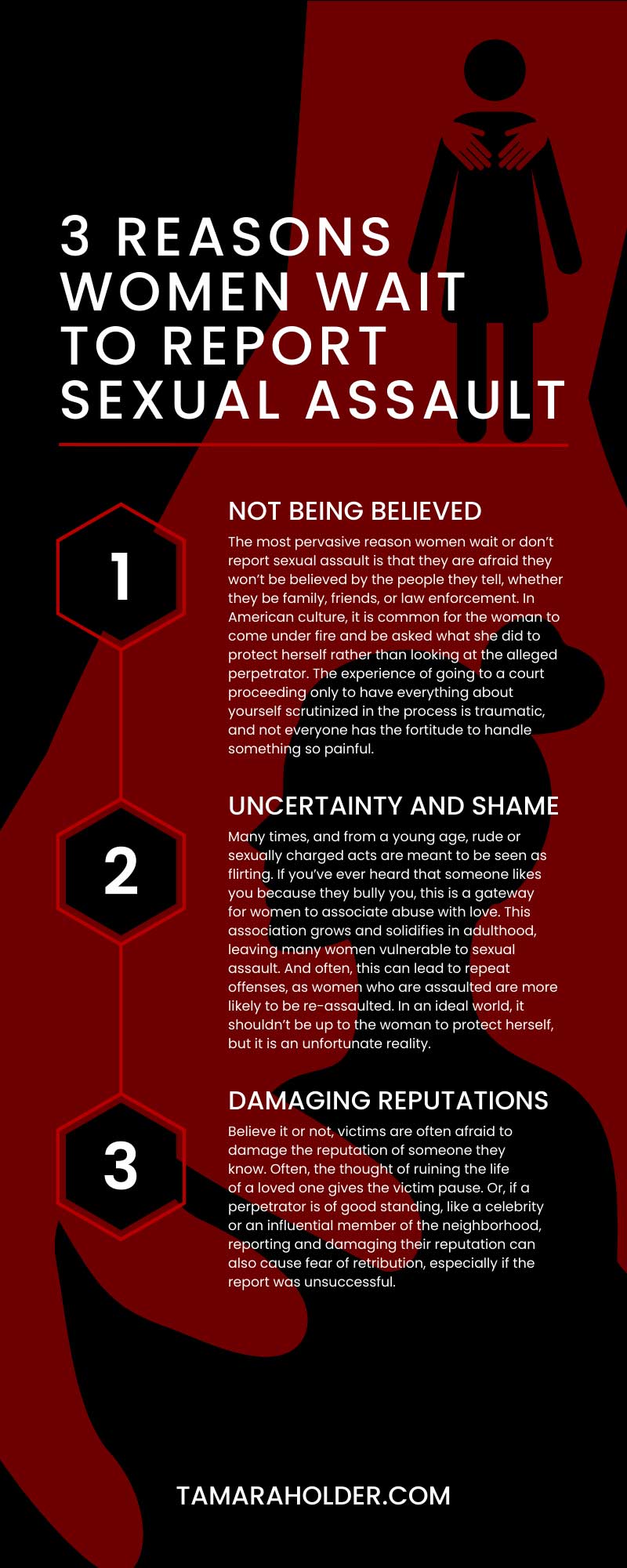
According to the Rape, Abuse, & Incest National Network (RAINN), an American is assaulted every 68 seconds, with only 25 out of 1,000 perpetrators ending up in prison. While many factors contribute to the statistical lack of imprisoned perpetrators, one of the most complex and common reasons is that many women wait to report sexual assault for weeks, months, and years, and sometimes they never speak out. While this is a complex phenomenon, a few indicators tell us why women are afraid to speak out and report their assault.
To help readers better understand why this occurs, this article will review the top three most common reasons why women wait to report sexual assault.
The most pervasive reason women wait or don’t report sexual assault is that they are afraid they won’t be believed by the people they tell, whether they be family, friends, or law enforcement. In American culture, it is common for the woman to come under fire and be asked what she did to protect herself rather than looking at the alleged perpetrator. The experience of going to a court proceeding only to have everything about yourself scrutinized in the process is traumatic, and not everyone has the fortitude to handle something so painful.
A woman can be asked what she was wearing, if she was intoxicated, alone, or what else she could’ve done that put her in a vulnerable position. The truth is, if someone wants to assault a person sexually, what they wear or drink will not matter, and it is never the victim’s fault. But proving yourself to court and loved ones is an arduous task that can permanently damage relationships.
Many sexual assaults are done by someone the victim knows, like a family member or close friend. There is an intense fear that if they tell someone, like a parent, the parent will be in denial or disbelief. A parent may not want to believe that someone they hold dear and have known for so long could do such a thing. The feeling of having your strongest, and sometimes only support system, not believing you is earth-shattering.
Often, this means that a victim will have to live with or around a perpetrator; even worse, if the perpetrator knows the victim tried to report the crime, it could lead to retribution. Suppose the victim is not safely removed far away from the aggressor, or the aggressor is not put into prison. In that case, this can make for an extremely dangerous situation and cause an offender to repeat.
Sometimes, women are unaware that what they have experienced constitutes sexual assault. It could be because their memory is unclear, or they never said no. Whatever the reason, it is essential to note that the lack of an answer does not explicitly mean consent.
Unfortunately, many modern sexual education programs, at least the ones that haven’t been removed from the curriculum, don’t teach consent-based practices, and can make a future victim unsure. For example, suppose someone asks you repeatedly to have sexual relations with them despite you previously saying no, and you give in due to pressure. In that case, this is sexual coercion and a form of sexual assault. Or, if someone is intoxicated and taken advantage of without being given a chance to say no, this is also sexual assault. If a party does not explicitly consent to a sexual act, that is sexual assault.
Many times, and from a young age, rude or sexually charged acts are meant to be seen as flirting. If you’ve ever heard that someone likes you because they bully you, this is a gateway for women to associate abuse with love. This association grows and solidifies in adulthood, leaving many women vulnerable to sexual assault. And often, this can lead to repeat offenses, as women who are assaulted are more likely to be re-assaulted. In an ideal world, it shouldn’t be up to the woman to protect herself, but it is an unfortunate reality.
The legal definition of sexual assault is clear and is as follows: sexual assault is contact, action, or behavior without the clear and explicit consent of the victim. This includes attempted rape, penetration of the victim, also known as rape, forced sexual acts, and unwanted fondling or touching. It is also important to note that not all sexual assault is rape, as rape is defined as a body part or object penetrating the vagina or anus, or if a sexual organ penetrates the mouth.
Understanding these legal terms and definitions will give women the tools to clear away uncertainty and provide them with the courage to report.
As mentioned, the victim likely knows the perpetrator’s identity as they are commonly a friend, family member, or even a medical practitioner. It is important to note that reporting against practitioners can be even more difficult as you specifically need a patient rights attorney, and different steps go into reporting.
Believe it or not, victims are often afraid to damage the reputation of someone they know. Often, the thought of ruining the life of a loved one gives the victim pause. Or, if a perpetrator is of good standing, like a celebrity or an influential member of the neighborhood, reporting and damaging their reputation can also cause fear of retribution, especially if the report was unsuccessful.
This is also because of the popular idea that women lie and report sexual assault to ruin a person’s reputation, either as revenge or to receive money. In truth, according to the National Sexual Violence Resource Center, out of the sexual assault cases that are reported, only two percent of reports are false. While ideally, that number would be zero, communities should be less worried about false statements that can be easily identified in court and more concerned about victims.
The idea that false reports garner money and status is preposterous, as the money it takes to go to court and the slandering that takes place is often not worth it. However, many of those who abide by the “femme fatale seeking revenge” school of thought have been further emboldened by the recent success of Johnny Depp in his trial versus Amber Heard. Many people, especially men, who had not been interested in sexually violent cases before, used this opportunity to try and prove the idea that the #MeToo Movement caused a flurry of women to falsely report for profit.
In reality, people like this are not interested in getting justice for men who have been abused and assaulted; they want to take away the voices of women.
These are just three of the reasons why women wait to report sexual assault, and there are many more that can’t be covered in one article. This is a highly complex subject, and many of the instances and examples we’ve given can be even harsher and apply even more to trans women and women of color. And remember, if the world won’t fight for you, you should still fight for yourself. And if you need help, attorney Tamara N Holder can help you uphold your rights and give you the representation you need to get the compensation you deserve.
Often, people don't think of sexual harassment in the workplace as something that can happen to them. However, when it happens, it can be incredibly damaging to the victim, often creating trauma that can be hard to reverse. That's why this article will review what you can do if you're a victim of sexual harassment at work, so you can reclaim your power and make sure it never happens again to you or anyone else at your workplace.
After you experience sexual harassment at your job, you should first determine how seriously your workplace takes sexual harassment. Unfortunately, not all facilities are the same; some have more lax policies than others or ignore accusations of sexual harassment. So, review your company's policies to help you determine what course of action to take.
For example, your company may have specific steps as to who you're supposed to inform of the incident and how to report it properly.
Ideally, you should document everything that happened, such as where, when, and how the sexual harassment occurred. Although this is not always possible, try your best to recall and record these details as soon as you can. You’ll also want to keep track of, and maintain, any digital or physical evidence such as correspondence, recordings, performance reviews, and corroborating statements of friends and fellow employees.
It's best practice to keep all this compiled information outside your workspace to prevent discovery or evidence tampering.
Before contacting a lawyer, you should assess how far you want to take your claim. For example, a serious sexual harassment claim can lead to a criminal case if evidence of a criminal act is uncovered. Sometimes, simply standing your ground can stop a harasser, but only if you feel safe doing so. Never put yourself in unnecessary danger by confronting your harasser. Ultimately, you can talk to a lawyer to learn your options and decide what's best for you.
Suppose you do decide to contact a sexual harassment attorney. In that case, they will inform you that you must file a claim through the Equal Employment Opportunity Commission (EEOC) if you haven't done so already. Afterward, they will contact your employer and inform them of the next steps. These steps range from organizing compensation to a criminal case.
Now that you know what to do if you are a victim of sexual assault at work, you're armed with the knowledge to hold the alleged harasser accountable and ensure you get fair compensation.
In most cases, it is difficult for a victim of sexual assault to come forward with their allegations. However, when it comes to reporting a physician, that act can become even more frightening. Society teaches us that doctors are to be trusted and held in high regard, but they are no more above the law than anyone else.
This article will answer the question: can you sue a doctor for sexual assault? Read on to learn more about your rights, what qualifies, and what to do about it.
In short, yes, you can sue a physician for sexual assault. While they may have some protections to help shield them from allegations, this does not mean that the case can't be brought to court. However, the category with which the case will be processed falls under medical malpractice. This is because the act of sexually assaulting a patient violates the medical code doctors and physicians have sworn to uphold.
Regardless of the gender of the victim or the alleged abuser, sexual misconduct consists of a non-consensual sexual relationship. While this can include what usually falls under sexual assault, such as forced touching, oral, or penetration, there are a few other instances that only apply to doctors and physicians:
If you're wondering whether you should file a civil suit for compensation or press criminal charges, you should know that both can occur simultaneously. For example, you can press criminal charges against a doctor, but you need to prove that they have committed the act beyond a reasonable doubt. In addition, you may not get all the compensation you are entitled to with a criminal case.
However, with a civil suit, there is a lower standard of proof as you only need to show a "preponderance of the evidence," which means that it is more likely than not that the situation occurred. You are the purser of the case in a civil suit, while a prosecutor is the pursuer of criminal charges.
While you can sue on your own, a criminal investigation and trial will occur separately if evidence of a criminal act is found in the civil case.
Lawsuits can cover medical bills, emotional and mental suffering, lost wages, etc. In addition, the alleged abuser may have to pay punitive damages. This means that, in especially heinous crimes or bad behavior, the alleged abuser must pay more than it would take to compensate you. The court can enact these when it wants to prevent others from being hurt by similar actions.
Now that you know you can sue a doctor for sexual assault, you have the confidence and knowledge to choose whether suing is the right step for you. If it is, contact a patient rights lawyer and get the representation you deserve.
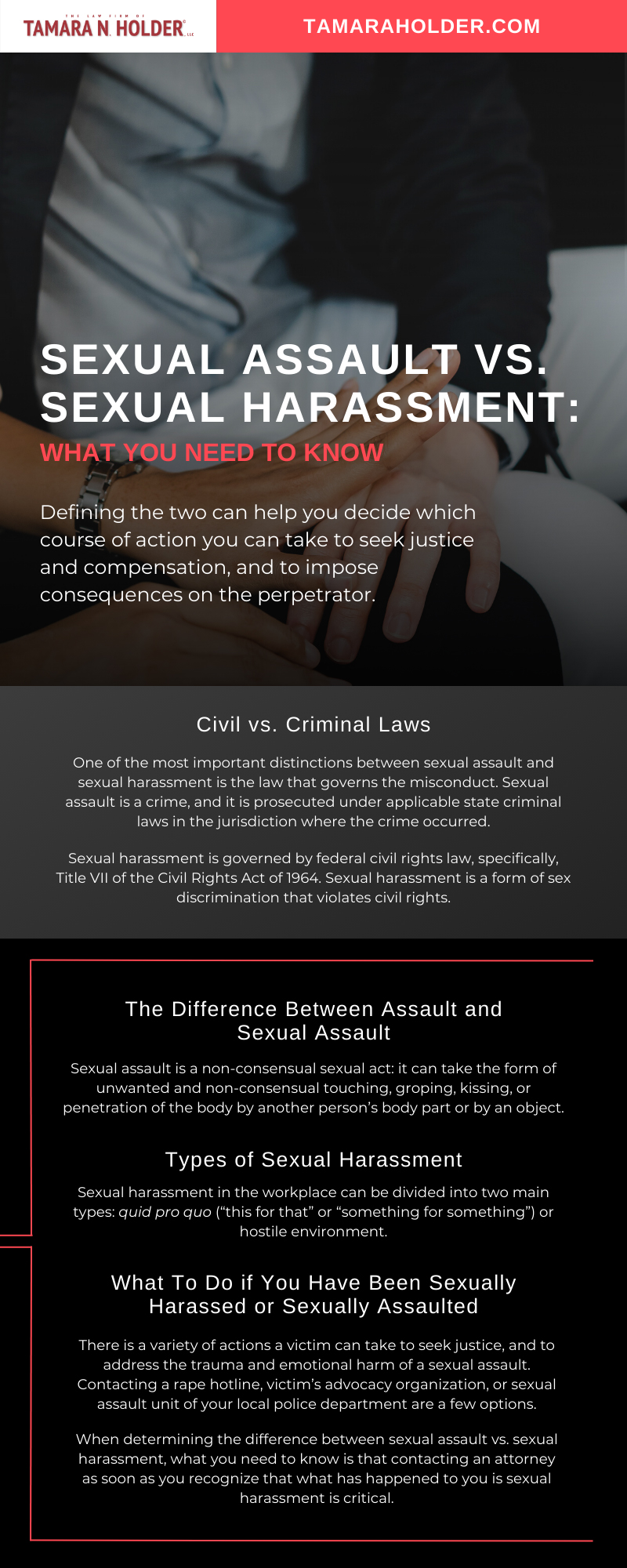
How do you determine whether you’re a victim of sexual assault vs. sexual harassment? What you need to know explains the actions you can take to get justice or compensation.
The age of #Metoo revealed how astonishingly common sexual harassment and sexual assault have been in US society and workplaces. When thousands of women finally declared, “Time’s up!” and came forward with their stories, consequences for unacceptable behavior followed.
If you’ve been the victim of sexual misconduct, it’s important to understand the difference between sexual assault and sexual harassment. As explained below, defining the two can help you decide which course of action you can take to seek justice and compensation, and to impose consequences on the perpetrator.
One of the most important distinctions between sexual assault and sexual harassment is the law that governs the misconduct. Sexual assault is a crime, and it is prosecuted under applicable state criminal laws in the jurisdiction where the crime occurred.
Sexual harassment is governed by federal civil rights law, specifically, Title VII of the Civil Rights Act of 1964. Sexual harassment is a form of sex discrimination that violates civil rights.
The crime of sexual assault can occur anywhere, including homes, schools, workplaces, and even doctor’s offices. It’s possible that you have been the victim of both sexual harassment and sexual assault. The location and context of where the alleged act or acts took place may be significant in the type of relief victims can ask the courts to impose.
Consult with an experienced civil rights lawyer, patient sexual assault lawyer, or employment lawyer to determine whether to file a complaint with the Equal Employment Opportunities Commission (EEOC) or a report to your local police or prosecutor’s office.
While state laws may be more specific, “assault” is generally understood any intentional action that puts a person in reasonable fear of imminent harm, whether or not the perpetrator ever touches the victim.
Sexual assault, on the other hand, is a non-consensual sexual act: it can take the form of unwanted and non-consensual touching, groping, kissing, or penetration of the body by another person’s body part or by an object. It happens when a perpetrator makes physical contact of a sexual nature with your body without your consent. It also occurs when the victim is incapable of giving consent.
Sexual assault may be violent, the result of coercion, or it may have happened when the victim didn’t understand that what happened was a sexual assault, as in some cases of doctor-patient abuse.
The legal definition of sexual assault varies from state to state, so your options to seek a remedy for the harm done to you may depend on where you live or where the assault took place.
Title VII of the Civil Rights Act of 1964 made sex discrimination illegal. Specifically, it states that no employer can refuse to hire, fire, or discriminate against a person in the terms and conditions of employment, including wages, based on race, color, religion, sex, or national origin.
Title VII also prohibits employers from classifying, limiting, or segregating employees or job applicants in ways that would deprive individuals of employment opportunities or affect their status as employees based on the protected classes listed above.
In June of 2020, the Supreme Court of the United States ruled in Bostock v. Clayton County that discrimination based on gender identity or sexual orientation constitutes unlawful sex discrimination. While that case was narrowly decided in the context of firing the plaintiffs based on their gender identity or sexual orientation, the EEOC has applied the same principle to discrimination in hiring federal employees.
Sexual harassment in the workplace can be divided into two main types: quid pro quo (“this for that” or “something for something”) or hostile environment.
Quid pro quo harassment happens when a person in a position of power over an employee requires that employee to perform sexual acts or grant sexual favors, or makes them endure unwanted touching, as the price for a pay raise, promotion, or other benefit of employment.
Threats of demotion, unfavorable work assignments, bad performance reviews, or termination of employment because of a refusal to acquiesce to a demand for sexual acts is also a form of “quid pro quo” discrimination.
A victim doesn’t have to be the subject of a quid pro quo sexual demand to be the object of sexual harassment. When an employer creates or tolerates an atmosphere that persistently makes an employee so uncomfortable on the basis of their sex that they can’t perform their job, that employer is presiding over an unlawful hostile work environment.
Things that create a hostile work environment based on sex may include persistent sexual innuendo, jokes, distributing sexually explicit images, unwanted touching, unwelcome flirting, or bullying based on a person’s sexual orientation or gender identity.
But hostile environments don’t necessarily depend on sexually explicit language, jokes, images, or touching. Where an employer encourages, tolerates, or ignores a work atmosphere that persistently discriminates against anyone because of their sex, including their sexual orientation or gender identity, to the extent that an employee feels so intimidated or uncomfortable they can’t perform their job, that employer is maintaining an unlawful hostile work environment.
This kind of discrimination could take the form of inferior working conditions, lack of appropriate or equal accommodations like lockers or changing rooms, or onerous and demeaning uniform requirements (such as being required to wear revealing clothing as a condition of employment).
Sexual assault is a crime. Non-consensual sexual acts constitute sexual assault, including when the victim was unable to consent, or didn’t know they had been assaulted.
There is a variety of actions a victim can take to seek justice, and to address the trauma and emotional harm of a sexual assault. Contacting a rape hotline, victim’s advocacy organization, or sexual assault unit of your local police department are a few options.
If you feel intimidated, or as if you won’t be believed about what happened, contact a lawyer with experience representing victims of sexual assault. Your attorney can help you determine the best course of legal action to take and advise you on the possible outcomes of reporting the crime.
Sexual assault can happen in the workplace. Sexual harassment may or may not be a prelude to sexual assault. The perpetrator may be someone previously unknown to the victim. In these cases, the victim may have recourse under federal and state anti-discrimination laws, as well as under criminal law to seek prosecution of the assailant.
Someone who has been discriminated against on the basis of sex in hiring, termination, or wages, conditions of employment, or who has been subjected to insufferable working conditions that make doing their job impossible based on sex, may have a claim for unlawful sex discrimination.
When determining the difference between sexual assault vs. sexual harassment, what you need to know is that contacting an attorney as soon as you recognize that what has happened to you is sexual harassment is critical. There are legal procedures and deadlines you may be required to meet, such as exhausting your remedies through your HR department and the EEOC before you file a lawsuit, or you could lose your opportunity to pursue your claim.
The Law Firm of Tamara N. Holder, LLC stands ready to fight for your rights and your dignity. If you have been victimized by sexual harassment, call Tamara N. Holder today.