In the United States, civil rights are derived from federal and state laws that prohibit discrimination, as well as from the Constitution of the United States and its Amendments.
Individuals violate civil rights through illegal discrimination. The government, or a person acting in a government capacity, violates civil rights when they deny or infringe freedom of speech, the press, religion, or the right to peacefully protest.
Civil rights violations occur when law enforcement conduct illegal searches and seizures or commit acts of brutality. Learn five common types of civil rights violations.
Title VII of the Civil Rights Act of 1964, the Age Discrimination in Employment Act (ADEA), and the Americans with Disabilities Act (ADA), coupled with court decisions enforcing these laws, prohibit discrimination in employment based on race, color, national origin, religion, sex (including sexual orientation, gender identity or presentation, and pregnancy), age, or disability.
Refusal to hire someone, firing someone, subjecting someone to unequal working conditions, denying promotions, or violating equal pay provisions based on one of the “protected classes” listed above, is a civil rights violation.
The freedoms guaranteed by the First Amendment to the United States Constitution include freedom of religion, including its “free exercise, freedom of speech and of the press, and freedom of assembly.”
Other amendments provide additional protections. They include:
Only governmental entities can violate civil rights bestowed by the Constitution.
The Education Amendments Act of 1972 (“Title IX” of the Civil Rights Act) makes it illegal to deny a person participation in, or the benefit of, education or other programs that receive federal funds, or to subject a person to other discrimination in those programs or activities based on sex.
The Fair Housing Act of 1968 (“Title VIII”) prohibits discrimination in the sale, rental, and financing of housing based on race, national origin, religion, sex, disability, and family status. A private property owner who refuses to sell a house or rent an apartment, or a lender that refuses to fund a mortgage based on one of these protected categories has committed a civil rights violation.
An all too common type of civil rights violation is police brutality. When police officers use excessive force, or commit sexual abuse like unlawful strip searches “under color of law,” they’re violating the victim’s civil right to equal protection under the law and due process. If you believe you have been sexually abused by law enforcement, contact a sexual misconduct lawyer.
The Law Firm of Tamara N. Holder, LLC represents victims of all forms of civil rights violations, including employment discrimination and sexual harassment.
Sexual harassment can happen to anyone of any gender identity or sexual orientation. In the most blatant instances, sexual harassment takes the form of a “quid pro quo” (“this for that”) where the perpetrator demands sexual acts from the victim in exchange for a pay raise, promotion, or plum assignment.
But sexual harassment doesn’t have to rise to the level of a quid pro quo to be illegal. Verbal harassment of a sexual nature, unwanted and unwelcome sexual advances, physical touching, or sending or displaying sexualized images or messages to employees may also constitute sexual harassment.
One of the saddest things about sexual harassment is that victims are often “groomed” or encouraged to view harassing behavior as “all in good fun,” “just a joke,” or “part of the job.”
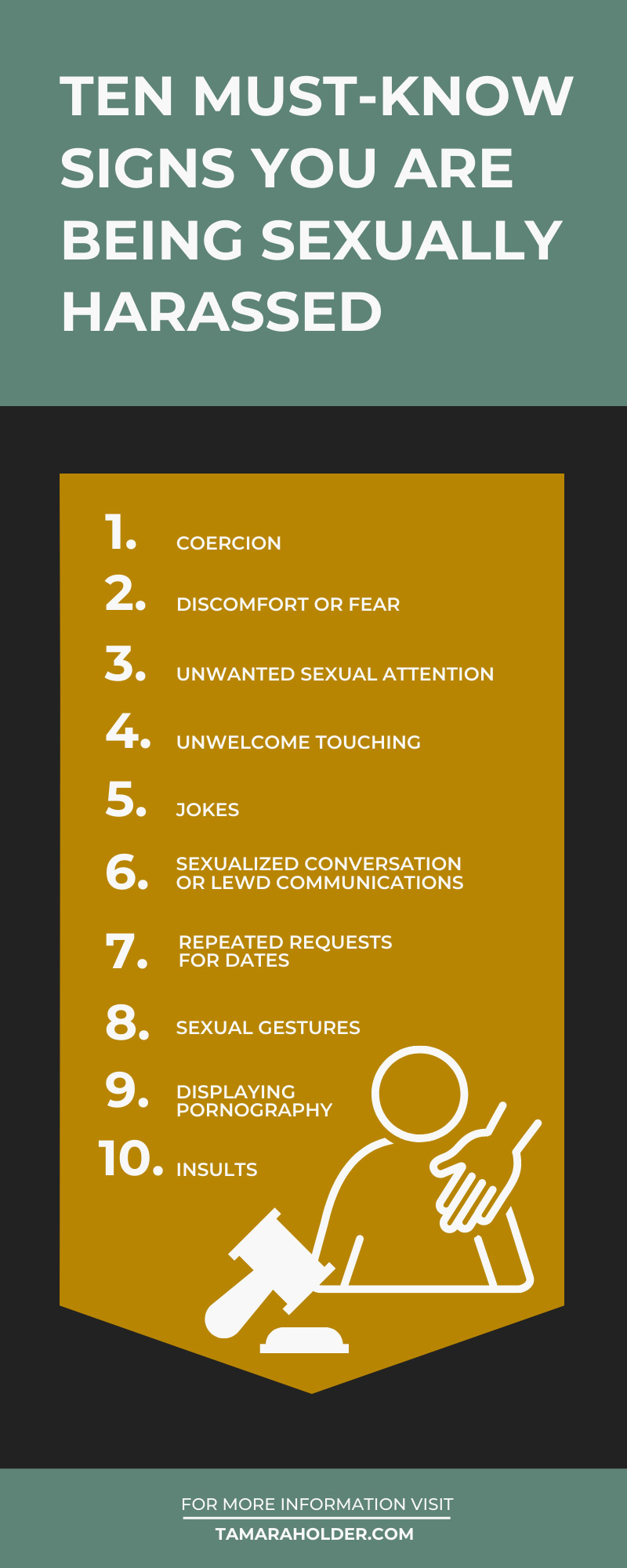
Nothing could be further from the truth. Learn these ten must-know signs you are being sexually harassed to ensure you can tell when things are not right in your workplace.
When a person in a position of power withholds a benefit like a pay raise, promotion, work assignment, or approval of earned vacation days unless an employee performs a sexual act, they are committing quid pro quo sexual harassment. No one should feel required to engage in sex acts just to keep or advance in their job.
Quid pro quo harassment need not include demands for physical contact. Requiring an employee to wear revealing clothing, dance, assume humiliating physical postures, or ensure similar forms of sexualized bullying to secure the benefits of their employment constitutes illegal sexual harassment.
What many victims of sexual harassment don’t realize is that if a supervisor or coworker’s conduct makes them uncomfortable based on sex, they’ve likely been harassed. Sexual harassment includes maintaining or tolerating sexualized behavior, language, or environments so pervasive that it negatively affects an employee’s work—or makes working impossible. This is true even if the perpetrators claim they didn’t know their actions could make someone uncomfortable.
If you are afraid to report discomfort, sexualized messages, or inappropriate sexual behavior to your supervisor or HR office because you anticipate retaliation, including demotion or termination, you are experiencing a form of sexual harassment. Retaliation for reporting illegal activity or for seeking redress under your employer’s policies and procedures is unlawful.
If you are afraid of being sexually assaulted because of someone’s behavior or language in the workplace, you have been sexually harassed.
The head-to-toe visual assessment that so many women and men have experienced in the workplace, where the message is that value as an employee is connected to physical appearance, is a form of harassment. Daily remarks about appearance, including compliments, can amount to sexual harassment if they make an employee uncomfortable based on sex or gender identity.
The office creep who goes around giving unsolicited shoulder massages, the person who always stands way too close in the elevator, and the jerk who thinks it’s funny to block your passage every time you walk down the hall are committing harassment if they are doing this because of their target’s sex, gender identity, or sexual orientation. It is perfectly rational and necessary to report this behavior as the harassment that it is.
When a workplace tolerates ribald jokes, either verbal, written, or “practical” (such as leaving a sex toy on someone’s desk), they are permitting a form of sexual harassment. Jokes that are demeaning to persons because of their sex, gender identity, or sexual orientation are a form of sexual harassment. Workers are entitled to pursue action through their employer’s HR department or other procedures for reporting sexual harassment.
Jokes are over when they reach the punchline, but conversations can last for several minutes or even hours. When workers spend time openly discussing their sex lives, sexual acts, pornography, or other sexual subjects, or frequently describe their work in sexualized terms, they are behaving as harassers. This is true even if the person feeling uncomfortable wasn’t part of the conversation, but simply within earshot.
Sending around sexual images, dirty jokes, or suggestive messages in the workplace is totally inappropriate. If the #MeToo movement revealed anything, it is the disgusting prevalence of this puerile and damaging behavior. If such behavior is still present in your workplace, you may have a hostile environment claim.
There is nothing adorable about this. A supervisor or coworker who doesn’t understand that no means no, even when “Sorry, I’m busy” turns into “NO, and please stop asking me” is committing a form of sexual harassment. Constantly being put in the position of saying no to a boss or coworker is stressful, unfair, and infuriating, and it is a form of unlawful unequal treatment based on sex.
We’ve all seen them, and maybe even used them in anger, but sexual gestures in the workplace are out of line. Aside from simply being rude and disrespectful, gestures or gyrations intended to suggest sex acts that make employees uncomfortable based on their sex, regardless of who the gestures are directed at, are a form of sexual harassment.
You don’t have to email a nude photo to someone for it to be inappropriate. The days of the topless calendar on the wall of the auto shop, or the wall posters of absurdly sexualized models are over, for good.
Displaying visual images that make others uncomfortable because of their sex can create a hostile environment even when the person displaying the photo thinks the picture is harmless. Putting a photo of your girlfriend, suggestively posed in a tiny bikini, on your desk for all to see can be seen as an aggressive gesture intended to intimidate employees based on their sex.
Insults are inherently demeaning and intended to humiliate the person who is the object of them. Whether run-of-the-mill or truly shocking, sexually-charged insults are a more aggressive form of name-calling that can’t hide behind “I was just kidding” statements.
Everyone knows the aggressive intent of flat-out sex-based insults, like the “c” word (rhymes with stunt) hurled at a woman or the “f” word (rhymes with maggot) directed at a non-binary male: they are meant to intimidate or threaten a person based on their sex.
If you or a co-worker has experienced any of these ten must-know signs you are being sexually harassed, contact an experienced sexual harassment lawyer. The law firm of Tamara N. Holder will discuss your case and advise you on possible courses of action to make the harassment stop and hold the harassers accountable.
When a lousy employer fires you for no good reason, it feels like the last straw. But there’s a difference between getting fired because your boss is a jerk, and getting fired illegally. The importance of understanding your rights as an employee intensifies when you don’t know what to do, other than quit.
Before you do, consult a law firm composed of unfair dismissal lawyers who can assess your situation and advise you. Recognize the importance of understanding your rights as an employee before you consider a lawsuit.
All states except Montana recognize some form of “at-will” employment. Employment “at-will” means that an employer can fire an employee for any legal reason, or for no reason at all. It also means an employee can quit for any reason or no reason, at any time.
No employer, even an “at-will” employer, can fire someone for an illegal reason. You can’t be fired because of your race, color, national origin, sex, religion, gender identity, sexual orientation, or disability.
The law also prohibits employers from firing people for filing legal complaints about discrimination, for reporting or refusing to engage in illegal activity (whistleblowing), or for another reason that violates public policy. Firing someone for taking time to serve on a jury, to vote, or for serving in the National Guard, for example, would impact the common good and therefore violate public policy.
Employers are required to comply with the terms of a legal contract of employment that specifies, or implies, a fixed term of employment or a promise of continued employment. While it is difficult to prove an implied employment contract, employers sometimes do or say things that create one.
To protect themselves from claims of an implied employment contract, employers will put language in offer letters specifically stating that the offer is for “at will” employment and that no contract exists. But they can diminish the impact of that language by ignoring written policies and procedures employees expect them to follow.
Likewise, if an employer lured someone into employment with false promises about pay or working conditions, and then fires that person for complaining, they may have committed actionable fraud.
When an employer deliberately makes you so miserable that you quit, they may have created a “constructive discharge.” Scenarios that may amount to constructive discharge are multiple job transfers to remote or dangerous locations, demotions and pay cuts, assigning work that is far beneath the employee’s skills, or assigning an impossible amount of work to create a pretext for poor performance evaluations leading to termination.
Every wrongful termination case depends on the specific circumstances between the employer and employee. When you realize the importance of understanding your rights as an employee, you can identify whether your situation may be wrongful termination. Consult a lawyer to learn if you have a case to try to regain your job or receive back pay or damages for lost opportunities.
The Fourteenth Amendment to the US Constitution, the Civil Rights Act of 1964, the Americans with Disabilities Act, and other federal and state laws provide for equal treatment under the law and prohibit discrimination on the basis of race, color, religion, sex, national origin, disability, sexual orientation, or gender identity. If you think your rights were violated, here are five qualities to look for when hiring a civil rights attorney.
Laws affecting civil rights can be amended or reinterpreted by the courts, including the United States Supreme Court. An experienced civil rights attorney knows how recent changes in the law could affect your case. Your lawyer should have a history of representing clients in the same types of cases as yours.
Some civil rights attorneys have expertise in several areas of civil rights law, such as race or sex discrimination in employment, police misconduct, or housing discrimination.
The most effective civil rights lawyers have a passion for defending and upholding fundamental rights and for fighting against discrimination and unequal treatment under the law. Look for a lawyer who is passionate about causes like yours.
Effective communication between attorneys and their clients is critical to achieving a successful outcome in a civil rights complaint or lawsuit. Your lawyer should be someone with whom you can confide and who explains legal concepts clearly without being patronizing.
Listening is even more important than talking. Choose a lawyer who you feel genuinely listens to you and who has compassion for your situation. If you meet with a lawyer, and they’re constantly interrupted by phone calls, responding to texts, or checking their email, you should leave.
Lawyers have a duty to gather all the facts and evidence and inform themselves about all sides of the story. In other words, expect your lawyer to listen to your story, but also to check out the details. It’s their responsibility to advise you on their best assessment of your likelihood of success in the case and to inform you of potential obstacles that may arise in your pursuit of a just remedy. That way, you both will be prepared and less susceptible to surprises as you press your cause.
Your lawyer should take your calls or return them promptly. If you sense your attorney will pay greater attention to their next attention-grabbing case, to the detriment of pressing your cause, look elsewhere.
Ask your prospective lawyer if you will work directly with them or if you will be assigned a less experienced associate.
Tamara N. Holder is an experienced civil rights attorney who has represented victims of sexual harassment, sexual assault, and those treated unfairly by the criminal justice system. She embodies all of the five qualities to look for when hiring a civil rights attorney and more. Call Tamara Holder to discuss your case today.
ATLANTA , Feb. 8, 2022 /PRNewswire/ -- A former Operations Manager for Republic Services (NYSE: RSG) has filed a charge with the EEOC, alleging the company disregarded her complaints of discrimination, and then fired her in retaliation. 
The former manager, who is a 57-year-old, disabled, Black female, is seeking federal and state investigations into Republic's corporate culture, from the top down. For example, she alleges that CEO John Vander Ark made a misleading public statement, during racial unrest following the death of George Floyd, falsely claiming that Republic is committed to "inclusiveness and equality."
"Dem boys are going to do what I say" - accusation alleges pervasive racist language by white supervisor.
The former manager, who had "exceeded expectations" in her annual performance reviews for seven years in a row, alleges Republic Services promised her a promotion for nearly two years, only to use her as its face-of-diversity token. For example, Republic asked her to help its lawyers in negotiations with the Teamsters, who were calling for an end to "Republic's plantation mentality." But after negotiations were over, rather than keep its promise, Republic promoted a less-experienced, less-senior white male.
She further alleges Republic decorated her with recognition as a tactic to quiet her complaints. For example, Republic invited her to join the exclusive McKinsey Black Leadership program, as just 1 of 6 Black employees in the entire company, while, at the same time, ignoring her complaints, including:
Her supervisor, a white male, repeatedly referred to Black male frontline workers as "dem boys."
During a meeting, her supervisor, a white male, instructed Black supervisors to "push back" on police when a driver was being issued a ticket. When a Black employee objected to this order, the white male supervisor laughed and said, "We wouldn't want you to be dragged."
When she warned her supervisor, a white male, that a truck was too dangerous to operate, he told her, "Dem boys are going to do what I tell them to do." A few weeks later, the truck rolled over in the landfill, injuring a Black employee.
Her supervisors were manipulating employee surveys documenting employees' feelings on diversity and inclusion in the workplace.
Republic fired her for "irreconcilable differences" despite having just deemed her, via a highly-acclaimed corporate assessment program, "top talent, ready now for the next role."
You may contact us with additional questions at contact@tamaraholder.com
This week, The Law Firm of Tamara N. Holder, LLC filed an EEOC charge on behalf of our client, against Look Sharp, a Bowling Green dry cleaning company, for discrimination after the company's owner, Trae Hill, terminated a new mother from employment because the job was “not the healthiest environment for someone still nursing a baby.”
Yet, Look Sharp publicly claims to be “the greener dry cleaner” and that its form of cleaning clothing is “safe, effective and smart."
Mr. Hill terminated the young mother from employment via text, telling her:
"I really appreciate your enthusiasm in wanting to be a part of our team. However, I don’t feel that our environment is the best thing for you, especially only 8 weeks after becoming a new mom and still providing milk to your new baby. As you know, the position requires you to be around a lot of chemicals and breathing them on a consistent basis would not be the healthiest environment for someone still nursing a baby. So I’m sorry, but I have to let today be your last day with us. I have no doubt there are more suitable jobs for you out there."
When the young mother objected to her firing, Mr. Hill said, “My only concern was the sincere safety of Ms. Miranda’s weeks-old baby, whom she was still nursing at the time. It’s alarming to consider even the possibility of a potential impact and possible long-term effects on a newborn.”
We believe our client was illegally fired, in violation of the Civil Rights Act of 1964, as Amended, and Kentucky Civil Rights Act, and look forward to an investigation by the EEOC and Kentucky Commission on Human Rights.

Text from Trae Hill, Look Sharp Dry Cleaners, Bowling Green
According to a federal lawsuit The Law Firm of Tamara N. Holder, LLC filed on behalf of Heather Cummins, our client alleges she became an employee of publicly-traded GFL after it purchased Waste Industries, including her Clarksville, Tennessee location.
Now, in GFL's attempt to be dismissed from the case, Vice President and General Counsel Mindy Gilbert filed an affidavit stating:

In response to the filings, Cummins says, "Nothing makes me feel more worthless than GFL's denial of my very existence and my contributions to the company that once recognized me as #1 for sales in my region."
Cummins alleges she believed she was a GFL employee for multiple reasons, including but not limited to:
Cummins filed suit against Waste Industries and GFL, in the United States District Court, Middle District of Tennessee, alleging she was told she had to resign, agree never to work for the company again, abide by a non-compete, and sign a confidentiality agreement if she wanted to be compensated for sexual harassment she endured by her supervisor, Chad Keelean.
Cummins is represented by Chicago-based attorney Tamara Holder who focuses her practice on institutional abuse and multi-plaintiff litigation. She is a nationally recognized voice on workplace equality and worked as progressive legal analyst and host on Fox News Channel for nearly a decade.
Our former employee of a publicly-traded, Toronto-based waste management company is suing the company for telling her that she would have to resign and "agree" to never work for the company again if she wanted compensation for being sexually harassed on the job.
Ms. Heather Cummins - who was hired by Waste Industries, in 2018, before it was acquired by GFL Environmental (NYSE: GFL) - filed a discrimination lawsuit against the company on June 22, 2021, in the U.S. District Court for the Middle District of Tennessee. In her complaint, Ms. Cummins alleges that, immediately after she was hired for a sales position in Clarksville, Tennessee, her general manager, Chad Keelean, sexually harassed her, propositioned her, and asked her to send pictures of herself to him, over the course of approximately eight months. Ms. Cummins states that when she rejected Keelean's advances, he would gaslight her by saying that he was "just joking," and brag about his clout in the industry.
Ms. Cummins further alleges that when she complained to GFL, the company offered to compensate her but, in exchange, she would have to:
Keelean, on the other hand, was allowed to depart from GFL without a non-compete agreement. In fact, Keelean has since built his own waste disposal company in the same region as GFL.
Ms. Cummins, a Tennessee native and married mother of three children, says she filed a lawsuit because, "GFL attempted to punish me for its own failures. Rather than protect me, it resorted to an attempt to silence me, ruin my career, and destroy my livelihood. These kinds of 'agreements' are archaic, should be illegal and against public policy."
Ms. Cummins is represented by Chicago-based attorney Tamara Holder who focuses her practice on institutional abuse and multi-plaintiff litigation. She is a nationally recognized voice on workplace equality and worked as progressive legal analyst and host on Fox News Channel for nearly a decade. If you have information about GFL Environmental that you believe may help our case, please contact us. 312-818-3850 or contact@tamaraholder.com
Chicago-based attorney, Tamara Holder, of The Law Firm of Tamara N. Holder, LLC, and their co-counsel, filed suit in the Northern District of Illinois on behalf of 34 former "Twin Peaks Girls" who worked at Twin Peaks Restaurants Illinois and Texas locations. Additionally, the firms filed requests to arbitrate for an additional 19 women signed an arbitration agreement upon hiring at Twin Peaks franchise La Cima Restaurants. The women allege they were recruited into a "fun" job with "flexible scheduling" only to then learn, after hiring, that they would be body graded every day and constantly fat shamed by management and corporate. The young women also allege that when they were sexually harassed by customers and complained to management, they were ignored or retaliated against for complaining. Additional claims involve race discrimination against African American workers, and sexual orientation against a homosexual male busboy.
For more on this case, check out the story written by Alexia Elejalde-Ruiz for The Chicago Tribune, on August 7, 2020:
Twin Peaks hit with federal lawsuit alleging lingerie uniforms, body grading system led to ‘rampant sexual harassment’

Tamara Holder is a Chicago-based attorney who focuses her practice on institutional abuse. Ms. Holder's work includes seeking clemency (via pardon, commutation of sentence) from Illinois Governor JB Pritzker via the Prisoner Review Board, workplace discrimination (sexual harassment, race discrimination, disability discrimination), and sexual abuse by doctors (filed suit against NorthShore University HealthSystem for harboring a now-indicted gynecologist). A plaintiff's attorney, Ms. Holder also provides consulting to companies accused of workplace misconduct and helps the company determine the proper response.
For inquiries please contact us at: contact@tamaraholder.com or (312) 818-3850


