Unfair pay is arguably one of the most damaging forms of workplace discrimination. Despite the laws in place to protect you, employers use loopholes and underpay workers doing the same job as the workers they’re paying fairly.
If you feel that you’ve been a victim of this kind of discrimination, you may ask yourself whether you can take legal action for unfair pay. Read on to review the laws in place to protect you, your rights, and what you can do to receive compensation.
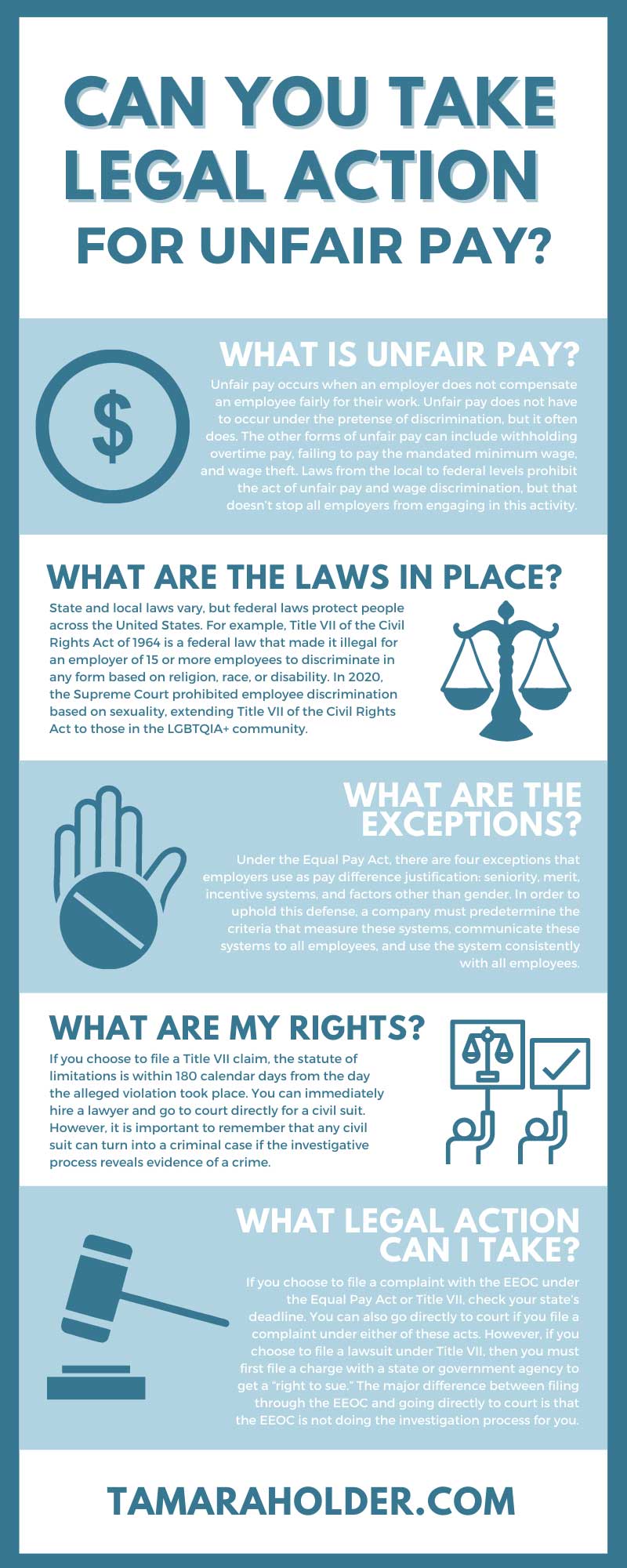
Unfair pay occurs when an employer does not compensate an employee fairly for their work. Unfair pay does not have to occur under the pretense of discrimination, but it often does. The other forms of unfair pay can include withholding overtime pay, failing to pay the mandated minimum wage, and wage theft. Laws from the local to federal levels prohibit the act of unfair pay and wage discrimination, but that doesn’t stop all employers from engaging in this activity.
There are many protected categories that an employer must not discriminate against, including those of a particular race, age, sexual orientation, gender, or ability.
State and local laws vary, but federal laws protect people across the United States. For example, Title VII of the Civil Rights Act of 1964 is a federal law that made it illegal for an employer of 15 or more employees to discriminate in any form based on religion, race, or disability. In 2020, the Supreme Court prohibited employee discrimination based on sexuality, extending Title VII of the Civil Rights Act to those in the LGBTQIA+ community.
In addition, the Equal Pay Act of 1963 prohibits discrimination based on gender and states that the employer must pay the same amount as coworkers of the “opposite sex.” However, the jobs between which the court is comparing pay do not have to be identical, but they must be equal in skill, effort, and responsibility. The job titles themselves do not apply in this comparison.
These federal laws also apply to all commonwealth and territories of the United States.
Despite the federal laws in place, there are some exceptions and loopholes employers will use to try and “legally” underpay you. Under Title VII, employers are allowed to discriminate against workers that do not operate in accordance with their religious beliefs. Companies in some states use this caveat to fire and underpay employees.
Title VII also does not apply to any Tribal Nations. However, employers operating on tribal land with 15 or more employees must comply with Title VII.
Under the Equal Pay Act, there are four exceptions that employers use as pay difference justification: seniority, merit, incentive systems, and factors other than gender. In order to uphold this defense, a company must predetermine the criteria that measure these systems, communicate these systems to all employees, and use the system consistently with all employees.
However, there are still factors other than gender that can be used to justify a difference in pay. For example, if the factor applies to all genders, furthers or is beneficial to the employer’s business, and the employee was aware of these factors, then the employer can use that to justify the difference in pay.
If you believe that you are a victim of an Equal Pay Act violation, you can file a claim with the US Equal Employment Opportunity Commission (EEOC), but you do not have to. However, you must file the complaint within the first two years after the alleged violation.
You also have the legal right to complain directly to your employer about pay discrimination. However, if you plan on taking legal action, it is advisable not to do so. Your employer might become aware of you filing a complaint and tamper with critical evidence before you have the chance to gather it.
If you choose to file a Title VII claim, the statute of limitations is within 180 calendar days from the day the alleged violation took place. You can immediately hire a lawyer and go to court directly for a civil suit. However, it is important to remember that any civil suit can turn into a criminal case if the investigative process reveals evidence of a crime.
If you decide to file a lawsuit, there are a few steps you should take as soon as possible. First, you should review your contract and your employer’s policies. Review these documents for policies related to discrimination, compensation, and other policies relevant to your wage. In addition, find out your company’s complaint procedures and deadlines.
Next, you’ll need to gather a paper trail to compile proof. This documentation should include documents about the responsibilities and wages of your coworkers, pay stubs, wage comparisons to other jobs in the same field, any digital correspondence, and witness testimonies. Do not keep this evidence at your job, but rather in a safe place at home or in a separate drive. Continue to document everything you can if you continue to work there.
Afterward, you can choose to report to your boss, HR, or your union. You can also file a complaint in court or with the government. It is important to note that choosing these avenues does not extend the deadline for filing a complaint with a government agency or court.
If you file a complaint with your boss or HR department, it is best to do so in writing so you can have an exact copy of the correspondence. If you’re part of a union, you can use your union’s grievance procedure or take collective action with a meeting or petition.
If you choose to file a complaint with the EEOC under the Equal Pay Act or Title VII, check your state’s deadline. You can also go directly to court if you file a complaint under either of these acts. However, if you choose to file a lawsuit under Title VII, then you must first file a charge with a state or government agency to get a “right to sue.” The major difference between filing through the EEOC and going directly to court is that the EEOC is not doing the investigation process for you.
There are a few things that could happen as a result of a successful case. You may get your job back if the business initially fired you due to your complaint, or your employer may have to change their policies and practices to comply with the law.
In terms of monetary compensation, you may receive payment for emotional or physical damage. In addition, you can receive “back pay,” which is the money you could have earned if your employer had not discriminated against you. Every case is different, and the outcome of the case is dependent upon many factors.
It is essential to understand that you can take legal action for unfair pay. Take your power back and get the compensation you deserve. If you feel that you’ve been the victim of unfair pay or wage discrimination, contact an equal pay attorney to get the representation you need.
In 2020, the supreme court ruled that workplace discrimination based on sexual orientation was unlawful. While this was a fantastic milestone for the LGBTQIA+ community, workplace discrimination still exists among this portion of the population. Many, understandably, live in fear and still wonder—can you be fired for being gay? The answer, unfortunately, is more complex than it should be.
On June 15, 2020, the Supreme Court ruled that Title VII of the Civil Rights Act of 1964 also protects people from discrimination based on gender or sexual orientation. Title VII protects all employees in every state, district, and United States territory, regardless of immigration status or citizenship. As Title VII is a federal law, it is a nationwide standard.
Businesses cannot fire people of the LGBTQIA+ community because of how they appear or how they choose to dress. In addition, they have a right to request equal access to bathrooms and locker rooms, cannot have clients taken away from them (even at the client's request) because of their sexual orientation or gender identity, and can file for harassment if the company does not respect their pronouns.
While this may seem perfect on paper, there are exceptions to Title VII. Most notably, religious organizations have the right to fire employees or reject applicants that are not in accordance with their religious beliefs. Unfortunately, many deeply religious states use this loophole to fire employees and applicants, even if their business has nothing to do with religion. In addition, Title VII does not apply to Tribal Nations, but employers with 15 or more employees operating on tribal reservations must comply.
So, can you be fired for being gay? The answer depends. When applying for jobs in deeply religious states, you should be wary. Utilize state equality index maps to see whether you live in a state that may fire you based on sexual orientation. These maps allow you to easily view which states do or don’t typically protect employee rights.
If you’re worried about your rights or believe that you’ve been a victim of workplace discrimination based on sexual orientation, contact a sexual orientation discrimination lawyer who will be on your side and protect your rights.
Wrongful termination cases can arise from many different situations. When filing a lawsuit for wrongful termination, your reasoning doesn't have to be limited to discrimination based on sex, gender, medical condition, or age. Often, these cases arise due to perceived revenge from the rejection of advances, enforcing your rights as an employee, and more.
If you believe you've been a victim, here's what to expect when filing a wrongful termination lawsuit to help you prepare.
It is vital for you to contact or hire a lawyer as soon as you believe that you've been a victim of a wrongful termination case. You can do so if you feel like you've been let go due to discrimination, harassment, or retaliation. In addition, it is best you review the terms and conditions of your initial contract. While a lawyer will be able to tell you if your case holds weight, you want to review your contract for specificities or vagueness that may have led to your termination.
In some cases, employees may not know the ins and outs of their contract, and your employer may have specific reasons that you weren't aware you signed to. Alternatively, if a rule in your contract is too vague, this can be a critical cornerstone in building your case.
So, take a moment to review your federal and state rights as well as what was outlined in your employee contract. Understanding your rights, terms, and conditions will make you more knowledgeable and give you confidence if you decide to contact a lawyer.
Ideally, you've chosen a lawyer who specializes in wrongful terminations and employee rights cases. Don't be afraid to ask your lawyer what their specialty is, as well as their success rate. You want a lawyer that will represent you to the best of their ability, so vetting different lawyers is your first step.
When you decide on a lawyer, they’ll perform a case evaluation. You’ll need to bring the police report, eyewitness contact information, medical papers, and any photos or videos, if applicable.
During your first meeting with your lawyer, the attorney will ask you a list of questions. This is to ensure that your case holds enough weight for it to go to court. They will ask you what happened, as well as where and why, so you may want to write down as many details as you can. Ideally, you would do so directly after the incident, but don't panic if you didn't. Just write down what you remember as soon as you can so you can keep your facts and memories as clear, concise, and accurate as possible.
If the attorney determines you have a solid case that warrants further investigation, you don't have to decide that you want to pursue the case immediately. The statute of limitations vary by state, so you have time to choose whether or not you wish to continue.
Pre-litigation is the phase before the filing of a lawsuit. This includes the gathering of all evidence and information relevant to your claim.
This is the most critical time period, as it’s when you'll compile evidence. Because of this, you'll want to hire a lawyer first and foremost to avoid any muddling of critical proof. Next, you'll want to gather any electronic communication, memos, termination notices, schedules, pay stubs, and evaluations to help you build a case. Again, hiring a lawyer from the beginning will help you gather everything you can. Afterward, your lawyer will contact your employer, stating the facts and possible legal claims you'll pursue.
At that point, your employer may offer to settle outside of court, but it is entirely up to you whether you want to accept that form of compensation.
Cost is one of the main reasons employers may ask to settle out of court. Not only can it be a significant cost for them, but they know it can be expensive for you too. While most lawyers operate on a contingency policy, which means only receiving payment if you win, not every lawyer does. And even if they don't operate on this policy, travel fees, filing fees, and copying charges may be relevant. Some people accept the out-of-court compensation fee if they don't feel like a lawsuit is worth it.
However, you should retain your lawyer if you choose to accept this form of settlement. If your employer is willing, you can negotiate compensation based on emotional distress, lost wages, and damages. This way, you can get the compensation you feel you deserve out of court. On the other hand, if your employer doesn't comply, you can continue to take the case to court.
With or without a contingency fee, a lawyer for a wrongful termination case may go up to about $14,000. It is important to keep in mind that an ex-employer may use this information against you to strong-arm you out of court and out of your compensation. Ultimately, it is up to you to decide whether you can afford it and whether you should continue the case.
Before you've officially filed your case and after you've hired your lawyer, you'll have to contact the EEOC, as they will carry out the investigation. Because of this, the charging process can take up to 180 days or longer to complete. After that, the case can take up to a year in court to be completed. So, in total, the minimum amount of time it takes to charge your employer and reach a settlement can take a year and a half, and it can even go beyond two years.
In addition, if it is found in the investigation that this is a criminal case, it will take even longer. While a civil and criminal case can occur simultaneously, you have to be dedicated to attending meetings and depositions.
This is another reason why employers may try to convince you to settle out of court. Not everyone has the dedication to pursue a case after they're informed of the time it will take. People have jobs, children, and other responsibilities they need to put first, and an employer knows this and will use it to persuade you to settle. Because of this, few wrongful termination cases end up going to trial, and only 5 to 25 percent of wrongful termination cases are successful.
Typically, a wrongful termination case settlement can be anywhere between $5,000 to $100,000, with the median being $40,000. This settlement will take into account wage loss, emotional distress, medical expenses, attorney fees, and more.
If the court determines that the offender's actions are especially heinous, they may require an employer to pay for punitive damages. Punitive damages are penalties used to ensure that the offender will not commit this act to others.
If your lawyer operates on a contingency fee, they will receive 30 to 40% of your settlement. However, this is not a catch-all number, so be sure to discuss what your lawyer's contingency rates are long beforehand.
Now that you know what to expect when filing a wrongful termination lawsuit, you know what it takes to build a successful case. So, if you feel that you've been wrongfully terminated, contact a wrongful termination lawyer today so you can start working on getting the compensation you deserve.

When a job turns toxic, you might be thinking about hiring an attorney to help you right the wrongs you believe have been done to you at work. If you think you’ve been the victim of unlawful employment discrimination or wrongful termination, learn how to prep for your consultation with an employment lawyer.
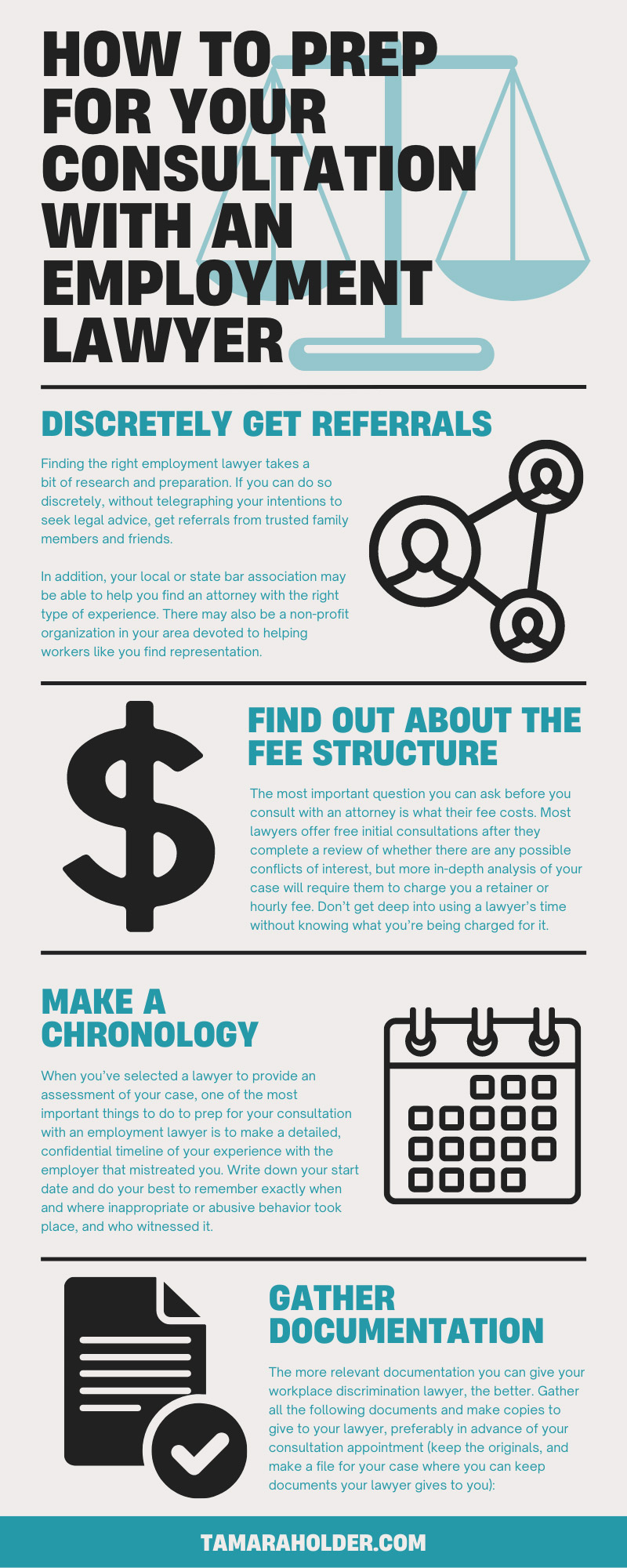
Finding the right employment lawyer takes a bit of research and preparation. If you can do so discretely, without telegraphing your intentions to seek legal advice, get referrals from trusted family members and friends.
In addition, your local or state bar association may be able to help you find an attorney with the right type of experience. There may also be a non-profit organization in your area devoted to helping workers like you find representation.
Remember that not all types of workplace mistreatment, or perceived mistreatment, rise to the level of actionable, unlawful discrimination. Your employer’s actions must have been based on your sex (including sexual orientation or gender identity), race, national origin, religion, disability, age, marital status, or pregnancy.
If your employer is a jerk and your workplace is miserable, but your boss’s behavior and lousy working conditions aren’t based on those protected categories, you may not have a case. However, that’s for your lawyer to decide.
The most important question you can ask before you consult with an attorney is what their fee costs. Most lawyers offer free initial consultations after they complete a review of whether there are any possible conflicts of interest, but more in-depth analysis of your case will require them to charge you a retainer or hourly fee. Don’t get deep into using a lawyer’s time without knowing what you’re being charged for it.
When you’ve selected a lawyer to provide an assessment of your case, one of the most important things to do to prep for your consultation with an employment lawyer is to make a detailed, confidential timeline of your experience with the employer that mistreated you. Write down your start date and do your best to remember exactly when and where inappropriate or abusive behavior took place, and who witnessed it.
Also write down the dates and duration of any significant job changes that your employer imposed on you. This is especially important if you left your job because your employer made it unbearable for you to stay.
Make detailed notes for each entry. Your chronology should include not just your start date, but who your supervisor was at the time you were hired. Include the details of what you believe was discriminatory behavior or inappropriate comments, including exactly what was said or done and who said or did it.
If you know that other workers were treated differently and better than you were, and you believe this was because of your status as a member of one of the protected classes listed above, provide details that show how others got better treatment than you did.
Similarly, if you know of other workers like you who endured similar treatment, write that down, too. Make notes about how these actions affected you emotionally and financially, and what you did about it. Did you complain to your HR department? If so, did they investigate? What conclusions, if any, did they reach? Did you never hear anything further on your complaints?
The documents you give your lawyer are confidential, and you should treat your copies as such also. Place your records for the case, including all your notes and timelines, in a locked drawer or file cabinet and keep the keys secured.
The more relevant documentation you can give your workplace discrimination lawyer, the better. Gather all the following documents and make copies to give to your lawyer, preferably in advance of your consultation appointment (keep the originals, and make a file for your case where you can keep documents your lawyer gives to you):
Your attorney may ask for additional documentation and will explain to you why it is needed.
Be on time; this is critical. You are paying for your lawyer’s time, and punctuality speaks to your commitment to addressing your concerns. Make sure you schedule your consultation for a time when you know you can show up and stay for as long as you need to.
Attorney-client communications are confidential and privileged. Your lawyer cannot discuss your case with anyone without your permission. Even if you give permission, you might unwittingly compromise confidentiality if your spouse or significant other doesn’t understand how critical it is to keep these communications private. Your partner can come with you to your lawyer’s office to provide moral support, but make it clear to them they won’t be sitting in on the conversation.
Tell your lawyer the full story, warts and all, even if it means describing language you used or behavior you engaged in that puts you in a negative light. It’s better to be prepared for whatever your employer may say about you to try to discredit your claim.
After all this preparation, you may find that your lawyer thinks your case is weak, and could be prohibitively costly to pursue. It doesn’t mean the attorney won’t try to get you some redress of your grievances, but the result may not be what you were hoping.
If your lawyer believes your case is meritless and involves resentment or revenge instead of genuinely viable legal claims, they’ll tell you so and politely decline the representation.
Seeking compensation or other relief from employment discrimination can be a tough road, but where your claims demonstrate that you have been the victim of unlawful action, pursuing those claims can be worth it. Even if the outcome isn’t what you’d hope, you will have shown your employer that you don’t put up with discriminatory treatment, and neither do any of your coworkers.
Title IX prohibits sex discrimination by any educational institution or activity that receives federal funds. Most often associated with equity in athletics, Title IX reaches far beyond the playing field. Here is what employees need to know about Title IX.
Several federal laws protect employees against discrimination. Title VII of the Civil Rights Act of 1964 prohibits discrimination in employment based on sex, race, color, national origin, religion, or disability. Enforcement begins with the Equal Employment Opportunity Commission.
Title IX is part of the laws that govern education in the U.S., and it is enforced by the Office of Civil Rights in the Department of Education.
Institutions and programs subject to Title IX must appoint a Title IX coordinator, who is responsible for investigating complaints, complying with regulations (like providing notice of complaint procedures to students and employees), scheduling hearings, and maintaining records and files.
Additionally, many staff positions at schools, colleges, and universities that place employees in positions of responsibility make staff in those positions “responsible employees” under Title IX. These individuals are required to report incidents of sex discrimination—including harassment, assault, bullying, and other sex-based discrimination—to the institution’s Title IX office.
One of the most important things employees need to know about Title IX is that Title IX coordinators and responsible employees are required to report an incident of sexual harassment, sexual assault, gender based bullying, or other sex discrimination to the Title IX office of the institution. The institution is then required to initiate an investigation.
Victims of sexual assault at educational institutions who do not want to launch an investigation or file a formal complaint can talk to a confidential employee, like a counselor. Designated confidential employees are not required to report incidents reported to them.
Employees, including student workers, parents, vendors, and anyone else who interacts with an institution or program subject to Title IX are covered by the law. Anyone who has been a victim of sex discrimination or sexual violence perpetrated by someone affiliated with the school or on the school’s grounds can file a complaint with the Title IX office of the institution or directly with the Office of Civil Rights of the Department of Education.
Where the victim also reports the incident as a crime, an institution’s responsibility to investigate doesn’t end if prosecutors elect not to bring charges, or if the accused is acquitted of a crime. The school must complete its own investigation and take such steps as it deems necessary to ensure that its environment is free of sex discrimination.
Talking about the incident with an experienced Title IX lawyer can help victims navigate the rules for filing complaints, and determine whether and when to file a lawsuit.
Toxic coworkers’ grousing may not rise to the level of harassment. Learn what makes workplace hostility illegal and how a hostile work environment affects your well-being.
Everyone who has been employed for a while has come across a truly insufferable coworker. Perhaps they complain constantly, take credit for your ideas, or practice poor workplace hygiene. Toxic work environments negatively affect both physical and mental health. But “hostile work environment” has a specific meaning under Title VII of the Civil Rights Act of 1964.
A hostile work environment exists if there is severe and pervasive harassment based on race, sex (including sexual orientation or gender identity), national origin, religion, disability, or age. To be severe and pervasive, the harassment must make it difficult or impossible for the victim to do their job. If the behavior is viewed both objectively (by an impartial third-party observer) and subjectively (by the victim), the work environment is considered abusive. A hostile work environment affects your well-being physically, mentally, and professionally.
Coming to work only to encounter coworkers or supervisors who bully and demean you or make you feel unsafe is extremely stressful. Stress, as many of us know, is bad for you. It can raise your blood pressure, affect your sleep, disturb your digestion, and contribute to insulin resistance.
A hostile work environment contributes to anxiety, depression, and in severe cases, can cause symptoms of post-traumatic stress disorder (PTSD). Symptoms of PTSD can include nightmares, unpredictable mood swings, insomnia, and angry outbursts.
A person under constant stress because of a hostile work environment will probably not be able to perform their job to the best of their ability, so their productivity will suffer. The employer only compounds this problem by imposing “performance improvement plans” or other adverse consequences on the victim.
If you or you or your coworkers have suffered persistent bullying, harassment, or humiliation based on a protected category like race or sex, contact a hostile work environment lawyer. An experienced workplace discrimination attorney can assess your case and help you put a stop to the abusive behavior.
Gender discrimination isn’t limited to cisgender women. People who identify as non-binary or agender experience it too. Here is how to identify gender discrimination in the workplace.
First, we must note that “sex” and “gender” are different, but are often used interchangeably under law. “Sex” refers to biological and physical characteristics of male and female bodies, from chromosomes to genitalia.
“Gender” is a social construct. It refers to roles and expectations imposed on people because of their sex, and it means how a person identifies themselves, regardless of what sex they were assigned at birth. Additionally, a person’s sex commonly delegates the way their parents socialize them as they grow up.
Under Title VII of the Civil Rights Act of 1964, discrimination in hiring, pay, working conditions, or opportunities based on sex, gender identity, and sexual orientation is illegal. Simply put, Title VII makes it illegal to treat workers differently or less favorably based on these three factors. Gender bias exists when there is a clear tendency to prefer one gender over another.
It’s not always obvious that you’ve been the victim of discrimination. Employers have become skilled at disguising discrimination behind seniority or job requirements that follow traditional or stereotypical limits on what “men” and “women” can do.
Several signs can help determine if an employer engages in gender discrimination. Here’s how to identify gender discrimination in the workplace.
Employers make mistakes from the get-go that can rise to the level of gender discrimination with job announcements that use discriminatory language. Employers under Title VII can only limit job opportunities based on sex if being one sex is a “bona fide occupational qualification” or BFOQ.
It’s very difficult to prove that being male or female is a BFOQ, except when the job involves intimate care of a person unable to care for themselves. Jobs that require an employee to assist a person in dressing, bathing, or using the bathroom in a home setting may be able to show that the persons receiving assistance will only accept it from someone of the same sex.
Job announcements including words corresponding with a particular gender identity can be evidence of bias. These include words like “confident,” “aggressive,” “decisive,” “outspoken,” or “strong,” which are traditionally male-assigned characteristics. Such language can deter cisgender women from applying for jobs, which is discriminatory. While men will apply for jobs in that they meet only 60% of the identified qualifications, some women will only apply if they meet 100% of the listed requirements.
Interviews are often a source of evidence of gender bias, whether conscious or unconscious. While questions about marital or parental status or plans aren’t illegal per se, they are powerful evidence of an intention to discriminate based on gender.
Even today, women hold more lower-level, lesser-paid positions than men. Workplaces that tend to steer people into stereotypical roles based on gender may be committing unlawful gender discrimination. For example, a woman applies for a managerial position, but gets an administrative assistant offer instead, while a less qualified man gets the supervisory job offer.
Similarly, men have experienced gender discrimination when they seek roles traditionally perceived as “feminine,” such as administrative assistant positions, nursing, teaching, or child care.
Positional discrimination or bias can result in workplaces where men are overrepresented in executive and managerial positions, while women hold most support positions.
Dress codes can indicate gender bias if, for example, women cannot wear pants, or only women are required to wear uniforms or revealing clothing.
Gender discrimination can be a consistent pattern of inferior work assignments to one gender, usually women, while offering men the “plum” accounts. For example, salespeople paid on a commission basis depend on reliable, repeat-purchaser accounts. When women receive a roster of inferior, unproductive accounts, yet are expected to meet the same sales goals as their male counterparts, they are victims of gender discrimination.
Lack of support can create cascade of negative consequences, from inferior performance reviews to lower pay. Studies have shown that men tend to get higher raises even when males and females receive the same scores on performance evaluations.
Job support is often a stepping stone to promotion. Being denied training opportunities, the chance to attend professional conferences and workshops, or being given fewer resources based on gender is a form of discrimination that can damage careers. A record of biased performance evaluations and a “failure to advance” result from gender bias, thus hindering women from gaining promotions—this is the phenomenon known as the “glass ceiling.”
Workplace language and communication can also be evidence of gender discrimination. Using diminutives, like “honey,” “sweetie,” or even “dear” communicates a patronizing attitude and devalues the contribution of the person on the receiving end of these “endearments.”
Studies conducted by George Washington University and Northwestern University School of Law show that men interrupt conversations 33 percent more frequently when speaking with women than when talking to other men. This behavior diminishes women’s voices, and may even result in a common workplace aggression: taking credit for another’s work. Women everywhere have had the experience of saying something in a meeting, and getting no response, but when a male worker repeats the same idea, he receives recognition and praise.
Interrupting women is so pervasive that it infects the court system. According to the Northwestern University study, women judges were interrupted 32 percent of the time during oral arguments, while committing the interruptions only four percent of the time. Even on the United States Supreme Court, female justices endured 65.9 percent of all interruptions.
These interruptions became painfully apparent during the COVID-19 pandemic when oral argument was held by phone. It got so bad that Chief Justice John Roberts had to take action to allow female justices adequate time to ask questions and be heard by instituting a process of taking turns according to seniority on the court. Since there are currently only three women justices and a new female justice recently confirmed, the women on the court will still have less seniority than the men for many years.
Even if all genders are treated equally in hiring, pay, and promotions, gender discrimination in the form of sexual harassment could still occur. Sexual harassment can take the form of sexual innuendo, suggestive jokes, unwanted touching, catcalls, sexual assault or attempted sexual assault, ogling, rating employees according to “attractiveness,” questioning an employee about their sex life or sexual practices, spreading sexually charged rumors, pressuring employees for dates, or displaying pornographic images. The length of this list is a sad commentary on the existence of hostile work environments across the country.
Now that you know how to identify gender discrimination in the workplace, some of these signs may ring some bells, and remind you of an experience with your employer. Contact an experienced gender discrimination lawyer who specializes in employment discrimination. Your attorney can assess your case, and take steps to help rid you of discriminatory treatment in your workplace.
If it is happening to you, there’s a good chance it’s happening to others. Stepping up to hold your employer accountable can not only help you, but also help your coworkers.

It may start as jokes about when you’re due to retire or with a sudden and inexplicably negative performance review. Recognize these five signs you are the victim of ageism in the workplace.
Employers who are scheming to replace older workers with younger, less expensive ones sometimes try to drive experienced workers out with demotions or unpleasant reassignments of duties. If you’ve been working on plum assignments with frequent client contact, and suddenly you’re doing research for a younger employee’s reports, your employer might be trying to get you to quit, to avoid terminating you and facing a discrimination lawsuit.
If you’ve been meeting or exceeding all your performance goals but your supervisor is finding creative ways to lower your performance evaluations, it could signal the beginning of a campaign to oust you from your job.
To prove age discrimination, you must show that your job performance is satisfactory, but your employer took adverse action against you anyway, and that younger employees in similar positions were given more favorable treatment. Employers try to protect themselves from age discrimination cases by building a record, even a spurious one, of sub-par job performance.
When the ranks of your similarly aged peers begin to thin, and the positions they previously occupied are taken by younger workers, you could be witnessing a concerted effort by your employer to purge older employees.
Layoffs that disproportionately affect older workers could signal age discrimination. Document your observations, keep your skills up to date, and volunteer for challenging assignments to show your commitment to your company’s success.
The image of the Silicon Valley start-up filled with young hipsters in black turtlenecks permeates some IT companies and departments. Even though Boomers invented most of the infrastructure and operating systems that supported the development of most of the business technology currently in use, employers seem to think their IT departments must project a youthful appearance.
If your technical skills are up-to-date but your employer questions your abilities anyway, you may be the object of ageism.
Watch for job announcements that describe a workplace as “energetic” or “youthful,” or that plainly state they are seeking “recent graduates.”
When colleagues or supervisors openly start questioning you about your retirement plans, you may sense an ageist target on your back.
If you suspect ageism at your workplace, consult an age discrimination lawyer who can help you sort suspicion from unlawful action and determine if you have a case for illegal age discrimination.
Blatant discrimination still occurs in workplaces and in hiring. Clueless or untrained hiring managers sometimes either stumble into discriminatory practices unintentionally or display unconscious bias during interviews.
However, discrimination can be more subtle than flat-out asking someone their age, their marital status, or whether they’re pregnant during an interview. And discrimination in the hiring process can begin long before any interviews occur. Knowing how to identify discrimination during the hiring process will help you pick up on inappropriate language, processes, or unfair treatment, from the time you notice a job announcement through the application, interviewing, and job offer process.
Title VII of the Civil Rights Act of 1964 and court decisions interpreting that statute prohibit employers from discriminating on the basis of race, color, religion, sex, or national origin. This prohibition applies to hiring and firing decisions, pay, and the “terms, conditions, or privileges of employment.”
Under the same law, it is illegal for one to “limit, segregate, or classify his employees or applicants for employment in any way which would deprive or tend to deprive any individual of employment opportunities or otherwise adversely affect his status as an employee.”
While it’s jarring to see that the text of the law prohibiting sex discrimination uses the phrases “his employees” and “his status as an employee” (emphasis added), both the letter and the spirit of the law are clear: discrimination in hiring is illegal.
But how exactly does unlawful discrimination play out in the hiring process?
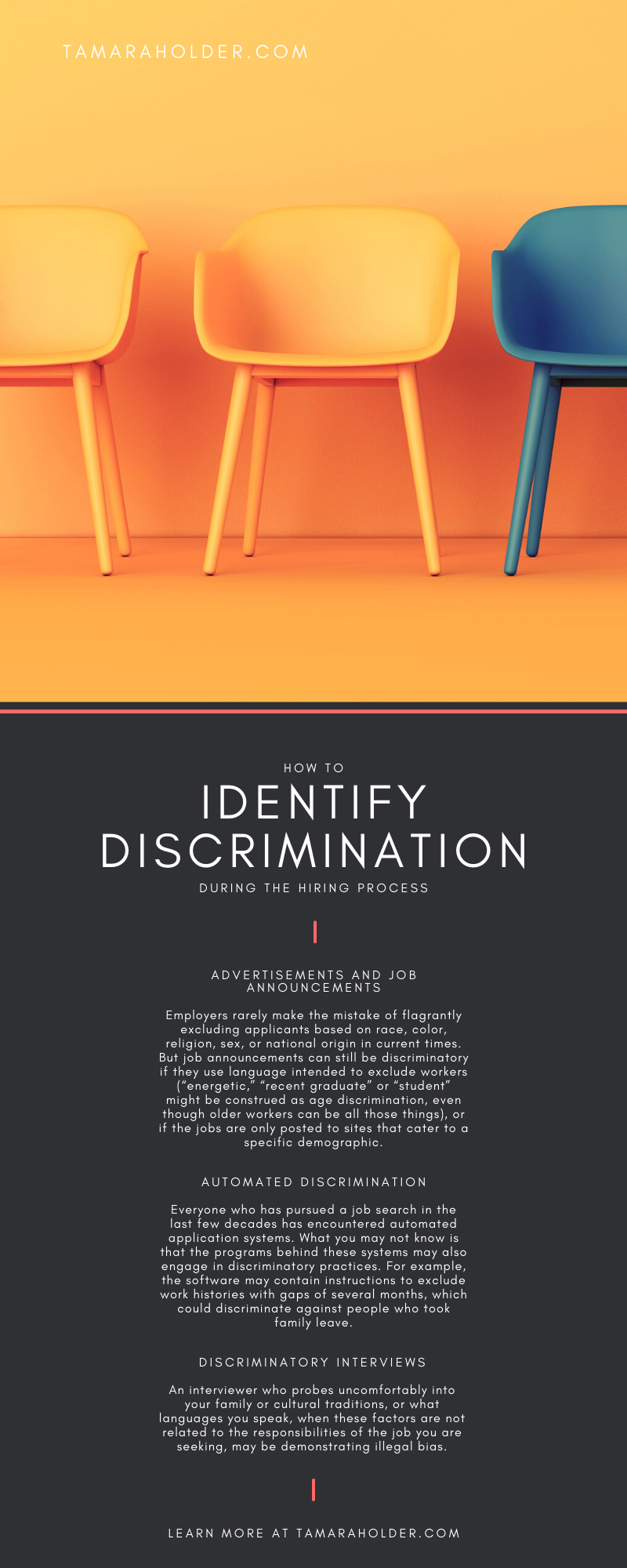
Intentionally or unintentionally, ads and job announcements can be discriminatory. For example, direct discrimination in job announcements would include ads that specify that only applicants of a certain age, gender, or religion should apply.
The only exception to this is what is called a “bona fide occupational qualification." Also known as a BFOQ, it may exist if consideration of a person’s sex, religion, or national origin is relevant and necessary for carrying out the particular job function in the course of the employer’s business. An example would be a job that involves intimate care for a person who cannot bathe or dress themselves, or where religious prohibitions dictate that genders cannot comingle—and if they did, this would “undermine the essence” of the business in question.
To legally limit the applicant pool to only people of a particular sex, religion, or national origin, the employer must show that no person of the excluded category could do the job without undermining the essence of the employer’s business.
Courts interpret claims that BFOQs exist very narrowly, and demonstrating that a limitation based on sex, religion, or national origin is a difficult standard for an employer to meet.
Employers rarely make the mistake of flagrantly excluding applicants based on race, color, religion, sex, or national origin in current times. But job announcements can still be discriminatory if they use language intended to exclude workers (“energetic,” “recent graduate” or “student” might be construed as age discrimination, even though older workers can be all those things), or if the jobs are only posted to sites that cater to a specific demographic.
Job descriptions that include gendered words (“waitress” instead of “wait staff” or “server), or exclusionary language based on national origin (“Latino” instead of “Spanish-speaking”) may indicate discriminatory intent.
Everyone who has pursued a job search in the last few decades has encountered automated application systems. What you may not know is that the programs behind these systems may also engage in discriminatory practices. For example, the software may contain instructions to exclude work histories with gaps of several months, which could discriminate against people who took family leave.
Artificial intelligence (AI) has been heralded as a potential cure to discrimination in hiring, as it supposedly eliminates human biases. But if the AI in use learned how to exclude resumes based on data describing successful employees in a non-diverse workforce, it will only find characteristics that describe the dominant type of employee in that cohort, whether that is white males under the age of 27 or women who attended Ivy League schools. AI is only as good as the data it learns from, and it isn’t good at understanding bias and discrimination issues.
Both hiring managers and job candidates have come to regard interviews as potential minefields of either liability or discrimination. Job interviews are supposed to be a tool to assess a candidate’s job-related skills and abilities. Questions in an interview should stick to objective measures that relate to the responsibilities of the position the interviewee is seeking.
But then there’s the small talk. It’s a misconception that questions about marital status, plans to have a family, or what church in town you attend are in themselves illegal. They are certainly uncomfortable, and a well-trained interviewer would never ask them. However, they can be flagged as evidence of an intention to discrimination, and they do become a legal issue if your answers to them are used as a reason not to hire you, especially if the employer hired a less-qualified, younger candidate or person of a different race with less relevant experience than you possess.
An interviewer who probes uncomfortably into your family or cultural traditions, or what languages you speak, when these factors are not related to the responsibilities of the job you are seeking, may be demonstrating illegal bias.
Proving discrimination in a job interview is difficult, as employers will rarely tell you why you didn’t get the job. They’ll say something vague like, “We went with a candidate we felt was a better fit,” or, “We found a candidate with experience that more closely fits the job description.” Employers have learned not to openly admit that they made a hiring decision because they were more comfortable with a younger person or a person of a different race.
If you believe you were discriminated against in the hiring process, document your experience as best you can and as soon as you can after the suspicion strikes you that discrimination may have occurred. For example, if everything was going swimmingly through two phone interviews, but the moment your in-person interviewer saw you their demeanor changed and the interview became perfunctory and abrupt, you might reasonably suspect discrimination based on race, color, age, religion, or national origin.
If your interviewer behaved in a way that indicated discomfort only after they saw you in person and you suspect racial discrimination, contact an experienced race discrimination lawyer. An attorney steeped in civil rights and discrimination laws can help you identify discrimination during the hiring process and assess whether you have a case for illegal discrimination that occurred during hiring.