This story was first reported by Aimee Levitt in Eater Chicago.
When Claire Henry began working as the marketing and programming director at the Ace Hotel in Chicago shortly after it opened in Fulton Market in the fall of 2017, she was excited by the possibility of creating a space where all sorts of people could come together to appreciate music, art, and food. To Henry, who was fresh out of grad school, it felt like a grand experiment, and she immediately began reaching out to artists and DJs to schedule a full slate of parties, talks, and exhibits.
Now, four and a half years later, the Ace has left town, and Henry, who says she was asked to leave her job in September 2020, is suing the hotel chain for defamation of character, corporate negligence, and infliction of emotional distress. The Ace’s ethos of diversity and inclusion was just a facade, and behind the scenes, the chain’s management was guilty of mistreating and even abusing its workers, specifically its workers who are Black, Indigenous, and people of color (BIPOC), her lawsuit argues, with specific examples gleaned from social media claims. Instead of taking responsibility for its culture, the lawsuit argues the Ace used employees like Henry, who is white, as scapegoats.
“Ace hires young, enthusiastic, excited people who really need [the brand] on their resume,” Henry says. “They need the connection, and they’re not in a position to fight. It feels like bullshit that these people are left hurt and damaged by a company that propped themselves up on the idea of community and connectedness and inclusivity. I got to a point, as so many employees who have made complaints have done, where you either stop talking about it, or you realize that this is how they continue to get away with this behavior.” That is why, she says, there are so many other complaints besides her own in the filing.
General counsel Meriem Soliman wrote in an email to Eater that the Ace was unable to comment on ongoing litigation.
During the first year of Henry’s tenure at the Ace, everything seemed to be going well. Henry said she received praise for her work from Ace’s management and members of the community. She sometimes felt overworked, underpaid, and undersupported: Her starting salary was $63,000 and she was expected to manage not only the hotel’s slate of programming — between three and 10 events a week — but also its branding in Chicago, with the assistance of only one other person, a social media manager. Still, she also felt like she was doing important work, partnering with interesting people, including singer-songwriter Zola Jesus, rapper Anderson .Paak, and the late artist and designer Virgil Abloh. The hotel also hosted a panel event with Eater Chicago back in 2019.
Henry says that she was always “hyper aware” of her race as she built the hotel’s schedule of programs. She wanted to make sure that the Ace was a place where all Chicagoans would feel comfortable. “I did not want to do programming that was reflective of just my perspective and who I was,” she says. She worked with DJ bookers to hire DJs to play a variety of music; she hoped that by hosting regular dance party nights, both they and Waydown would develop a following. Waydown was the first rooftop bar in Fulton Market, then a slightly out-of-the-way industrial area, and part of Henry’s job was helping it find its place in Chicago.
Her work did not go unnoticed. “Ace Hotel helped fill a gap in the limited number of nightlife options for Black Millennials, thanks to a host of creatives and thoughtful staffers who centered our needs,” wrote the Triibe, a website that describes itself as “reshaping the narrative of Black Chicago and giving ownership back to the people.” The Triibe specifically singled out Waydown (which was later renamed Little Wild) in its article.
Henry’s official title at the Ace was “cultural engineer,” one she and her counterparts across the chain disliked, she says. It made them sound like they were engineering, or manipulating, culture, and it didn’t quite specify their place in the management hierarchy. They asked upper management for a better title that more accurately described the work they actually did: managing the hotel’s brand and cultural programming, not determining what the culture of the hotel was to be. But Henry says in the lawsuit their requests were ignored.
In late 2018, the Ace Chicago hired a new general manager, Jesse Boles, who wanted to revamp aspects of the hotel that he felt were faltering. One of those was Waydown. Boles and his managers at Ace’s corporate headquarters felt the bar had too much of a club atmosphere, Henry says; they envisioned it as something more like a cocktail bar. In mid-2019, they drew up a list of music that they no longer wanted played there. This included trap music, a popular hip-hop subgenre that features intense instrumentals (characterized by sharply accented hi-hats and rumbling sub-bass) and raps about street life. The music was one of the main draws for the young, Black crowd who came to the venue to dance. (The Ace’s list of music to be cut also included country pop.)
Henry told management that she thought this decision would be “dangerous,” and would create racial tension within the staff and with the public, but she says they ignored her. Instead, they left it to Henry to break the news to the staff, who assumed that the decision had been hers and that it was racially motivated. Neither of these things, she says, was true. She asked Ace’s management to clarify who had made the decision, but, she says in the lawsuit, they ignored her request, and the staff continued to believe that Henry wanted to discourage Black people from coming to Waydown. When customers complained about the removal of trap music on social media and in person, the Ace didn’t respond, according to the lawsuit; the bad feelings festered and were increasingly directed toward Henry.
Ace employees from across the chain responded to the post with a litany of complaints and anecdotes about racism within the hotel’s management, which were cited in Henry’s lawsuit. Black workers claimed they had been harassed and punished for behavior for which their white colleagues were praised. An unnamed former manager of the Ace Chicago’s restaurant, City Mouse, was quoted in the lawsuit as saying they had specifically been told by upper management not to hire BIPOC workers.
According to the lawsuit, Henry and her fellow so-called cultural engineers felt that, given their role, which required plenty of interaction with both the hotel staff and the community, they were best-suited to report to upper management on the general mood, both inside the hotel and out. Instead, Boles held a meeting with the staff at Waydown to which Henry was not invited.
The following day, according to the lawsuit, Boles sent an email to the staff acknowledging “that many systems and policies designed to address employee issues have an inherent bias toward existing structures and, as a result, do not do enough to support vulnerable groups” and vowing to do better. In response, an Ace Chicago bartender sent an email to all Ace employees worldwide; it included a Google doc created by Waydown staff that claimed that Henry had “advocated” for the removal of trap music, and also included a list of demands that called for “reform of the ‘Cultural Engineering’ department and for current head at Ace Hotel Chicago, Claire Henry, to be TERMINATED.”
In an Instagram post at the end of July, the Ace said it was listening and taking action, including instituting implicit bias training, salary reviews, listening circles, and investigation of all allegations. One of the first of those investigations was of Henry, specifically her role in the removal of trap music. The Ace’s CEO, Brad Wilson, had already announced in an email to the entire organization that Henry would be “investigated for inappropriate bias and racism,” and if she was found guilty, she would be fired.
In July, Henry was interviewed by an outside investigator, and in August, she says she was told by the investigator and the Ace’s head of HR that they found that her behavior had not been racist or biased. Henry, and later her lawyer, Tamara Holder, asked the Ace to send a message to all employees clearing her name. Instead, in September, the hotel handed her a separation agreement, ostensibly because of “reduction in workforce,” and offered her a payment of $3,930.82 in exchange for waiving all claims against the company, according to the lawsuit. The agreement arrived just as Henry was about to go on furlough, so she was never given a chance to explain her departure to her coworkers.
“They needed to say, ‘We need to fix that,’” says Holder. “[They needed to say to the employees] ‘Look, we’re sorry that Claire looks this way to you. This is what she’s done. Let’s have a conversation about the trap music issue.’ Because that’s what a family and a community does.”
For Henry, what happened to her is just one example of the way she says the Ace had mistreated other employees. “It’s not just one employee who is voicing concerns and having issues,” she says. “This is a larger problem of the way this company treats their employees and how they want you to feel part of a tight-knit, close community and celebrate art and diversity and inclusion. But when they were faced with a large culture and social upheaval, they failed to rise to the occasion.”
Henry is asking for $50,000 in damages, less than the equivalent of what she earned each year working at the Ace. She’s been able to continue working in the arts and interior design, in a far less public role. But both she and Holder feel it’s important that the Ace should answer to her accusations and explain the discrepancies between its rhetoric of inclusion and the way it actually treated its employees, and why no one responded to Henry’s many requests to officially clear her name.
Holder filed the lawsuit on January 21. The Ace has yet to respond.
*******
If you have information about Ace or Atelier Ace, please contact Tamara Holder at contact@tamaraholder.com or 312-818-3850.
Sexual orientation discrimination in the workplace occurs when an employee is treated unfairly due to their sexual orientation, and it can manifest as harassment or a denial of benefits or rights. Despite the progress society has made in its strides toward acceptance, this form of discrimination is still an issue. Unfortunately, due to the laws that aim to protect members of the LGBTQIA community, many aggressors have attempted to become more subtle in their transgressions and use loopholes to get around the law. This insidiousness has made it even more important for members of the LGBTQIA community and their loved ones to recognize sexual orientation discrimination at work. No one should get away with this bigotry, and aggressors should face punishment to the full extent of the law.
Sexual orientation discrimination is, by definition, the differential treatment of an employee based on their sexual orientation, and it’s illegal. It includes discrimination against people who identify as gay, lesbian, bisexual, pansexual, etc. When most people think of this form of discrimination, they typically think of the power imbalance between an employee and an employer. However, discrimination can occur between two peers or an employee against their employer. A power imbalance does not have to be in place for a discriminatory action to qualify as discrimination. Do not hesitate to take the appropriate action, which will be discussed later, if you suspect you are a victim of sexual orientation discrimination.
A coworker may or may not know your actual sexual orientation but may treat you in a discriminatory manner. For example, preferential treatment, such as praise, promotions, desirable jobs, or positions, targeted mainly or solely toward heterosexual workers constitutes sexual orientation discrimination. It may not always look like someone telling off-color jokes or hurling epithets. It may look as simple as workers of a particular sexual orientation only being in lower positions.
At first glance, this may not sound discriminatory, as it could be a genuine mistake. However, the current percentage of adults who identify as LGBTQIA has recently risen to 7.1 percent of the US population. That is 23,394,500 people in the United States, making it highly and statistically improbable that a corporation would never hire or promote a single person in the LGBTQIA community. If you notice this trend at your workplace, it is likely not a mistake.
The best way to tell if this is the case is to talk to HR and conduct a meeting with your employer or coworker, but you should only do so if you feel confident that you will be safe and not unwittingly outed by your company. Having a recorded meeting in place can ensure your safety and create a paper trail. In addition, if you have a meeting with HR to discuss the issue and they immediately resolve the problem, it is possible that the issue was accidental. However, if you find that nothing improves because of the meeting and they take no action to remedy the situation, there may be a more significant issue.
This applies not only to subtle acts of discrimination but also to more overt actions like jokes, comments, harassment, bullying, or even violence. Note any action that makes you feel unsafe, uncomfortable, or purposely undervalued or underpaid, and bring it to the attention of the appropriate members of your workplace. How your coworker and company react is the best way to tell if sexual orientation discrimination is occurring. A workplace cannot fire you for simply inquiring about a concern. If they do, that will tell you all you need to know about the company and be grounds for legal action.
Recently, under the June 15, 2020, ruling of Bostock v. Clayton County, Georgia, by the Supreme Court, members of the LGBTQIA community are officially a protected class and fall under the protections given in the 1964 Civil rights act, most notably under Title VI and Title VII. Title VI particularly prohibits discrimination against protected classes that receive federal financial assistance. Title VII prohibits discrimination against protected classes in general places of employment.
It should be noted that the other protected classes are gender, race, sex, religion, ethnicity, disability, veteran status, and pregnancy status. If a company is willing to discriminate against one protected class, they are likely to discriminate against another. If you are part of another one of these protected classes or work with other members of protected classes, you may also want to keep an eye out for other forms of discrimination. It may help you build a case if you decide to proceed with litigation.
Bona fide occupational qualification, also known as the BFOQ defense, allows employers to legally discriminate based on the idea that a person cannot fully meet a job’s requirements based on who they are. For example, regarding sexual orientation discrimination, say you apply to become a youth group leader at a religious facility. This facility can refuse to hire based on the idea that, because of your sexual orientation, you cannot meet the religious standards they have set. This defense can be used in a myriad of situations that put LGBTQIA members at risk. Despite the many attempts to eliminate the BFOQ defense, it still stands true and is a large part of how some employers get away with sexual orientation discrimination.
To file a complaint, you must do so within the first 180 days of the alleged discriminatory action to the EEOC. However, there are a few steps you may want to take before you do so. As stated previously, you may want to contact HR as soon as possible to either meet with the alleged aggressor or get a feel for the company’s policies on legal proceedings. However, only do so if you feel safe enough. If not, it’s best to contact a sexual orientation lawyer immediately. Before you meet with your lawyer, you may also want to gather any evidence you may have, such as physical or digital correspondence, work reviews, and your contract.
Organizing a meeting with a sexual orientation lawyer can help you better understand whether your case will hold water in court before you start taking legal action on your own and possibly waste your time. Once you’ve done so, retain that lawyer to help you file a complaint with the EEOC. The EEOC will then conduct its own investigation, which may take up to 10 months to complete. Hiring a lawyer makes filing a complaint easy and ensures you don’t waste any time or effort.
Now more than ever, it’s crucial to recognize sexual orientation discrimination at work and stomp it out for good if we want society to progress and move forward. If you fear that you’ve been a victim of sexual orientation discrimination, contact a lawyer immediately to see if you’re entitled to proceed with litigation and receive compensation.
The legal definition of wrongful termination is the termination of an employee that breached an employment contract or public law. For example, an employee cannot be terminated based on gender, race, ethnicity, religion, or disability. In addition, an employee cannot be fired on the grounds of retaliation, such as an employee reporting illegal activity or engaging in other protected activities.
Despite this, not everyone knows how to identify if they were wrongfully terminated. That’s why this article will provide you with five signs you were wrongfully terminated from your job.
Whistleblowers report at least 40 percent of illegal activity that occurs in the workplace. If your employer became aware of your reporting of unlawful activities, or you were suddenly fired after reporting, this can indicate that you were wrongfully terminated. For example, you can legally file a whistleblower action if you report your supervisor for filing false reports or stealing money from a cash register. If your employer fires you, they’re firing you for engaging in a protected act that is within your legal right, and that is considered wrongful termination.
Employees can be wrongfully terminated for participating in protected activities other than whistleblowing. For example, one of the reasons why pregnancy status is a protected class/characteristic is because many pregnant people are fired for either needing too much help, taking too many necessary breaks, or because an employer wants to fill in the spot before the pregnant employee needs to take leave. In addition, employees can also be wrongfully terminated for “asking for too much time off” or “being sick too often,” even though sick leave and time off are within their rights.
Sometimes an employer will fire an employee for seemingly no reason. If you ask your employee why you were fired, and they can’t or refuse to give you a specified reason, this may fall under wrongful termination. Legally, you are allowed to request the reason for your termination in writing. If your employer refuses to provide you with one, you could pursue litigation and further investigation.
In terms of harassment, wrongful termination could occur if an employee reported the harassment or if they refused the advances. For example, if an employer makes sexual advances at an employee and that employee refuses those sexual advances and is subsequently fired, that is wrongful termination. Typically, this is referred to as wrongful termination due to retribution or retaliation.
For those wrongfully terminated based on discrimination, this can look like an employer firing an employee due to bias against a race, gender, disability, religion, ethnicity, sexual orientation, pregnancy status, and/or veteran status. Often, this kind of discrimination may appear as refusing to hire certain people, leaving them out of training and meetings, or giving them undesirable projects or clients to set them up for failure.
While being able to tell whether you were wrongfully terminated from your job can be difficult, it’s easier if you pay attention to these five signs. Subsequently, if you believe you’ve been a victim of wrongful termination, contact unlawful termination lawyer Tamara N Holder today to receive the legal representation you deserve.
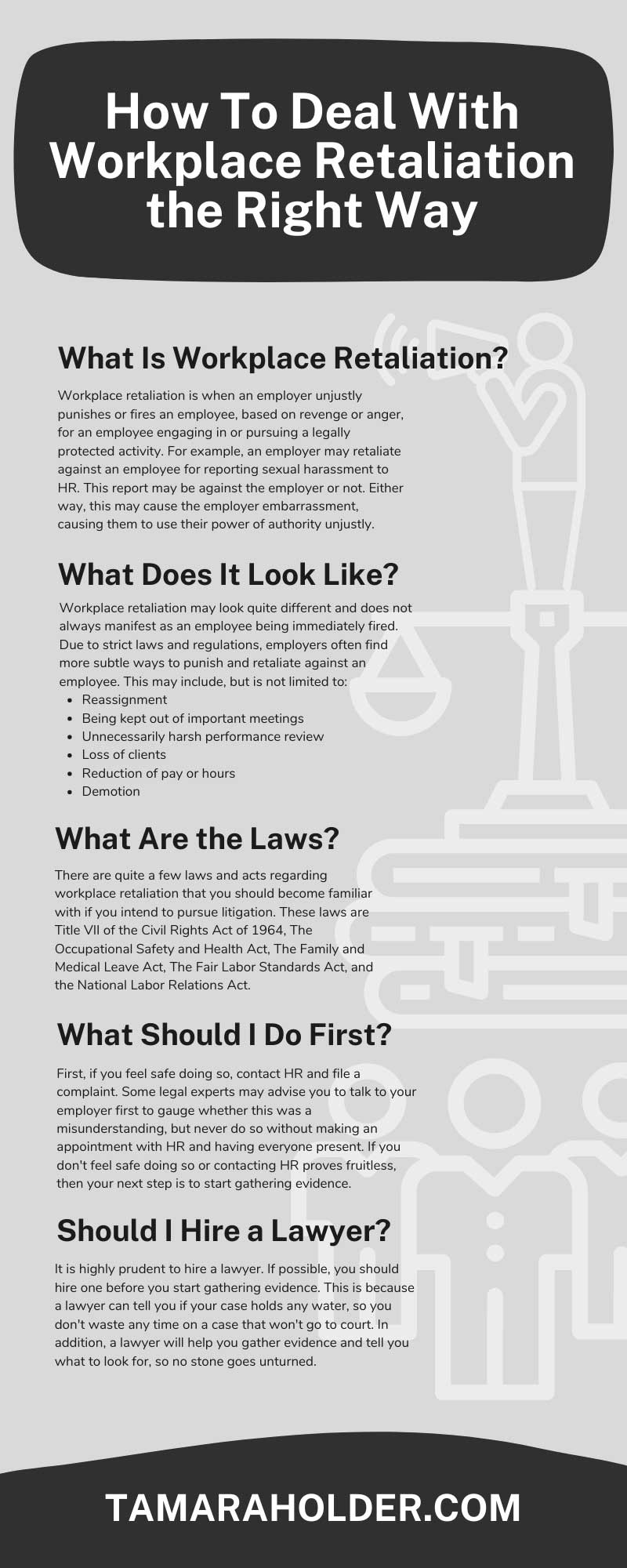
Experiencing workplace retaliation can be one of the most frustrating and humiliating experiences an employee can go through. However, if you believe you’ve been a victim of workplace retaliation, you have a right to pursue litigation and get the compensation you deserve. To go through the proper steps and give your case the best chance at succeeding, read on to learn how to deal with workplace retaliation the right way.
Workplace retaliation is when an employer unjustly punishes or fires an employee, based on revenge or anger, for an employee engaging in or pursuing a legally protected activity. For example, an employer may retaliate against an employee for reporting sexual harassment to HR. This report may be against the employer or not. Either way, this may cause the employer embarrassment, causing them to use their power of authority unjustly.
Regardless of the reason, workplace retaliation is illegal, and it is within your legal right to pursue litigation against the employer. However, due to its legal complexity, there are appropriate and inappropriate steps that you as an employee need to consider.
Before moving on to the legalities, you should know what workplace retaliation looks like. This is the first step in identifying whether your case will hold any water if it goes to civil court. There are a few common activities that may incite an employer to engage in workplace retaliation. Often an employer will retaliate if an employee files for worker compensation, refuses to engage in illegal activities, files a claim against the employer, tries to take earned and protected leave of absence, or participates as a witness in a case already active against the employer.
Workplace retaliation may look quite different and does not always manifest as an employee being immediately fired. Due to strict laws and regulations, employers often find more subtle ways to punish and retaliate against an employee. This may include, but is not limited to:
Because proving that these events occurred due to an employer retaliating, it’s best to pursue action as quickly as possible.
There are quite a few laws and acts regarding workplace retaliation that you should become familiar with if you intend to pursue litigation. These laws are Title VII of the Civil Rights Act of 1964, The Occupational Safety and Health Act, The Family and Medical Leave Act, The Fair Labor Standards Act, and the National Labor Relations Act.
Title VII prohibits virtually all forms of discrimination in the workplace, with special protection against an employee who engages in protected acts. This law also protects employees engaging in discrimination or harassment complaints.
The other laws are more particular about what they protect but are implemented because employers often retaliate against these groups of people. For example, The National Labor Relations Act protects employees who take action to improve working conditions, in or out of a union, against employee relations. Similarly, The Occupational Safety and Health Act protects employees from retaliation if they attempt to improve their workplace.
The Fair Labor Standards Act and The Family and Medical Leave Act protect employees who complain about wages and employees who request time off, respectively. All these laws are designed the way they are because the organizations that make them know some employers will attempt to snuff out an “insurgency” to gain complete and total control. This is directly against the foundational morals of the United States, so don’t be afraid to take legal action.
First, check your contract and employee handbook for information on the next steps you should take. Typically, a company will outline the process you must take to file a complaint. Make sure you follow these outlined steps quickly and precisely. However, if you’ve reviewed your contract and handbook thoroughly but can’t find the appropriate steps to take, here’s what you need to do.
First, if you feel safe doing so, contact HR and file a complaint. Some legal experts may advise you to talk to your employer first to gauge whether this was a misunderstanding, but never do so without making an appointment with HR and having everyone present. If you don’t feel safe doing so or contacting HR proves fruitless, then your next step is to start gathering evidence.
Have print and digital copies of correspondence, copies of your performance reviews, and copies of your contract and employee handbook. If you feel comfortable doing so, you may request any witnesses to write or record their experience. However, do not keep any of this at your place of employment, but keep physical backed up digital copies at home. This is to avoid any evidence tampering.
To ensure evidence has not been manipulated, do not let your employer know you’re filing a complaint with the EEOC until you’ve gathered as much as possible. Still, ideally, you won’t mention anything at all.
It is highly prudent to hire a lawyer. If possible, you should hire one before you start gathering evidence. This is because a lawyer can tell you if your case holds any water, so you don’t waste any time on a case that won’t go to court. In addition, a lawyer will help you gather evidence and tell you what to look for, so no stone goes unturned.
Then, your lawyer will contact the EEOC and help you file a complaint. You must file the complaint within the first 180 days after the alleged incident. Your lawyer will also inform you if the state covers a 300-day extension under specific anti-discrimination laws.
Part of the reason it is so critical to hire a lawyer is that an investigation under the EEOC can assume to 10 months. If they find no proof of your allegation, you must then take the case to court on your own. A lawyer can ensure that you have a case, and you’ll be less likely to waste months of your time.
After you’ve hired a lawyer, compiled your evidence, and filed a complaint with the EEOC, you’ll have to wait until the investigation is complete. However, before the investigation, the EEOC will reach out to your employer and inform them of your allegation. At this point, your employer may try to settle with you out of court. Regardless of your lawyer’s advice, you can settle out of court if you choose.
However, remember your employer knows how much time, money, and effort it takes to bring a case to court and follow through. This means that your employer may offer you much less than you’re entitled to. If you feel their offer is enough and worth it rather than putting in all the effort of going through civil court, you can accept the offer. You are not required to take the offered out-of-court compensation if it is not enough.
If you choose not to take the settlement, your case will go to civil court, where they will review the evidence presented and determine whether the allegation is correct and how much compensation you’re entitled to receive. The average amount of compensation varies widely from $5,000 to $80,000. This number can change, though, and include pain and suffering, lost benefits, lost wages, and may include punitive damages if the act proves egregious enough in court.
Now that you know how to deal with workplace retaliation the right way as well as what to expect, you’re better prepared to get your legal rights upheld and receive the compensation you deserve. If you’re looking for a representative with experience, Title IX discrimination lawyer Tamara N. Holder can help you get the job done correctly.
While many policies, laws, and regulations are in place to protect you as an employee, that doesn’t mean discrimination and illegal activities don’t happen in the workplace. However, there are times when employees are afraid to act, either because they’re afraid of retaliation or fear they’re being “too sensitive.” If you’re unsure whether it’s time to get a professional legal opinion, here are five signs that it’s time to talk to an employment attorney.
Wage theft is illegal and often occurs in the form of unpaid overtime, being paid less than the legal minimum wage, non-agreed upon deductions, or simply not playing an employee. Not being paid the appropriate amount or not being paid at all, even once, must be addressed immediately. A more significant issue may be at play if nothing is done to rectify the situation. You may be entitled to wage loss compensation if you are consistently underpaid.
Retaliation occurs when an employer demotes, harasses, punishes, or fires an employee for engaging in a legally protected action. For example, if you’re fired for taking sick leave or bringing an employer’s bad behavior to attention, this is illegal. Unfortunately, many whistleblowing laws have a short time frame, so if you believe you’ve been unjustly treated due to reporting criminal conduct, you’ll want to file a complaint as soon as possible. Ideally, you’ll want to go directly to the EEOC; however, you should always review your company’s overall reporting policies before acting.
Suppose you are being unjustly treated, demoted, ignored, or harassed because you are part of a protected class. In that case, it is in your best interest to contact a discrimination lawyer immediately. The protected classes are age, race, gender, national origin, disability, sexual orientation, veteran status, and pregnancy status. While outright discrimination has been mostly substituted for underhanded, subtle inequity, it is still discrimination, and you are entitled to pursue litigation.
Sexual harassment and sexual assault in the workplace are taken very seriously by the EEOC and the law. Inappropriate sexual comments or actions that make you uncomfortable should be reported. However, many people are afraid to report sexual misconduct due to a fear of not being believed. While this may, unfortunately, be the case for some, it is in your best interest to hire legal representation as soon as possible.
Ideally, if any of the above happens to you, you’ll first talk to your supervisor or the Human Resources department. If nothing is done about your report, you need to speak with an attorney, especially if similar complaints have been made in the past and nothing has been done about it. No one should feel unsafe at their place of employment.
These are just a few signs it’s time to talk to an attorney, and many more exist beyond this short list. As a rule, if you feel unsafe or suspect illegal activity is occurring at your job, it would be wise to speak to a legal professional. Many lawyers will provide you with a free consultation, so you can feel confident before you file an official complaint.
While everyone can experience burnout from time to time, if you go into work feeling scared, nervous, or uncomfortable, it may be time to reevaluate the company culture of your job. No one should ever have to feel unsafe where they work, but with how often success is associated with burnout and exhaustion, it can be hard to set the right boundaries and recognize when things have gone too far. To help you protect your mental, emotional, and even your physical health, this article will review the top signs you’re in a hostile work environment.
Often, hostile and toxic work environments get confused. The main difference between the two is that in a hostile work environment, some form of workplace discrimination is at play, or the environment violates some standard of the law. In a toxic work environment, legal issues are not at play, but rather the company culture is negative and oppressive. While both can be damaging, you likely won’t have a legal case against a toxic work environment.
As mentioned previously, workplace discrimination is the main sign of a hostile work environment. Workplace discrimination occurs when an employee of a protected class is being treated less favorably. As of 2020, the protected classes can protect people for the following reasons: age, race, religion, national origin, sex, gender, pregnancy status, and physical or mental ability. Discrimination is illegal and the most important indication of a hostile work environment.
Another indication of a hostile work environment is a very high turnover rate. If many people are coming and going from the company, that’s an indication that people are not happy working there, especially if those leaving are not far from their onboard date. You may also notice a lack of seasoned workers and little experienced leadership. This likely occurs because no one is working there long enough.
This is where most people get hostile and toxic work environments confused because both often have employees with an overall negative attitude. This can include pessimism, verbal abuse, gossip, and much more. However, remember that an illegal act must take place in order for it to be considered hostile environment. Either way, if someone’s behavior makes you uncomfortable, regardless of their intention, it’s an issue that needs to be addressed.
Retaliation occurs when an employer takes unnecessary punitive action against an employee for participating in legally protected actions such as requesting time off, refusing to participate in illegal activities, filing a valid complaint, and much more. This is also illegal and should be taken very seriously. If you notice this happening to an employee, or you fear it may happen to you, this is a sure sign that you’re working in a hostile work environment.
Being aware of the signs of a hostile work environment can save you a lot of heartache and unnecessary suffering. If you feel that you’ve been a victim, you’re entitled to take legal action and get the compensation you deserve. No one should have to work in unsafe and unfair conditions. That’s why hostile work environment attorney, Tamara N Holder, will represent you and help you win your case.
Approximately three years after the enactment of Title VII of the Civil Rights Act of 1964, older adults became a protected class, along with race, color, religion, sex, and national origin, under the Age Discrimination in Employment Act of 1967. Unfortunately, federal law did not stop age discrimination in its tracks. Typically, when an employer wants to discriminate against a protected class, they find more subtle ways to skirt the law. That’s why it is critical, now more than ever, to understand how to identify if you were fired illegally based on your age.
The Senate and House of Representatives enacted the Age Discrimination in Employment Act of 1967 (ADEA) to designate older adults as a protected class under federal law. This act defines older adults as being 40 years or older. It states that an employer may not discriminate against an employee based on age in the hiring process, promotion process, compensation requirements, discharge, or the terms, conditions, and privileges of employment.
In the context of this article, that means that under federal law, an employer cannot fire you based on your age. In addition, it is also important to note that the Age Discrimination Act of 1978 prohibits mandatory retirement before the age of 70 and all mandatory retirements for federal workers. Today, it is illegal for any employer to adopt a mandatory retirement age.
However, your employer can still fire you if you’re deemed “unfit to work.” This means that if you cannot perform the essential roles of your job with reasonable accommodations. You cannot lose your job simply because of a medical condition or temporary illness, especially if you can still do your job. This is important for older adults as long-term illnesses become more common.
Despite these rules and regulations, one glaring exception still worries older adults, their loved ones, and representatives alike. Bone fide occupation qualification (BFOQ) is an employment law under the ADEA. Employers can legally restrict hiring or terminate an employee based on age, sex, religion, or national origin if they cannot perform essential tasks.
For example, if someone cannot lift the weight required for a construction job due to a disability, this is a BFOQ. You must consider all these laws, regulations, and stipulations if you feel you’ve been a victim of termination due to age discrimination.
Identifying workplace discrimination based on age is sometimes more complicated than in the past. For example, many employees who want to discriminate based on age will assign undesirable assignments to an older employee to coax them to quit. In the same vein, they can also assign tasks that are bound to fail to have a reason to give an employee a poor work review, laying the foundation for “reasonable termination” if the employee fights back.
In addition, demanding requirements that do not match the job is another common tactic employers use. For example, suppose an employer suddenly adds to an employee’s contract that they have extensive knowledge of pop culture, social media, and current celebrities for a cashier job at a supermarket. In that case, this is likely a way to get them fired. While it often won’t be as overt as that example, paying attention to it is essential. If you’re noticing poor reviews that are not warranted, investigate where they’re coming from.
Occasionally, age discrimination in the workplace can be more overt. It can look likes jokes and teasing but make no mistake; this can still qualify as age discrimination. Please take note: jokes, quips, or comments that make you uncomfortable and do not stop after you report them are a problem. This can also look like employers commenting that they need “fresh blood” or asking when you’re going to retire.
Occasionally, age discrimination in the workplace will take the form of massive layoffs of older workers, not receiving earned promotions or raises, not receiving meeting invites, or not receiving training on new protocols or technology. Any of these instances require further investigation if you feel safe doing so.
If your employer wrongly fires you, there are a few steps you need to take before going forth with any legal action. The first and most important step is gathering any physical evidence you can. This can be in the form of an employee contract, digital or physical correspondence between you and your employer, your employee handbook, or any other paperwork that states the terms and conditions of your role or employment.
Ensure you obtain printed copies and store all data on a drive to protect the evidence. In addition, do not leave your compiled evidence anywhere else but in your own dwelling to avoid tampering. In the same vein, do not tell your employer you’re filing a wrongful termination claim until you’ve met with a lawyer, compiled your evidence, and filed a claim with the Equal Employment Opportunity Commission (EEOC).
Secondly, contact any witnesses or other potential victims if you can, as they may have evidence of past illegal activity that you don’t possess. Some may be willing to testify in court if necessary.
Once you’ve compiled your evidence, you have two options. First, you can contact a lawyer to see if your case holds water, then they will advise you to contact the EEOC. Or you can go directly to the EEOC and file a claim yourself. It is important to note that you must file a claim with the EEOC to comply with the law. Remember, you only have 180 calendar days from the incident to file a claim with the EEOC.
The EEOC will notify your employer that legal action is being taken against them. At this point, your employer may try to settle with you out of court. Whether you choose to do so or not, having an experienced age discrimination attorney on your side is critical if you want to get the compensation you deserve. If you choose not to settle out of court, the case will move to civil court.
However, the EEOC must investigate before the case can move to civil court. This investigation process can last up to 10 months after you’ve filed your claim. In the meantime, your lawyer will continue to advise and help you build your case.
It is critical to hire an attorney because, after the investigation, the EEOC can send you a Dismissal and Notice of Rights if they do not determine that there is reasonable cause to believe that discrimination has occurred. This means you have 90 days to file a lawsuit in federal court. Therefore, having a lawyer review your case beforehand can save you a lot of potentially wasted time.
Now that you know how to identify if you were illegally fired based on age and what to do about it, you have the power and the knowledge to take your power back and uphold your rights as an employee.

Gender discrimination is an illegal act in which a person experiences unfair treatment based on their gender. Typically, when one thinks of gender discrimination in the workplace, one thinks of the struggles of cis-gendered women. While this is partially true, nonbinary and transgender members of the LGBTQIA community also face gender discrimination in the workplace for their identity.
Again, this is illegal, and the impacts of gender discrimination in the workplace are much more harmful and insidious than one may initially imagine.
Different subsets of people experience gender discrimination in the workplace at different rates and in various forms. For example, according to the Equal Employment Opportunity Commission, Black women are disproportionally affected by gender discrimination in the workplace. Other groups that are disproportionately harassed are Hispanic and Latin women, Asian women, Native American women, pregnant women, and transgender and nonbinary people.
Typically, women of color also face racism in conjunction with gender discrimination. Pregnant women fear getting laid off or replaced before their allotted maternity leave ends. Transgender and gender non-conforming people may also face higher rates of violent harassment and gender discrimination.
Many mental-health ramifications can occur in employees who are the victims of gender discrimination in the workplace. Because people spend so much of their lives at their place of employment, it is not always an option to just quit. Many people are stuck in a hostile and potentially dangerous work environment. This constant exposure has lasting impacts on the mind. It can lead to depression, anxiety, isolation, low self-esteem, and much more.
If a person is fired or harassed based on their gender, it also has social and economic effects that can ruin a person’s life. Many adults make their network of friends through their job. If one becomes isolated from their social network, it can also lead to the mental repercussions we’ve stated previously.
In addition, if the employer fires the employee or pays them less than their peers, the employee may need to take on multiple jobs to feed themselves and their family while keeping a roof over their heads. This can lead to hunger, homelessness, lack of medical care, and lack of proper access to everyday necessities.
While the impacts of gender discrimination in the workplace may not seem immediately apparent to those on the outside, to those suffering, it can be an uphill battle that negatively affects the physical and mental health of many women and gender non-conforming people. That’s why, if you believe you’ve been a victim of gender discrimination in the workplace, you need gender discrimination attorney Tamara N Holder to help you uphold your rights as an employee.
Racial discrimination in the workplace directly violates Title VII of the 1964 Civil Rights Act and is unquestionably illegal. While it is completely within your rights to file a claim with the EEOC and take legal action, this doesn't stop aggressors from discriminating against people of color.
However, racial discrimination in the workplace isn't as apparent as slinging racial epithets anymore. While that still happens, most racial discrimination has become subtle and can leave one questioning what they've just experienced. To help you identify it, here are five common signs of racial discrimination in the Workplace.
Two of the most common signs of racial discrimination in the workplace are stereotypical jokes and comments. Unfortunately, these often go unnoticed or unreported because aggressors will often pass them off as just jokes or misunderstandings. However, make no mistake—if a comment or action makes you uncomfortable, you need to speak out against it and tell them how it made you feel. Occasionally, it could just be ignorance on their part, but if it doesn't stop, then you can file a complaint with HR and move on to legal action, if necessary.
Favoritism can be difficult to spot, as it can often make one question whether they're being sensitive or seeing something that isn't there. The best way to go about making sure this isn't a racial discrimination issue is to ask your supervisor what you can do to receive the same rewards and privileges as your peers. If you continually don't receive the same treatment, then racial favoritism may be at play.
While companies are not required to hire a certain amount of protected classes, it is near impossible to find a place that doesn't have at least one person of color in their workforce, as many POC exist in America. If you come across a corporation or business that isn't relatively small or family-owned, and they don't have at least one person of color, that is a red flag and may indicate racial discrimination in the hiring process.
While hostile behavior may seem overt, it can be hard to tell if it is racially motivated if the aggressor isn't specifically making inappropriate racial comments. The best way to tell if this is a racial issue is to observe the aggressor's behavior around white and other POC employees. If you feel safe doing so, schedule a sit-down with you, the alleged aggressor, and HR to see if the hostility may be due to a previous disagreement or personality issue. If the perceived issue is addressed and resolved, but the behavior does not dissipate, this is indicative of a larger issue.
Lack of employee movement is one of the easier signs to pinpoint as it can quickly become apparent whether or not it is a racial issue. If you notice others doing the same or equal work as you, moving to higher positions while you stay in the same place, this can signify racial discrimination. Read your employee handbook and contract carefully for stipulations and qualifications for promotion before you take up the issue with HR.
Hopefully, knowing these five common signs of racial discrimination in the Workplace helps you become better at identifying illegal and discriminatory behavior. If you believe that you've been a victim of racial discrimination, contact race discrimination attorney, Tamara N. Holder, to get the legal representation you deserve.


