Aside from questioning, trauma, and fear of nobody believing them, a large part of why so many sexual harassment victims don’t press charges is because they’re afraid of what might happen after. This fear of the unknown lets abusers and aggressors manipulate others and get away with their crimes. To help take some of that fear out of reporting, here’s what to expect after filing a sexual harassment claim.
Whomever you file a complaint with, it is their responsibility to take your claim seriously and contact the right people to get started on the investigation as quickly as possible. During the investigation, you should prepare for the investigator assigned to your case to ask questions about the incident. They’ll ask you about serious details such as what happened, when it happened, who the alleged aggressor is, and if there were any witnesses to the event. They also may ask you to recall the events in chronological order or why you may have waited to report them.
These questions are not to blame or hurt you in any way but rather to get a complete picture of what has occurred. It is also imperative to note that corrective action should happen immediately and is typically done in proportion to how severe the harassment was. The aggressor could receive a warning, demotion, reassignment, or even get fired. Regardless, corrective action must occur.
While this may come as a surprise, it is rare for the alleged aggressor to commit acts of retaliation against an employee who has filed a claim. This is because investigators and judges look at the timing between an employee engaging in a protected act (i.e., filing a claim) and retaliatory action. The closer the reprisal is in time to the protected activity, the easier it is to prove in court that the aggressor was acting in malice. If the alleged aggressor retaliated against you, it would make them look more guilty of the initial charge.
It is common for sexual harassment cases to get settled out of court for a few different reasons. Most companies, and many victims, don’t want the publicity that comes with a trial. Additionally, both parties often don’t want to deal with the time and cost of going through the process. It’s also impossible to predict the outcome of a court case, so many find it a safer bet to get monetary compensation by settling out of court.
Now that you know what to expect after filing a sexual harassment claim, contact the Law Firm of Tamara N Holder today so we can put you in contact with a sexual harassment attorney.
The US Department of labor legally defines workplace retaliation as an action that occurs when “an employer…takes any other type of adverse action against an employee for engaging in protected activity.” Unfortunately, it’s not always easy to tell whether you’re a victim of workplace retaliation or if emotions cloud your judgment. Read on to learn how to tell if you’re a victim of workplace retaliation so that you can decide which steps to take going forward.
Retaliation occurs when an employer punishes an employee for engaging in a protected act, but what constitutes a protected act? Protected acts are activities that workers should be able to engage in without fear of retaliation from management, supervisors, and or employers. These acts include but are not limited to refusing to participate in illegal acts, reporting harassment, filing for workers’ compensation, whistleblowing, filing a claim with the EEOC, and more.
An employer might retaliate against an employee for engaging in these protected acts for many reasons. These actions may hurt the reputation of the employer or the company, cost them money, or lead to any number of negative outcomes. It may sound harsh, but it is not your responsibility to worry about these consequences when you’re engaging in activities that are within your legal rights.
Due to the imbalance of power between employer and employee, it’s easy for employers to gaslight, coerce, or confuse employees regarding the retaliatory acts the employer takes. If you’re uncertain, there are three easy questions you can ask yourself to determine the truth.
It may sound frightening, but it is in your best interest to ask your employer why they took the action that they did and receive their reasoning in writing. You should do the same with other supervisors or management that are involved in the process. If their explanations don’t make sense or are not consistent with one another, these issues can be a significant red flag.
How close in timing did the suspected retaliation occur in relation to the protected act? If you notice the timing is close, perhaps within a few days or weeks, it could indicate that your employer is retaliating against your actions. Generally, the closer in time the two events occur, the more likely it is that retaliation is the culprit.
Any sudden shift in treatment, behavior, or attitude toward you is worth noting, especially if it feels out of place, disproportionate, or undeserved. Additionally, observe other employees and see if they are receiving similar treatment without having taken similar actions. If you’re seemingly the only one experiencing these issues, it’s likely not a coincidence.
As you continue through this article and look through the signs of workplace retaliation, keep these three questions in mind.
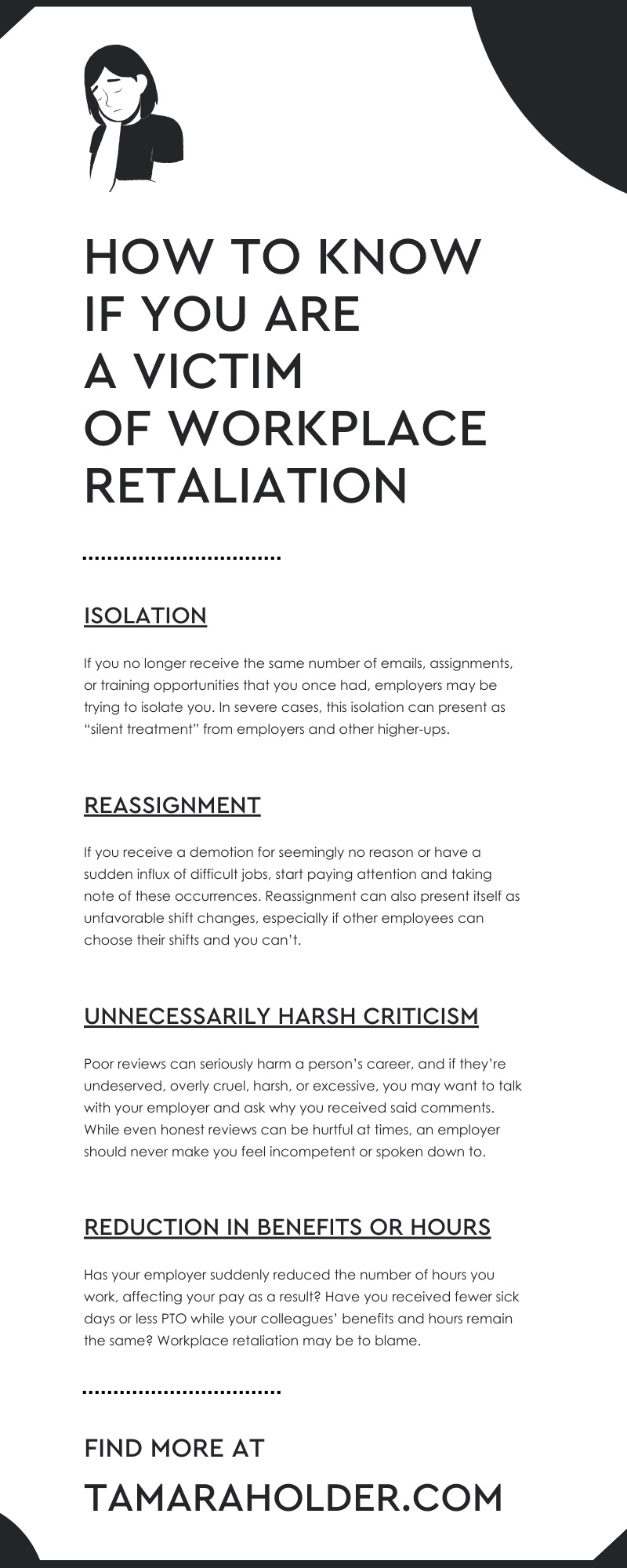
If you no longer receive the same number of emails, assignments, or training opportunities that you once had, employers may be trying to isolate you. In severe cases, this isolation can present as “silent treatment” from employers and other higher-ups. If an employer bad-mouths you to other colleagues, they may also ignore and or avoid you. Sometimes, retaliation isn’t just to punish you—it’s to make you hate the environment so much that you quit of your own volition.
If you receive a demotion for seemingly no reason or have a sudden influx of difficult jobs, start paying attention and taking note of these occurrences. Reassignment can also present itself as unfavorable shift changes, especially if other employees can choose their shifts and you can’t. Remember, it’s not uncommon for relating employers to make conditions unbearable for you to work in. They take steps to impact your performance and give them a “better reason” to fire you.
Poor reviews can seriously harm a person’s career, and if they’re undeserved, overly cruel, harsh, or excessive, you may want to talk with your employer and ask why you received said comments. While even honest reviews can be hurtful at times, an employer should never make you feel incompetent or spoken down to. Take a look at your productivity, timeliness, and professionalism, and ask yourself if your metrics are what changed. If your performance is still reasonable, yet you feel inundated with negative reviews, you may have a bigger issue on your hands.
Has your employer suddenly reduced the number of hours you work, affecting your pay as a result? Have you received fewer sick days or less PTO while your colleagues’ benefits and hours remain the same? Workplace retaliation may be to blame. This kind of retaliation can have serious effects on a person’s work-life balance and overall income, so be sure to ask other employees if they’re experiencing the same issues.
Employees who consistently produce quality work should have a chance for a promotion or raise. If you seemingly can’t get ahead despite doing well, if not better than others, take some time to speak with your employer. They may be able to provide you with a good reason and steps to help you get that promotion or raise you’ve been seeking. If they can’t give you a clear answer or refuse to assist, don’t let this go unnoticed or unchecked.
Often, the most egregious and glaring forms of workplace harassment happen when things go from petty behavior to outright bullying, physical harassment, or sexual harassment. Pranks, sexual requests or jokes, threats, violence, and insensitive jokes or comments are not appropriate in any professional space under any circumstances. It is an employer’s job to provide you with a safe workspace, and if they are the purveyor of this bullying or do nothing to stop it, it is in direct violation of their duty as an employer. Do not let them make you feel that your pain, discomfort, or fear is part of the job or simply “locker room talk.” It is always inappropriate, and you should treat it as such.
Now that you know how to tell if you’re a victim of workplace retaliation, you can better determine if that is the case in your situation. If so, what comes next? If you believe that your employer has unfairly punished you for engaging in protected acts, it’s time to contact a hostile workplace lawyer. Contact The Law Firm of Tamara N. Holder today so that we can provide you with the legal consult and representation you deserve.
Regardless of age, experience, or seniority, aging employees are vulnerable to age discrimination in the workplace. Despite this, older workers are an essential part of the workforce and deserve to have their employers value and respect them, just as any other employee. To help you understand your rights as an older employee, this article will review what rights protect aging employees in the workplace and what you need to know about ageism.
The Age Discrimination Act defines age discrimination as unfavorable or unwanted treatment or harassment of an employee based on age. This form of discrimination can take on many forms, and as employees age, it can directly relate to disability discrimination. This can take on the form of age-related comments or insults, isolation, and even denial of accommodations. Typically, employers use these acts to subtly force older workers out of their job without directly firing them and possibly receiving a discrimination suit.
Despite the illegality of ageism, it is important to note that a rare but existing exemption allows employers to discriminate to a certain degree. This is known as a bone fide occupational qualification, or BFOQ, stating that an employee must have specific attributes and qualities to do a job. Unfortunately, because age can often correlate to physical abilities, employers can deny hiring you or fire you if you cannot complete the activities required in your employment contract. To be precise, if a job requires you to have a certain level of vision, but you develop severe presbyopia, they are entitled to find someone who can do the job.
Furthermore, age is considered a protected class, and though at-will employment states have considerable power, they are not exempt from discrimination laws. The notion that you can get fired for any reason in these states without contest isn’t true.
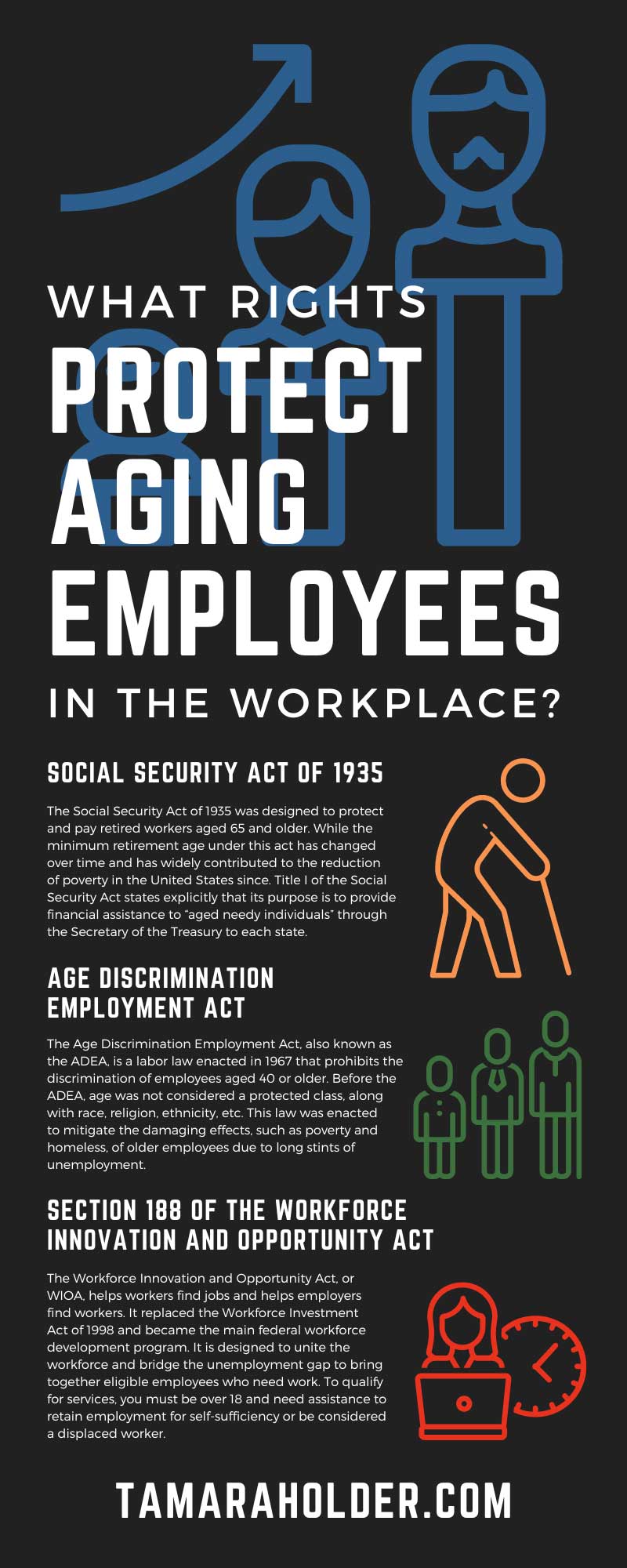
Likely, you are familiar with this act as many of its facets remain under contention. Still, it is one of the most pivotal acts, partially dedicated to aging workers, that has been passed into law in America. The Social Security Act of 1935 was designed to protect and pay retired workers aged 65 and older. While the minimum retirement age under this act has changed over time and has widely contributed to the reduction of poverty in the United States since. Title I of the Social Security Act states explicitly that its purpose is to provide financial assistance to “aged needy individuals” through the Secretary of the Treasury to each state. This act protects the futures of aging workers throughout America.
The Age Discrimination Employment Act, also known as the ADEA, is a labor law enacted in 1967 that prohibits the discrimination of employees aged 40 or older. Before the ADEA, age was not considered a protected class, along with race, religion, ethnicity, etc. This law was enacted to mitigate the damaging effects, such as poverty and homeless, of older employees due to long stints of unemployment.
The ADEA prohibits denying layoff, training, promotion, benefits, or refusing to hire, fire, or pay an employee on the basis of their age. This includes physical or verbal harassment, including derogatory terms or actions that make an employee feel unsafe. An employer’s job is to provide a safe work environment for their employees, and an active deviation from this is a serious legal issue.
Additionally, it is unlawful under this act for employers to force retirement upon an employee or for employers to enforce a mandatory retirement age. All attempts to force out an employee based on their age is illegal under Federal Law.
The Workforce Innovation and Opportunity Act, or WIOA, helps workers find jobs and helps employers find workers. It replaced the Workforce Investment Act of 1998 and became the main federal workforce development program. It is designed to unite the workforce and bridge the unemployment gap to bring together eligible employees who need work. To qualify for services, you must be over 18 and need assistance to retain employment for self-sufficiency or be considered a displaced worker. However, to mitigate instances of age discrimination in this program, Section 188 was implemented within the WIOA.
Section 188 subsection 1.2 states that individuals cannot be denied benefits based on sex, religion, color, or age. Additionally, this section is further supported by the Age Discrimination Act of 1975, which prohibits age discrimination in programs that receive federal funding.
This program and its supporting legal pillars help ensure that those of any age who are willing and able to work receive employment to better support themselves. While there are still strides to be made in terms of reducing the percentage of unemployed eligible workers, it continues to safeguard Americans across the country, giving them a better chance at a better quality of life.
If you feel you’ve been a victim of age discrimination in the workplace, it is essential to speak out about it. Your first step is to write down what you know, or the situation's who, what, when, where, and whys, so you have consistently clear details about the event. Your next step is to report the incident to your supervisor, manager, or member of HR. If the behavior does not improve, or you do not feel safe discussing these issues with higher management, you may need to take more severe measures. It is entirely within your right to file a complaint within 180 days of the incident with the EEOC and arm yourself with legal representation.
Ultimately, knowing what rights protect you as an aging employee in the workplace is a critical part of staying educated in order to protect yourself. Big-name companies like to take advantage of everyday workers that aren’t intimately familiar with the law, but the Law Firm of Tamara N Holder can help. We can put you in contact with an age-discrimination lawyer with the knowledge and experience to give you the legal representation you deserve.
Discrimination is legally defined as the unfavorable treatment of an employee on the basis of their traits, such as their sex, race, color, ethnicity, religion, disability, and more. While we should consider the moral implications of these abhorrent acts, we must also discuss their effects on a workplace’s environment. This article will review how discrimination affects the workplace to help others learn more about the damaging effects of bigotry in all forms.
When acts of discrimination occur in the workplace, it leads to an overall decline in morale due to fear, stress, depression, and anxiety. For employees, it can feel like a no-win situation that they can’t escape, especially when it isn’t possible to simply leave. Over time, resentment towards management will begin to build, forming an overall more negative environment and attitude that impacts everyone.
In a similar vein of morale loss, productivity will also take a nosedive. If an employee can’t focus on their job due to stress and fear, how can they effectively do their work? Employees are the lynchpin of a functioning business, and if their productivity declines, it will create a domino effect that can result in a negative impact on the overall standing of a company. When employees disengage, it erodes job satisfaction; if people don’t want to work for a business, that business will fail.
Demoralization will eventually lead to valued employees quitting if left unchecked and unfixed, which can create a ripple of resignations. This doesn’t just affect turnover rates, as applicants will catch wind of dissatisfaction, whether from online reviews, social media posts, or current employees warning candidates.
Not to mention that recruitment is a costly and lengthy process, not including the time and effort it takes to train a new employee. Overall, you will lose loyal, competent workers and have to spend more of the company’s resources finding, training, and retaining new ones. Discrimination affects the workplace in a way that creates an environment of negativity and fear.
Unfortunately, many discriminatory acts can lead to unfair dismissal, especially when the perpetrator is in management. If you or a loved one has experienced discrimination in the workplace or have been wrongfully terminated due to discrimination, The Law Firm of Tamara N. Holder can help. We specialize in discrimination cases and can put you in contact with one of our experienced unfair dismissal lawyers to help get you the representation and compensation you deserve.
Sex discrimination in the workplace is legally defined as the unfavorable, negative, or unwanted treatment of any employee based on their sex, sexual orientation, gender identity, or pregnancy status. To help you better understand this form of discrimination and how it can affect employees, this article will review the four types of sex discrimination in the workplace.
Sex is described as the physical and psychological differences between females and males, including primary and secondary sex characteristics such as chromosomes, genitals, height, and muscle mass. In general, it is how our current society categorizes one another at first glance, and assigned female at birth (AFAB) women are considered vulnerable to sexual discrimination in the workplace. They can be regarded as too weak, emotional, or unfit to lead and, at times, paid less than their male counterparts simply based on their sexual characteristics and the stereotypes that come with it.
Sexual orientation is an individual's desire to have romantic, physical, or emotional relationships with a particular gender or genders, such as homosexual, heterosexual, bisexual, and so forth. Like sex, sexual orientations also come with certain stereotypes that make a person more or less vulnerable to workplace discrimination. For example, heterosexuality is widely considered "normal" and most often will not be the subject of sexual orientation discrimination. Conversely, homosexual relationships are still considered to be the minority, and there are many harmful stereotypes associated with homosexual and other LGBTQIA+ relationships that make them the target of sexual orientation workplace discrimination.
If a cis-man is considered "effeminate" or a cis-woman is acting "too masculine," they may be pinned as homosexuals and thus the subject of discrimination by homophobic employees or employers. People of differing sexual orientations can be subject to hiring discrimination, losing out on promotions, pay discrimination, and even violence.
Gender identity is the gender with which a person identifies and can be different from their assigned sex at birth. There are many gender identities to which a person can relate, and these identities can change at any given time. Those not considered the "norm" or cis-passing may be subject to the same workplace discrimination as those of differing sexual orientations. Particularly, trans men and women across the globe are more subject to violence. In the workplace, a person who doesn't appear to fit in the boxes of cis-male or cis-female may be disproportionately rejected or punished, let go, harassed, and harshly reviewed by their employers.
Pregnancy status is one of the most common types of sex discrimination in the workplace. Often, employers don't want to give time off to pregnant or looking to become pregnant workers. This often leads back to sex discrimination, as cis-females are often the most likely to be subject to pregnancy status discrimination. To an employer, a non-pregnant person who can do more work can easily replace a pregnant person.
If you feel like you've been a victim of sex discrimination in the workplace, contact The Law Firm of Tamara N Holder. Here, we can provide you with a knowledgeable and experienced gender discrimination lawyer and the legal representation you deserve.
Sexual orientation discrimination in the workplace is legally defined as negative, unwanted, or differential treatment of an employee based on their sexual orientation. Despite this singular definition, sexual orientation discrimination can look very different depending on the action and the aggressor. To help you better identify this form of discrimination and understand the rights of LGBTQIA workers in America, this article will review the different types of workplace sexual orientation discrimination.
On June 15, 2020, the Supreme Court ruled in a 6-3 decision that Title VII prohibits discrimination on the basis of sexual orientation or gender identity. These forms of discrimination became illegal by making them part of the protected classes that fall under this Title. Additionally, because federal law generally takes precedence over state law, even employers in at-will employment states can get taken to court for discrimination. It is also illegal to discriminate against an employee whom an employer perceives to be of a particular sexual orientation. For example, if an employer fires an employee for being gay, but the employee turns out to be heterosexual, that is still illegal.
The only time discrimination is “allowed” is if an employer determines an employee lacks a bone fide occupational qualification or quality necessary to do the job. However, this is only allowed in very narrow circumstances and is mainly used in cases where an applicant or employee is extremely disabled. Even then, it can be hard to prove and even more difficult to prove in cases where sexual orientation is the quality in question. Ultimately, you shouldn’t let a BFQ argument go unchallenged, as a flimsy claim will quickly fall apart under questioning.
Workplace sexual orientation discrimination can occur during the hiring process, either in the interview portion, job description, or application process. It is illegal for an employer to ask you to identify your sexual orientation or any questions surrounding your sexual orientation. These questions can take the form of overtly inquiring, asking about your marital status, or even asking if you plan to get married. Discriminatory employers may drop hints about their preference for whom they’d like to work for them or how they feel about the LGBTQIA community. While singular, isolated cases are harder to prove, you shouldn’t assume that these cases are solitary, as behaviors such as these are almost always repeated and should get reported.
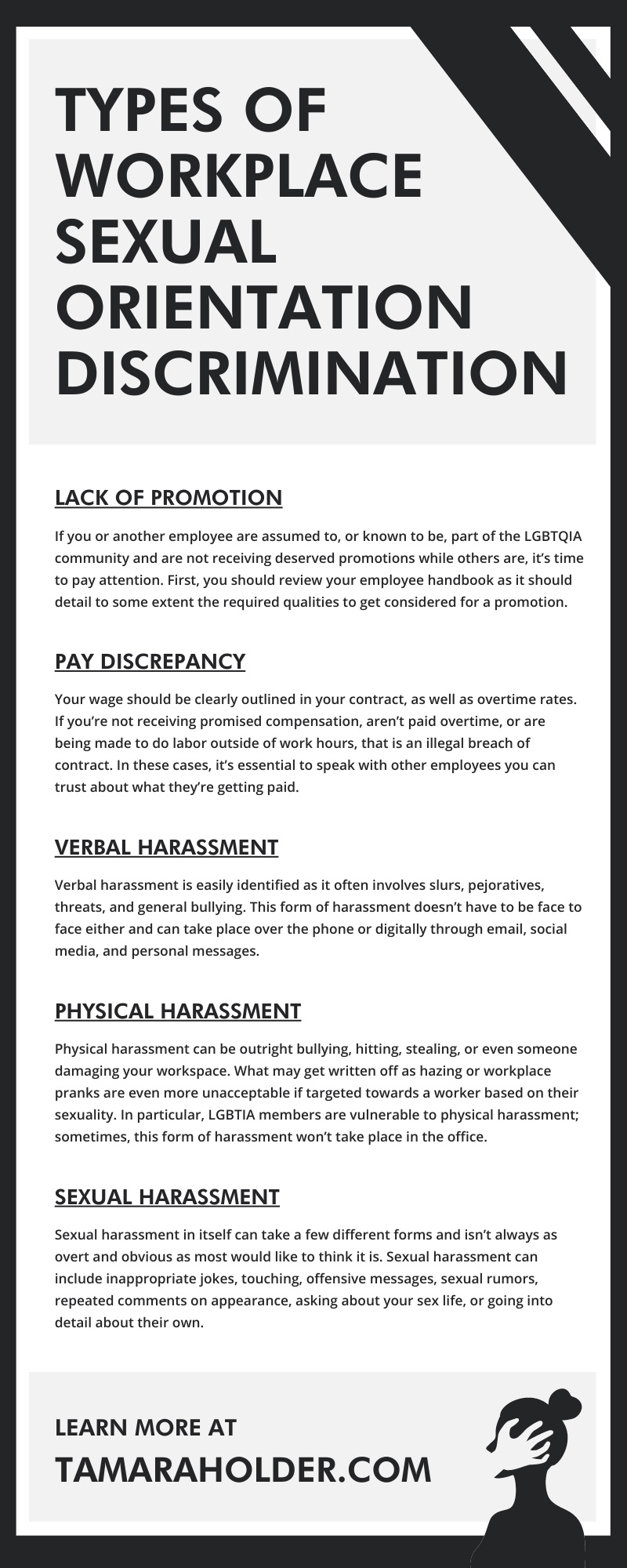
If you or another employee are assumed to, or known to be, part of the LGBTQIA community and are not receiving deserved promotions while others are, it’s time to pay attention. First, you should review your employee handbook as it should detail to some extent the required qualities to get considered for a promotion. If you can’t find the information you’re looking for, talk to a supervisor, manager, or HR personnel who can point you in the right direction. If you meet the qualifications but are consistently passed over for promotion, this may be a cause of sexual orientation discrimination, and it’s worth consulting a lawyer.
Your wage should be clearly outlined in your contract, as well as overtime rates. If you’re not receiving promised compensation, aren’t paid overtime, or are being made to do labor outside of work hours, that is an illegal breach of contract. In these cases, it’s essential to speak with other employees you can trust about what they’re getting paid. It’s best to talk with those with the same job title, similar duties, experience, and length of employment to get a better picture of the situation. If other workers receive fair pay for their labor, and an employee of differing sexual orientation is not, this is blatant sexual orientation discrimination.
Verbal harassment is easily identified as it often involves slurs, pejoratives, threats, and general bullying. This form of harassment doesn’t have to be face to face either and can take place over the phone or digitally through email, social media, and personal messages. Most often, this type of harassment isn’t done overtly but gets acted out more insidiously in the form of “jokes” or “workplace banter.” Even if the aggressor claims they didn’t know they were being offensive, you should still report it, lest they continue their bad behavior and harass another person. Generally, if it makes you feel uncomfortable or unsafe, speak to someone.
Physical harassment can be outright bullying, hitting, stealing, or even someone damaging your workspace. What may get written off as hazing or workplace pranks are even more unacceptable if targeted towards a worker based on their sexuality. In particular, LGBTIA members are vulnerable to physical harassment; sometimes, this form of harassment won’t take place in the office. Aggressors often believe that if they take their bullying “off school grounds,” they can’t get in trouble for it, but this isn’t the case. If someone you work with harasses you in any way, in or out of work, contact your place of employment and the police, especially if you feel unsafe.
Sexual harassment in itself can take a few different forms and isn’t always as overt and obvious as most would like to think it is. Sexual harassment can include inappropriate jokes, touching, offensive messages, sexual rumors, repeated comments on appearance, asking about your sex life, or going into detail about their own. Quid pro quo sexual harassment is another issue that LGBTQIA members are vulnerable to and is defined as seeking sexual favors in return for job benefits. The aggressor may offer raises or promotions or threaten you with demotion or poor performance reviews to get you fired.
Ultimately, all forms and types of workplace sexual orientation discrimination are illegal, regardless of where you live or if you’re located in an at-will employment state. However, if you’re struggling to determine if what you’ve experienced counts as discrimination, need help forming a case, or desire legal counsel, the Law Firm of Tamara N Holder can help. Our firm is dedicated to providing knowledgeable and experienced discrimination lawyers for gay, lesbian, and bisexual people or any other members of the LGBTQIA community.
Racial discrimination in the workplace is any unfavorable treatment of an employee or applicant based on their race, ethnic origin, or skin color. If you believe you've been a victim of racial discrimination or have witnessed racial discrimination occur, it is in your and everyone else's best interest to report it. But that in itself is a scary prospect, especially if a supervisor or someone in a higher position in the company than you committed the discriminatory act. To help take some of the fear out of filing a complaint, here are a few effective ways to report racial discrimination at work.
First and foremost, if you are currently in a discriminatory situation, make sure you are in a safe place where you can sit down and record the events in as much detail as possible. Remember to record the who, what, when, where, and why of what happened if you can.
Often, the most effective way to report racial discrimination is to speak directly to management. You can talk to your supervisor or speak with Human Resources. A supervisor can take the appropriate steps and speak to HR for you, but you'll want to go directly to Human Resources if the aggressor is a supervisor. Ideally, you'll do this as soon as possible so the right people can take quick and accurate action. The details you recorded will also aid the subsequent investigation process.
If, for some reason, you are too afraid or are uncomfortable speaking with management directly, you can write a letter using the details you recorded. You can write this letter yourself, and many online templates can assist you in putting together this letter. You can send this letter to your supervisor or human resources, but there are likely mechanisms in place for you to file a complaint anonymously. There's also no shame in placing the letter directly on the director's desk, but that does run the risk of unwanted eyes seeing you or the letter.
If management does nothing after you’ve followed these reporting methods, or you are uncomfortable working with anyone in a management position, a race discrimination lawyer can help. Speaking with a lawyer doesn't necessarily mean you have to take legal action. A lawyer can help you decide the next best steps if no other methods are working or can even help file a complaint for you. However, if management takes no action to investigate and remedy the situation, this is a systemic issue, and your lawyer may advise you to file a complaint with the Equal Employment Opportunity Commission (EEOC). Fortunately, they can help guide you through this complaint process, represent you, and give tips on how to best protect yourself.
Many employees believe they are not getting paid fairly for their work and are being paid below their market value by their employers. As an employee, discussing your wage with your employer is within your legal right, but doing so can feel intimidating. If you believe you deserve a raise or aren’t getting paid fairly, here are a few tips for discussing your pay with your employer.
First and foremost, you need to do your homework before you talk to your employer about your pay. Gather pay data for someone in your area with your level of experience in comparison to similar companies– don’t just review the average salary. It’s also wise to look at your employee handbook and determine the company’s raise policy. For example, if they give out raises once a year, they may not be willing to give you another one, or they may list steps to take for you to request a raise.
No matter how close your relationship is with your boss, only ask for a raise in a professional appointment. The last thing you want to do is blindside your employer, and setting up an appointment lets them know exactly what you’re there to talk about. Conversely, you don’t have to set up an appointment specifically to discuss your raise. You can meet with your employer to discuss your job performance and send a written request for a raise afterward.
Whether you decide to discuss your wage in person or not, you want to prepare carefully. It’s a good idea to list your achievements and other compelling reasons why you believe you deserve a raise. You don’t have to gloat, but now is the time for you to show your commitment, drive, and how valuable you are to the company. If you’re going to have a meeting in person, it’s also a good idea to rehearse what you’re going to say and ask so you can stay steadfast and confident. Staying assured of yourself is vital; you can think of it as marketing yourself to your employer.
A few outcomes can occur: your boss can say yes, no, or give you a noncommittal answer. If your boss says no, don’t lash out; continue to stay positive. Instead, ask what you can do to qualify for a raise in the future, and ask when they would feel comfortable speaking again. If they give you a noncommittal answer, wait a few months before confidently asking again.
Hopefully, these tips for discussing your wage with your employer will help you feel a little more confident in getting the pay you deserve. However, if you feel like you aren’t getting paid fairly and your employer is consistently dodging your request for a well-earned raise, you may have a legal issue on your hands. In some cases, you may get discriminated against or purposefully underpaid. In those cases, you need an equal-pay lawyer to help you look into your specific situation and determine whether you need to take legal action.
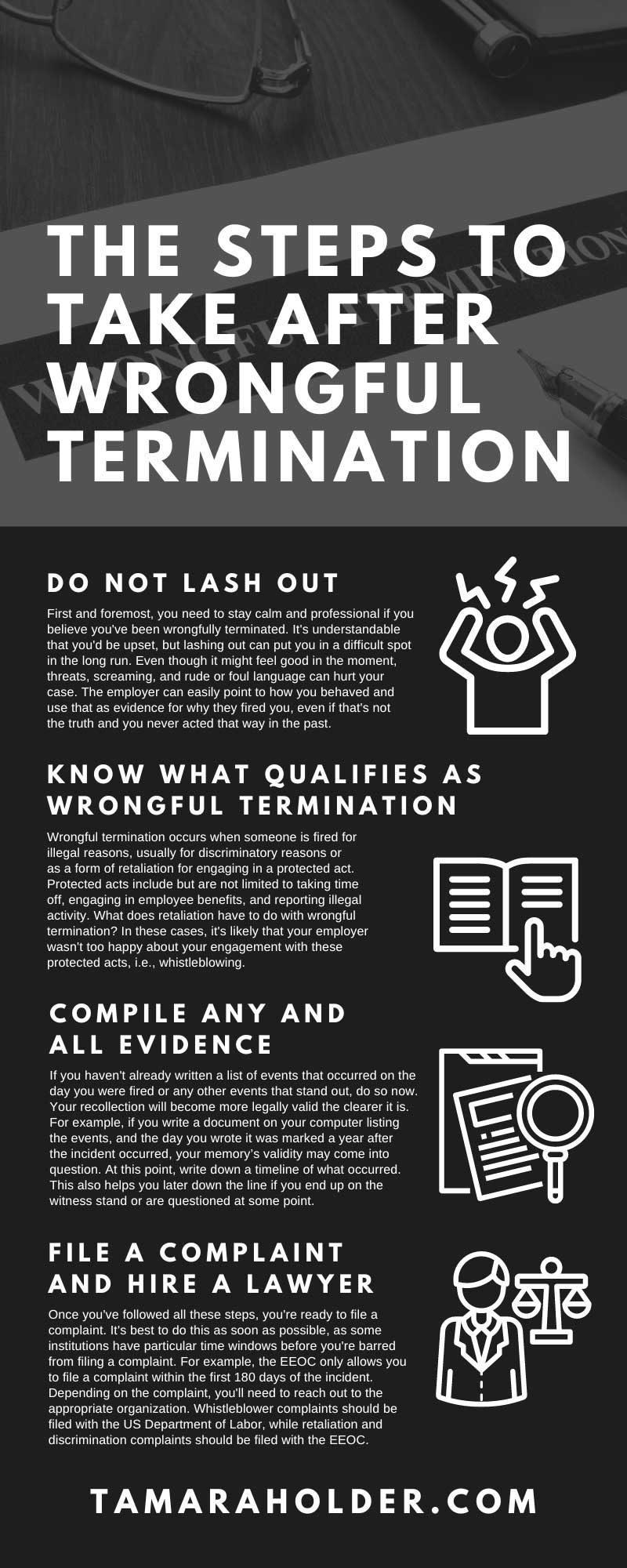
Getting terminated from your job can put a massive amount of stress on you, both emotionally and financially. Being wrongfully terminated from your job can be even more stressful. Wrongful termination is the illegal dismissal of an employee, and even if you live in an at-will state, you may have a case. If you believe you've been unfairly dismissed, here are thesteps to take after a wrongful termination.
First and foremost, you need to stay calm and professional if you believe you've been wrongfully terminated. It's understandable that you'd be upset, but lashing out can put you in a difficult spot in the long run. Even though it might feel good in the moment, threats, screaming, and rude or foul language can hurt your case. The employer can easily point to how you behaved and use that as evidence for why they fired you, even if that's not the truth and you never acted that way in the past.
Not only can lashing out put your case at risk, but acts of revenge can easily land you in a civil or criminal lawsuit, depending on the severity of the retaliation. Keep in mind that—at this point—nothing you say or do will likely change your former employer’s mind, and being rehired by the people you feel wronged by can make things even more complex. By staying calm, you'll have a much clearer mind later on when you have to recall the events, which we'll discuss later in this article.
As mentioned previously, wrongful termination occurs when someone is fired for illegal reasons, usually for discriminatory reasons or as a form of retaliation for engaging in a protected act. Protected acts include but are not limited to taking time off, engaging in employee benefits, and reporting illegal activity. What does retaliation have to do with wrongful termination? In these cases, it's likely that your employer wasn't too happy about your engagement with these protected acts, i.e., whistleblowing.
However, there is another side to this coin. You must genuinely ask yourself whether you were wrongfully terminated or whether there's a possibility you were clouded by the emotions of being fired. Is there was a breach of contract you were unaware of? Did you consistently meet the expectations of your job? Was there some form of falling out, dispute, or issue you were responsible for?
In these cases, it's best to thoroughly review your employee contract, especially if you didn't receive an answer as to why you were fired. If you haven't, you can request in writing the reason why you were fired, as some employers won't inform you until you ask. You should also look over your employer's hiring, firing, and disciplinary rules, not only to see if you've accidentally breached the rules but also to ensure they haven't as well.
If you haven't already written a list of events that occurred on the day you were fired or any other events that stand out, do so now. Your recollection will become more legally valid the clearer it is. For example, if you write a document on your computer listing the events, and the day you wrote it was marked a year after the incident occurred, your memory’s validity may come into question. At this point, write down a timeline of what occurred. This also helps you later down the line if you end up on the witness stand or are questioned at some point.
Once you've done this, it's time to start gathering as much relevant evidence as you can. Any physical or digital correspondence, reviews, contracts, or witness statements should be kept in a private file close to your person. Ultimately, your goal is to prove one of two things depending on your claim—a pattern of behavior or temporal proximity. While these aren't the only ways to prove your case, they're the most common and have the strongest standing ground.
Finding evidence of a pattern of behavior, such as aggression, discrimination, or unprofessionalism, can prove there is a larger issue at hand that goes beyond just you. If you believe you were fired in retaliation for engaging in a protected activity, then you would need to prove temporal proximity. This would be the time between the protected act and the day of termination.
For example, suppose you report a supervisor for sexual harassment to HR and get fired by your employer a week later. In that case, that is proof of temporal proximity and correlation of events.
Once you've followed all these steps, you're ready to file a complaint. It's best to do this as soon as possible, as some institutions have particular time windows before you're barred from filing a complaint. For example, the EEOC only allows you to file a complaint within the first 180 days of the incident. Depending on the complaint, you'll need to reach out to the appropriate organization. Whistleblower complaints should be filed with the US Department of Labor, while retaliation and discrimination complaints should be filed with the EEOC.
Employment law is incredibly complex, and without the proper knowledge and assistance, you may miss out on compensation or lose a case you should've won. Employment organizations can also help you determine whether your case holds water and prevent you from wasting unnecessary time and money. For example, investigations done by the EEOC can take more than a year, only for it to result in a right-to-sue notice.
This means they found no evidence of illegal activity, but you have the right to sue within the next 90 days. Not only can that feel like a massive waste of time and energy, but at that point, most lawyers won't take a case with only 90 days to prepare. They can also walk you through filing a complaint and sending it to the right organization. The EEOC and other organization agents don't represent you and don't have your best interest in mind, but an attorney does.
Remember that employment law is complex, and you shouldn't have to navigate it all on your own. Knowing the steps you need to take after wrongful termination and hiring a wrongful termination lawyer can help you reclaim your power and get you the compensation you deserve.