Governor Ron DeSantis continues to utilize children to advance his anti-LGBTQ agenda. 
In its latest effort to sanitize sexuality, the DeSantis administration has now entered a private place of business, threatening to revoke the liquor license of the Hyatt Regency Miami, following the “Drag Queen Christmas” event that was held at the hotel-affiliated James L. Knight Auditorium in December. The admission policy allowed children under the age of 18 to attend the show with an adult.
The DeSantis administration does not take aim directly at the drag queens but instead claims that, because children were exposed to the drag show (despite a warning from the state), the hotel’s premises should lose its liquor license.
The Florida Department of Business and Professional Regulation accuses the venue of several violations, including a prohibition of "lascivious exhibition" to people under the age of 16. “The nature of the show’s performances, particularly when conducted in the presence of young children, corrupts the public morals and outrages the sense of public decency.”
“Exposing children to sexually explicit activity” violates the Department's licensing standards for operating a business and holding a liquor license,” claims a DeSantis official.
Last year, Governor DeSantis signed the “Parental Rights in Education” bill, commonly referred to as the "Don't Say Gay" law, which prohibits public school teachers in Florida from holding classroom instruction about sexual orientation or gender identity.
This is a different kind of war DeSantis has started. It is now clear that DeSantis does not want to protect kids from topics in a public education setting. It is now clear that DeSantis is using kids as a tool to root out a community that contributes to the economy and creates the flair that makes Miami great.
In 1992, the Miami Herald published a collection of stories, “A Gay Renaissance,” highlighting how the influx of gay people to Miami restored dilapidated Art Deco buildings, opened businesses, opened a local chamber of commerce, and built political clout. In 1994, Miami became the first city in Miami-Dade County to ban discrimination based on gender identity. “We are here to live in peace. We are citizens just like everyone else. We are lawyers and doctors and judges. And the fellow who delivers the newspaper, and the ones who are waiting on you, and who are washing your dishes,” said Michael Aller, of the Miami Beach Chamber of Commerce.
If the DeSantis administration is genuinely concerned about the welfare of children, it would prohibit them from being permitted to enter establishments like Tilted Kilt and Twin Peaks Restaurants, which have locations across the state, where young waitresses are hyper-sexualized, and required to don lingerie while serving liquor to patrons who bring children along.
DeSantis is attempting to set a dangerous precedent which could lead to the administration threatening to close movie theaters where adults to bring their children to movies with sexualized scenes. Or restrictions on concerts like Lady Gaga, Madonna and Beyonce. Now is the time for Floridians to stand up to this witch hunt against the LGBTQ community disguised as an effort to protect the children.
Tamara Holder is a nationally recognized civil rights attorney. She built a pro bono legal clinic at Rainbow Push Coalition under Rev. Jesse L. Jackson, Sr, and was a progressive legal analyst on Fox News Channel for nearly a decade.
Wrongful termination and unfair termination are terms that often get used interchangeably, but, legally speaking, they are two very different things. If the situation surrounding your dismissal is cloudy, the reasons seem vague, or something doesn’t feel right, knowing your rights is essential, even if you work in an at-will state. To help shed some light on these complex employment laws and what you’re entitled to as an employee, let’s review the differences between unfair and wrongful termination.
Dismissal and termination have the same definition and simply mean the firing or removal of an employee. Essentially, unfair dismissal is the unfair termination of an employee and typically occurs if the termination gets deemed harsh or unreasonable. For example, if someone gets fired because the employer thinks they stole from the cash register without evidence, the court would consider it an unreasonable and unfair dismissal. However, if the dismissal gets conducted in small businesses, there are different regulations regarding termination, and it must be consistent with the Small Business Fair Dismissal Code.
Wrongful termination occurs when an employee gets fired for unlawful reasons that either violate their contract, discrimination laws, employment laws, violate public policy, or is done in retaliation. One example of wrongful termination could be if an employee got fired because of their race or religion, as this would violate anti-discrimination laws. Alternatively, if an employee gets fired at the end of their shift, but their contract states the employer must give them two weeks’ notice before dismissal, the law considers it wrongful termination.
The difference between unfair vs. wrongful termination lies in why an employee got terminated. Additionally, the consequences of terminating someone based on a protected characteristic, such as race or religion, differ significantly from firing someone because the employer simply doesn’t like them. Violating federal employment, labor, and anti-discrimination laws can put an employer in jail. In contrast, an employer may need to reinstate or compensate an employee if they’re found guilty of unfair dismissal.
In an at-will employment state, an employee can get fired for almost any reason unless otherwise stated in the employment contract. Due to this policy, it is essentially legal for at-will employers to unfairly dismiss an employee. For example, if an employer fires you for showing up to work wearing a T-shirt of a sports team they hate, they can fire you; it’s unfair but not considered illegal. However, at-will employers cannot fire anyone for virtually any reason. If you’re fired in a way that violates wrongful termination laws, your employer can get held accountable.
Contact The Law Firm of Tamara N Holder today if you believe you've been wrongfully terminated. We’ll put you in contact with one of our wrongful termination lawyers so you can get the legal representation and compensation you deserve.
During a consultation with an attorney, you can get a good sense of how they feel about the odds of success, how they’ll handle your case, and if they’re a good fit for you. To help you find the best legal representation for your case, let’s review the five most important questions you must ask your employment attorney before hiring them.
Many law firms don’t just engage in one area of law, so it’s very common to find a practice that simultaneously engages in employment, business, or family law. This doesn’t mean the attorney doesn’t have experience in employment law, but there is a chance they have less experience than an attorney in a firm that exclusively practices employment law. You can get a feel of their experience and exposure to employment law cases if you ask them how much of their practice they dedicate to employment law. Remember that the more complex your case is, the more experienced you want them to be.
Most law firms tend to focus on representing employees as it’s easier, and more likely, for an employer to have the money to find quality legal representation. However, this isn’t always the case–defenses and arguments vary widely depending on whether their client is an employer or an employee. You’ll want an attorney that’s competent in representing people like you.
There are no guarantees in law. However, some scenarios are more likely to occur in employment law cases. A knowledgeable and experienced employment attorney should be able to give you an idea of how your case may play out. Some standard employment law results include the following:
Attorney fees can vary depending on the practice. Some attorneys only charge a contingency fee, which means you don’t have to pay anything unless you win your case. Others might charge an hourly wage or a monthly retainer fee. None of these charging methods is wrong or better than the other; it simply depends on what they charge and what you can afford. However, it is arguably one of the most important questions you should ask an employment attorney–if you can’t pay, they can’t represent you.
Every employment case is unique and different from the other, and there are many different areas of employment law. While an employment attorney should be competent in all of them, that doesn’t mean they’ve handled every type of employment law case. The more cases they’ve taken that are similar to yours, the more equipped they are to handle it. Additionally, there is no shame in asking an attorney what their success rates are with cases like yours and cases they’ve taken in general.
If you believe you’ve been a victim of harassment, abuse, or discrimination in the workplace, contact the Law Firm of Tamara N Holder today. We can put you in touch with a workplace discrimination lawyer and get you the representation you deserve.
Sexual harassment is an umbrella term that categorizes the entirety of sex-based crimes. In particular, sexual harassment refers to unwanted verbal assault or actions of a sexual nature.
Sexual assault and sexual abuse fall under the umbrella term of sexual harassment, but sexual assault refers to physical acts, such as molestation, whereas sexual abuse typically refers to sex crimes against children. However, the psychology behind why some children don’t report sexual harassment is very different from that of adults. Therefore, this article on why some people don’t report sexual harassment will focus on acts that fall under sexual harassment and sexual assault.
We know that sex-based crimes are incredibly underreported, but why?
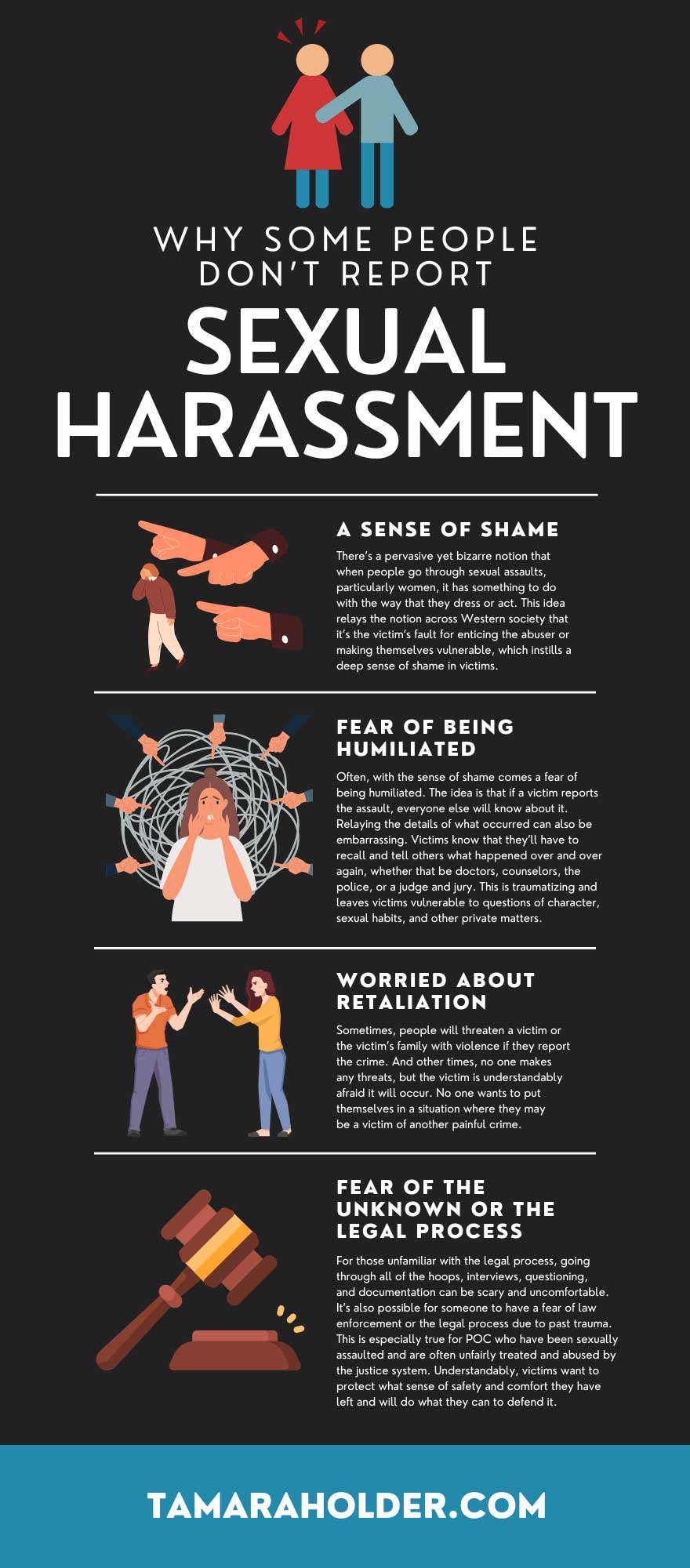
There’s a pervasive yet bizarre notion that when people go through sexual assaults, particularly women, it has something to do with the way that they dress or act. This idea relays the notion across Western society that it’s the victim’s fault for enticing the abuser or making themselves vulnerable, which instills a deep sense of shame in victims.
For men, it’s a feeling that they weren’t strong enough or masculine enough to prevent the situation or the notion that things like this don’t happen to boys. None of these ideas are true, but when you have these beliefs instilled in you, the act of being assaulted, let alone reporting it, feels deeply shameful.
Often, with the sense of shame comes a fear of being humiliated. The idea is that if a victim reports the assault, everyone else will know about it. Relaying the details of what occurred can also be embarrassing. Victims know that they’ll have to recall and tell others what happened over and over again, whether that be doctors, counselors, the police, or a judge and jury. This is traumatizing and leaves victims vulnerable to questions of character, sexual habits, and other private matters.
Fear of retaliation or revenge often arises when sexual harassment occurs in the workplace, but this isn’t always the case. It’s true that many workplace victims are afraid of losing their job or being demoted if they report the incident. However, there’s also a fear of physical retaliation that goes beyond the workplace.
Sometimes, people will threaten a victim or the victim’s family with violence if they report the crime. And other times, no one makes any threats, but the victim is understandably afraid it will occur. No one wants to put themselves in a situation where they may be a victim of another painful crime.
It’s an upsetting and horrifying statistic, but those who have gone through a sexual assault will go through more throughout their lifetime, either by the same abuser or different abusers. It’s likely that these people have reported an incident in the past, but nothing ever occurred. This may sound like something that doesn’t often occur, but it’s easy and common for an officer or a counselor to not grasp the situation or fall into social biases and blame the victim. If they’ve reported a sex-based crime before and didn’t receive justice, a victim can feel hopeless and see no point in reporting.
Sexual harassment often causes post-traumatic stress disorder. One of the ways that the brain copes with severe stress or stressful situations is to deny the reality of the incident or minimize what occurred. They can convince themselves that what happened “wasn’t that big of a deal” because they weren’t hurt or the crime “wasn’t that serious.” In truth, every case of sexual harassment is serious.
On the other hand, some may deny that the incident occurred to protect themselves, and, on occasion, the brain can almost completely wipe the memory to protect the body.
While this may sound strange, it’s common for victims to be afraid that their abuser will get in trouble. Another alarming statistic that contributes to this is that most often, the victims know their abuser, and it’s less common for a stranger to sexually assault someone. They could be a friend, family member, partner, or any other person that they care about that they don’t want to see go to jail. Sometimes, even more horrifyingly, other family members know the assault occurred and don’t want the abuser to go to jail and will try to threaten or convince the victim not to report the assault.
For those unfamiliar with the legal process, going through all of the hoops, interviews, questioning, and documentation can be scary and uncomfortable. It’s also possible for someone to have a fear of law enforcement or the legal process due to past trauma. This is especially true for POC who have been sexually assaulted and are often unfairly treated and abused by the justice system. Understandably, victims want to protect what sense of safety and comfort they have left and will do what they can to defend it.
Many sex-based crimes have a set statute of limitations. While there’s great debate over whether these statutes should exist, the fact of the matter is that they do. Victims need time to process, sometimes longer than the statute of limitations allows, and when this occurs, victims will resign themselves to keeping the incident a secret for the rest of their lives.
Even if the statute of limitations has passed, you should report the incident to the police. It’s highly likely that an abuser will abuse again or commit another crime. When you report the incident, police have to file and keep it. Then, they can use it to verify the story of possible future victims or catch the abuser on an entirely different charge.
Now that we understand a little bit more about why some people don’t report sexual harassment, what can we do about this alarming trend? The answer is complicated, as it involves a lot of social and legal reform. What we do know is that it starts with holding abusers accountable.
There are 463,000 rape victims each year, and 90 percent of those cases are women. Holding abusers accountable directly correlates to protecting the women of America. That’s why women’s rights lawyer Tamara N Holder uses her expertise to help end this cycle of abuse.
Illegal termination, otherwise known as wrongful termination, occurs when an employee is fired or let go for reasons that violate anti-discrimination laws or if said reasons breach an employment contract. If you’re unsure what this looks like or if you’ve been a victim of it, let’s look at five examples of illegal termination that employees should know about.
Age, gender, sexual orientation, pregnancy status, disability, race, ethnicity, and religion are all protected characteristics under anti-discrimination laws. This means that an employer cannot treat you unfavorably due to a protected characteristic, including termination, as it would be considered illegal discrimination.
For example, an employer cannot fire an elderly employee simply because they have biased or discriminatory beliefs about the elderly, as it directly violates anti-discrimination laws. In fact, this particular form of discrimination occurs so often that there are age discrimination attorneys specifically for this reason.
As an employee, you have particular rights that allow you to engage in certain activities, known as protected acts, but an employer may not be so keen on your participation. Protected acts can include taking entitled sick leave or vacation time, filing a worker’s compensation claim, or asking for disability accommodations. Say an employer really needs you on a specific day, but you were approved for vacation time well beforehand and take the day off. When you come back, your employer fires you for not being there—they would be firing you for engaging in a protected act.
Whistleblowing involves reporting illicit activities that may be occurring in the workplace. While this is also technically a protected act, it is one of the most common examples of illegal termination. You have a legal right to report crimes or violations that occur in the workplace, especially if you’re asked or encouraged to participate in them. Say, for example, you file a report about your employer engaging in unsafe workspace practices—that employer cannot legally fire you for doing so to protect themselves.
If your employer fires you for doing something that is required of you in your contract or doesn’t follow the right termination procedures, this is considered illegal termination. For example, if it states in your contract that the termination policy requires a verbal and written warning beforehand, and you receive one or neither, that qualifies as a breach of contract. As a result of this breach, you have technically been terminated illegally.
Constructive dismissal, or constructive termination, occurs when an employer makes it impossible for an employee to conduct their responsibilities. Essentially, they will attempt to make the workplace intolerable, and if you can’t do your job, they believe they technically have the grounds to fire you. But this is not the case. For instance, if an employer suddenly changes the location of your employment without sufficient notice and fires you for not being able to attend, or you quit as a response, this is constructive dismissal.
Employees have rights, and even at-will states can’t illegally terminate you. If you believe that you’ve been a victim of wrongful termination, contact the Law Firm of Tamara N Holder today to get the legal representation you deserve.
Wage violations, wage and hour violations, or wage theft are all terms that generally refer to the same thing: an employer not properly paying an employee. Most wage violations occur due to ignorance of the law, not malice. While that isn’t an excuse, it’s certainly fixable.
If you’re an employee that wants to know more about their rights or an employer who doesn’t want to get caught in a sticky legal situation, this article is for you. Let’s take a close look at the most common types of wage violations in the workplace, so you can either identify or avoid them.
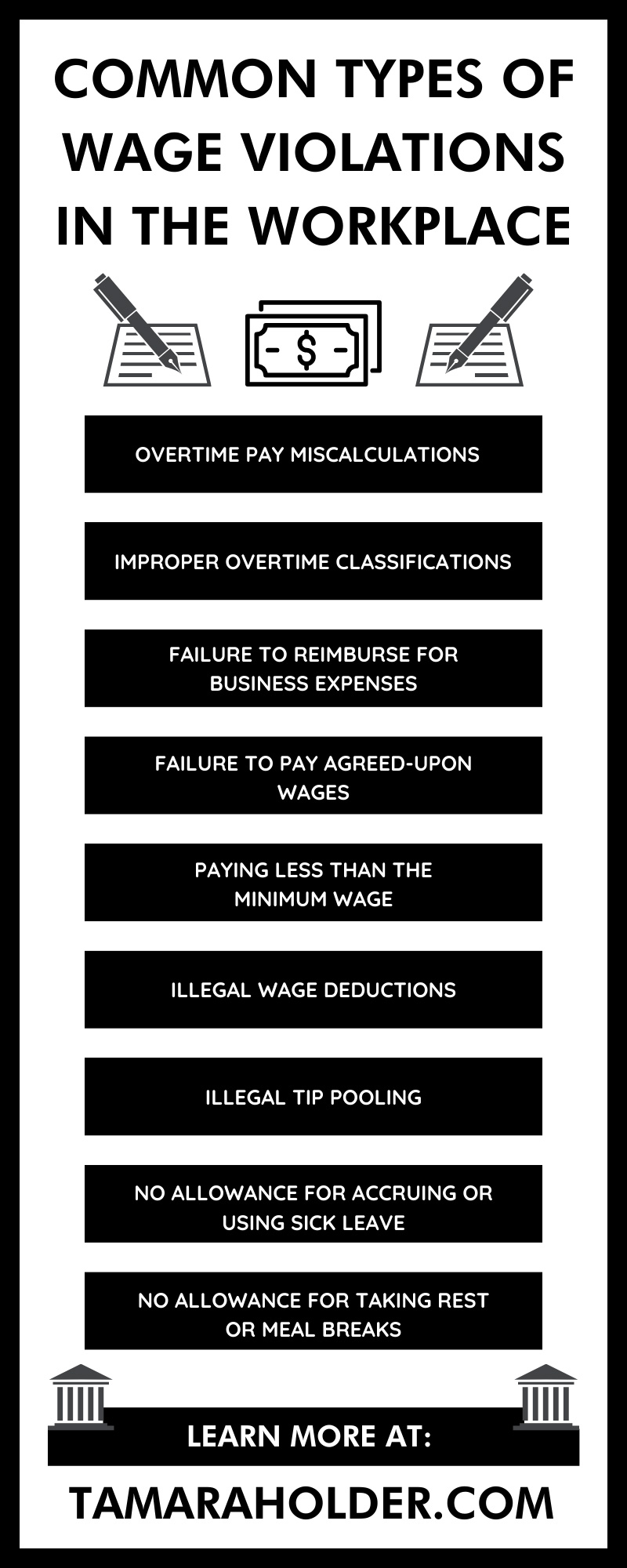
When an employee makes different pay for different tasks, overtime miscalculations can occur. While state laws vary, an employee should receive 1.5 times the amount of their hourly wage for exceeding 8 hours and 2 times their hourly wage for exceeding 12 hours.
Additionally, employers cannot average the hours worked during the pay period to calculate overtime pay. Say a person who typically works 40 hours a week has to work overtime. If said employee works 60 hours the first week of a pay period and 20 hours the second week, it averages to 40 hours per week during the pay period. Some employers make the mistake of thinking this doesn’t count as overtime, but it does. The overtime system works on a week-by-week basis.
Certain employees are exempt from overtime pay due to their classifications. These exemptions are where things can get a little tricky for employers, as there is some obscurity concerning salaried employees.
Many employees and employers alike assume that all salaried employees are exempt from overtime pay, but that isn’t always true. It’s important to look into the pay standards and regulations for all employee classifications if employers want to avoid unpaid overtime claims.
For many employees, it is up to them to get what they need for their job. The resulting expenses are business expenses. Business expenses can include travel costs, tools, supplies, and continued education or training. Under the Fair Labor Standards Act (FLSA), employers don’t have to pay their employees reimbursement for business expenses.
However, if the business expenses incurred cause the employee’s earnings to dip below minimum wage, then, under federal law, the employer must reimburse the employee for these work-related expenses. Regardless, it is wise for employers to have a clearly defined reimbursement policy and an accessible system for employees to request reimbursement for business expenses.
If an employer fails to pay an employee any agreed-upon wages—such as regular wages, overtime, or commissions—it would be considered wage theft. It is an employee’s right to receive pay for their labor. Therefore, in most cases, paycheck deferments are illegal, even if an employee agrees to them.
While some situations may be accidental, it should be a cause for concern if your employer consistently “forgets” to pay you or has issues with check bouncing. Even if an employee quits or is terminated, it is their right to receive earned wages and payment for unused vacation days.
The minimum wage varies from state to state, and it is up to the employer to pay that minimum hourly wage. If an employee is eligible for tips, an employer can pay less than this standard. However, this is only the case if the tips add up to minimum wage once factored in.
If for any reason, an employee does not receive the minimum wage and the correct payment for the hours they worked, the employee is entitled to damages. This includes wages lost, attorney fees, and other punitive damages if the case is severe enough.
There are very few situations in which an employer can legally deduct from an employee’s wages. An employer cannot take gratuity or business expenses out of any employee’s wages. Additionally, if an employer lends an employee money outside of work, they cannot deduct the money owed from the employee’s wages.
Employees should keep in mind that a smaller paycheck doesn’t always mean their employer is stealing from them. Legally, an employer can deduct or withhold pay for retirement, insurance policies, social security, Medicare, state income, and federal income taxes.
There are specific laws that also vary from state to state regarding tip-pooling policies. For example, in Massachusetts, Florida, and California, tip pooling is allowed, but only among serving staff and not with management or owners. However, in other states, it’s illegal for employers to mandate tip pooling. If employees want to pool tips, it’s something they must agree to without the influence of their employer.
Laws surrounding paid sick leave vary from state to state, but there is currently no federal law that requires private employers to give paid sick leave. However, employees have coverage under the Family and Medical Leave Act, and more states are protecting their employees from going to work ill.
What this means is that employees can take unpaid time off and return to their positions without punishment. This also means that in states where paid sick leave is mandatory, such as California, not being able to accrue or use sick leave is considered wage theft.
While there are also no federal laws surrounding meal breaks and rest periods, businesses that do employ this policy must adhere to it. Under federal law, these breaks are considered compensable work hours included in the workweek and help determine if an employee worked overtime. If any employer violates this policy, they are violating their employees’ contracts. Even if an employee opts out of taking their lunch break, if the policy is in place, the employee must offer it.
While these are some of the most common types of wage violations, this certainly isn’t an exhaustive list. If you believe you’ve been a victim of wage theft for any reason listed or not listed here, it’s time to contact The Law Firm of Tamara N. Holder. We can get you in contact with one of our wage discrimination lawyers who specializes in the field and is intimately familiar with wage theft and wage discrimination laws.
Although there are many employment laws in place that prohibit racial discrimination, there is, unfortunately, no way to stop people from engaging in racist practices in the first place. What we can do is hold accountable the employers that either refuse to punish racist actions or that act in racist ways themselves. However, racism in the workplace is not obvious as it once was, and racial slurs and epithets have become less common. In order to help you identify racism in its more modern and insidious form, this article will review the five most common race discrimination practices in the workplace.
Direct racial discrimination refers to someone being put at a disadvantage or being treated unfairly because of their race. For example, an employer engaging in direct discrimination may tell an applicant of Asian ethnicity that they don’t want to work with Asian people. The same concept applies to someone being treated unfairly because they are perceived to be of a particular race, even if they aren’t; this is known as discrimination by perception.
While it may sound odd, a person does not need to be a member of a minority group in order to be racially discriminated against. Racial discrimination by association is a form of direct discrimination that occurs when an employee is being treated unfairly because of the race of someone they know. For example, an employer engaging in discrimination by association may treat an employee unfairly because of the race of their friends or partner.
Indirect racial discrimination occurs when a rule, policy, or workplace practice applies to all employees but may put one group at a disadvantage due to their race. For instance, if a dress code prohibits employees from wearing headwraps or headscarves, this would be considered indirect racial discrimination. This is because this particular work-wide policy puts people of certain ethnoreligious or cultural groups at a disadvantage.
Racial harassment is not limited to racist language, as it can occur whenever someone experiences unfavorable or unwanted behavior due to their race. In order to be considered harassment, the instance must have either violated one’s dignity or created a hostile workplace environment. Even if the aggressor didn’t mean for something to have a certain effect or had a specific intention that did not take place, the action can still be considered racial harassment.
Racial victimization is another form of direct discrimination that occurs when someone is treated unfairly or unfavorably due to their involvement (or believed involvement) in a past racial discrimination complaint. The victim may have made a claim, gathered evidence for a claim, or even supported someone else’s claim. If they are isolated, fired, or harassed as a result of their involvement, the aggressor is engaging in racial victimization.
Now that you know a little bit more about the most common race discrimination practices in the workplace, you’re better prepared to snuff out racism and hold aggressors accountable. If you’ve been a victim of any of these racist acts or practices, contact the Law Firm of Tamara N Holder today. We’ll put you in contact with one of our dedicated and experienced race discrimination attorneys so that you can start receiving the legal protection you deserve.
Although many would like to believe we’ve progressed past sex discrimination as a society, there is still quite a lot of work that we need to do. Sex-based discrimination still occurs throughout many aspects of life, and although there are laws in place to help mitigate harm, they do not stop people from hurting others. In order to protect yourself from this kind of discrimination, it’s important to understand what Title IX is, what title IX attorneys do, and how they can help you.
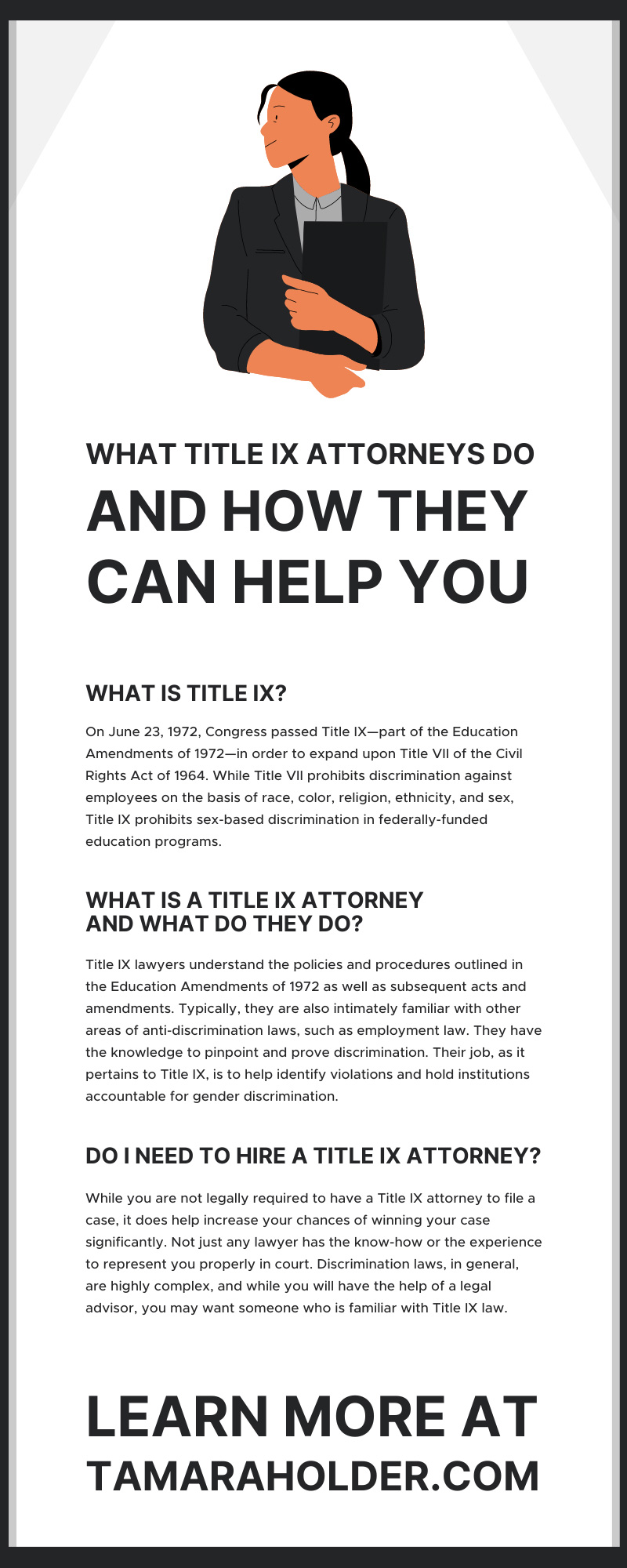
On June 23, 1972, Congress passed Title IX—part of the Education Amendments of 1972—in order to expand upon Title VII of the Civil Rights Act of 1964. While Title VII prohibits discrimination against employees on the basis of race, color, religion, ethnicity, and sex, Title IX prohibits sex-based discrimination in federally-funded education programs. More specifically, no education program that receives funding from the government can exclude someone on the basis of sex in any aspect. Each person should have access to financial assistance, counseling, athletics, recruitment, and employment opportunities.
Sex-based description, also known as gender discrimination, is the unwanted or unfavorable treatment of a person based on their sex and is in direct violation of Title IX. However, what exactly does this kind of treatment look like, and how can we tell when someone is in violation of Title IX?
Gender discrimination, sexual harassment or violence, and retaliation on the basis of gender are all illegal acts, but they do not always fall under Title IX. In these individual cases, the legal onus falls on the alleged perpetrator, as schools simply cannot control everyone on campus. However, if students act in a discriminatory manner, it is up to the school to have clear policies and procedures regarding sex-based discrimination and to act accordingly. If a school lacks a way to report sex-based discrimination, does not have clearly defined procedures or consequences, or has discriminatory policies, they are in violation of Title IX.
Now that you have an idea of what Title IX is and what violations look like, you should learn more about what Title IX attorneys do. Title IX lawyers understand the policies and procedures outlined in the Education Amendments of 1972 as well as subsequent acts and amendments. Typically, they are also intimately familiar with other areas of anti-discrimination laws, such as employment law. They have the knowledge to pinpoint and prove discrimination. Their job, as it pertains to Title IX, is to help identify violations and hold institutions accountable for gender discrimination.
They deal with a variety of educational institutions, as Title IX applies to all public schools, not just universities. Most commonly, they deal with cases where schools refuse to or inadequately deal with sex-based discrimination. If a student is a victim of sexual assault, denied the option to join a program, subject to sexist policies, or harassed, a Title IX lawyer can handle the case.
While you are not legally required to have a Title IX attorney to file a case, it does help increase your chances of winning your case significantly. Not just any lawyer has the know-how or the experience to represent you properly in court. Discrimination laws, in general, are highly complex, and while you will have the help of a legal advisor, you may want someone who is familiar with Title IX law. They can help you gather documentation to support your case, prepare you for an interview with the Title IX investigator, and help you respond to evidence in court.
When searching for an attorney, you should always conduct an interview before hiring. Your first step is to ask them what their specific area of practice is. While they may tell you they’re a Title IX attorney, your next step is to ask how many Title IX cases they’ve handled. There’s no shame in being direct and honest in your interview. If your Title IX case is complex, you want a lawyer who understands the realities of these cases, not just theoretical arguments.
After you confirm they’re an expert in the necessary field, it’s time for the uncomfortable question—how many Title IX cases have they won? While it’s not necessary for them to have a 100 percent success rate, there’s no harm in knowing your odds. Ultimately, a Title IX lawyer should be honest and upfront about the odds of your case and thoroughly inform you of the investigative process. If a lawyer is generally vague about their pricing, area of practice, or case statistics, take these factors as red flags.
In order to file a Title IX complaint, you or your lawyer needs to contact the US Department of Education’s Office for Civil Rights. Before doing so, you first want to inquire as to the institution’s grievance procedures. However, if you’re at this point, they likely have none or have ignored your complaints.
Additionally, you must file a complaint within 180 days of the incident, and if you have not, you must request a waiver. If you request a waiver, you and or your lawyer prove that there was reasonable cause as to why you did not file the complaint earlier. Fortunately, filing a complaint is simple, and you can easily fill out an electronic complaint on the OCR’s website.
Now that you know a little bit more about Title IX and what Title IX attorneys do, let us know how we can help you. Here at the Law Firm of Tamara N. Holder, we dedicate ourselves to protecting the rights of women and LGBTQIA+ members. If you believe that a federally-funded education program has sexually discriminated against you, contact us today. We can put you in touch with one of our Title IX defense lawyers and provide you with the legal consult and representation you deserve.
Although the world is progressing, changing, and becoming more tolerant of various sexual orientations and gender identities, discrimination against people within these groups still exists. Sometimes, in response to this progression, others become more resolute and planted in their outdated mindsets. This means that to protect yourself from this kind of harassment, you must understand what rights protect you from sexual orientation discrimination.
Title VII of the Civil Rights Act of 1964 was formed to protect people from being discriminated against by their employers on the basis of race, color, ethnicity, religion, and sex. On June 15, 2020, the Supreme Court made a decision in the Bostock v. Clayton County case. In summary, this decision held that discrimination against someone based on their sexual orientation or gender identity is prohibited under Title VII. This means that LGBTQIA+ workers are protected against employment discrimination and can take legal action against their employer if discrimination occurs.
The Affordable Care Act (ACA) was enacted in 2010 and is designed to increase health insurance coverage for uninsured people. Section 1557 was implemented in the ACA in order to prohibit discrimination against individuals based on race, color, ethnicity, religion, and sex, specifically in health programs. However, in response to the Bostock v. Clayton County case, this section was updated to further prevent discrimination on the basis of sexual orientation and gender identity.
Unfortunately, there are very few sexual orientation discrimination rights to protect you in other aspects of society. The Fair Housing Act, The Equal Credit Opportunity Act, the Jury Selection and Service Act, and Title VI of the Civil Rights Act all do not explicitly prohibit sexual orientation or gender identity discrimination. However, if the Equality Act were to pass in the United States Congress, it would undoubtedly impact all of these acts as well as Title II, III, VI, and IX, to explicitly prohibit this kind of discrimination.
In America, 18 states have no explicit prohibitions against sexual orientation and gender identity discrimination. These states and territories are:
There is still work to do.
Regardless of how much progress there is to be made, there are people dedicated to protecting LGBTQIA+ members in America. If you’ve been discriminated against based on your sexual orientation or gender identity where you work, remember that this is illegal. The Law Firm of Tamara N Holder can put you in contact with one of our dedicated sexual orientation discrimination lawyers to help you get the representation and compensation you deserve.


