The workplace should be a safe environment for every person, regardless of gender identity or sexual orientation. However, even with how far we’ve come as a society, discrimination and harassment toward transgender employees can happen in the workplace, leading to a hostile work environment and inequity.
For employers and employees alike, it’s crucial to learn how to identify the signs of transphobia in the workplace and work to create a welcoming, inclusive space. Let’s explore how to identify transphobia in the workplace and what you can do to address it.
Before we can recognize the signs of transphobia in the workplace, we must first understand what transphobia is and how it impacts the work environment.
Transphobia is the irrational fear or hatred of transgender individuals or those who do not conform to traditional gender norms. It includes prejudicial attitudes, discriminatory behaviors, and systemic and institutional bias that affects transgender people at all levels of society. Transphobia can be both overt and covert and manifest in various ways, ranging from verbal insults and harassment to physical and sexual violence.
One of the most significant ways transphobia impacts the workplace is through its toll on mental health. Transgender individuals who experience discrimination or harassment in the workplace often report high levels of stress and anxiety. This struggle can lead to decreased productivity, absenteeism, and higher rates of mental health disorders such as depression and post-traumatic stress disorder (PTSD).
To mitigate the impact of transphobia on mental health, employers should prioritize creating safe and inclusive work environments where all employees receive proper support and resources. Employers should also consider providing mental health services as a standard employee benefit, including gender affirmation healthcare services.
In addition to mental health, transphobia also has a significant impact on workplace productivity. Transgender individuals experiencing discrimination or harassment in the workplace may feel undue stress and distractions, leading to reduced focus on tasks and poor performance.
Helping transgender individuals feel accepted within the workplace and offering equal opportunities to all employees can greatly increase productivity and morale. Employers should also explicitly prohibit discrimination and harassment in their policies, training, and workshops.
Transphobia in the workplace can lead to high employee turnover rates as transgender individuals seek out more accepting and inclusive work environments. High employee turnover is costly for employers, as they must continuously recruit and train new employees to fill vacant positions.
By prioritizing creating an inclusive and supportive environment for transgender individuals, employers can improve employee retention and strengthen the business’s overall culture and performance. Remember, diversity breeds innovation and success.
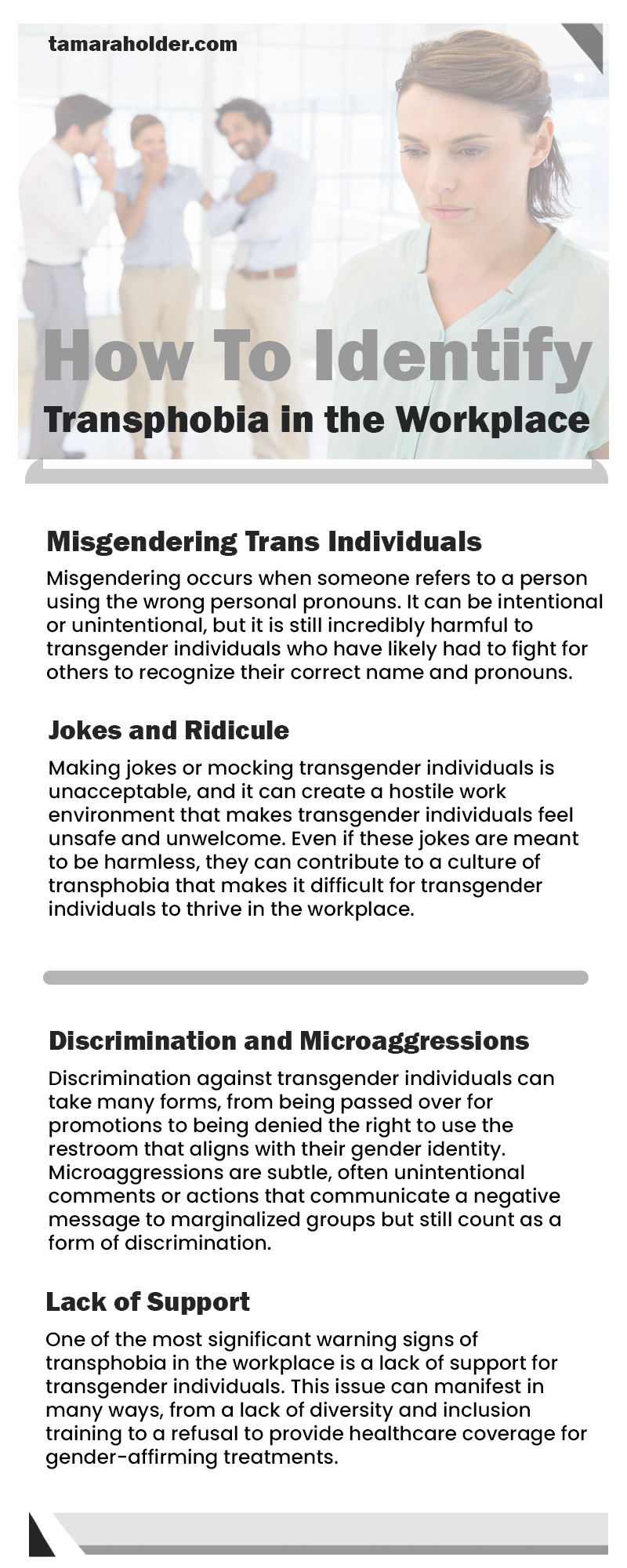
Misgendering occurs when someone refers to a person using the wrong personal pronouns. It can be intentional or unintentional, but it is still incredibly harmful to transgender individuals who have likely had to fight for others to recognize their correct name and pronouns. If you notice someone consistently using the wrong name or pronouns for a transgender colleague or employee, it is important to correct them and encourage others to do the same.
Making jokes or mocking transgender individuals is unacceptable, and it can create a hostile work environment that makes transgender individuals feel unsafe and unwelcome. Even if these jokes are meant to be harmless, they can contribute to a culture of transphobia that makes it difficult for transgender individuals to thrive in the workplace. If you witness someone making jokes or ridiculing a transgender colleague or employee, speak up and let them know that this behavior is not acceptable.
Discrimination against transgender individuals can take many forms, from being passed over for promotions to being denied the right to use the restroom that aligns with their gender identity. It is important for employers to have policies in place that protect transgender individuals from discrimination. Additionally, employees should be aware of their rights and able to advocate for themselves and their colleagues. Discrimination against transgender individuals is not just illegal—it is morally wrong, and it has no place in the workplace.
Microaggressions are subtle, often unintentional comments or actions that communicate a negative message to marginalized groups but still count as a form of discrimination. Examples of microaggressions against transgender individuals can include asking invasive questions about their transition, refusing to acknowledge their gender identity, or treating them differently than their cisgender colleagues. These actions might seem small, but they can add up and create a culture of transphobia that makes it difficult for transgender individuals to feel safe and valued at work.
Finally, one of the most significant warning signs of transphobia in the workplace is a lack of support for transgender individuals. This issue can manifest in many ways, from a lack of diversity and inclusion training to a refusal to provide healthcare coverage for gender-affirming treatments. Employers that fail to support and value their transgender employees send a message that these individuals are not welcome in the workplace. Working for an employer that does not respect its employees can have serious consequences for mental health and well-being.
Knowing how to identify transphobia in the workplace, unfortunately, isn’t enough. To protect trans employees, we must also learn how to respond to transphobia and cultivate a more inclusive work environment.
Creating a safe and supportive work environment for transgender employees can help send the message that transphobia is not acceptable. Establish policies that prohibit discrimination based on gender identity or expression.
Additionally, consider offering healthcare benefits that include gender-affirming care coverage. Celebrate transgender inclusion by recognizing Transgender Visibility Day or Pride Month. You can also create a diversity and inclusion committee to ensure that the workplace is welcoming and inclusive for all.
An essential part of creating an inclusive workplace is to provide support and resources to transgender individuals who have experienced discrimination. The HR department should have resources, such as counseling services, support groups, and employee assistance programs available to provide support to workers.
There may also be local organizations that provide outreach or advocacy services to trans individuals. As an ally, it is important to support others in both your actions and your words.
An effective way to create inclusivity in the workplace is by educating your staff on issues around transphobia. You can do so by hosting workshops or training programs that teach the importance of diversity and sensitivity around trans employees.
Workshops should cover the basics, such as the trans experience, identity, terminology, appropriate language, and how to promote an environment inclusive of transgender individuals. When people feel supported and valued, it can have a huge positive impact in the workplace.
If you’ve been a victim of transphobia or feel transphobia is running rampant and unaddressed in your place of work, contact the Law Firm of Tamara N. Holder. Tamara Holder is a sexual discrimination lawyer with years of experience dealing with sexual orientation and gender discrimination cases just like yours. She’ll do everything she can to hold alleged aggressors and abusers accountable.
As you near retirement, you may find that the benefits you thought you were entitled to are not as straightforward as you once believed. All too often, older employees find themselves losing out on crucial retirement benefits and promotions simply because of their age.
Age discrimination is a pervasive problem that affects countless individuals across the world. Let’s take a look at everything you need to know about age discrimination in retirement benefits so that you can be better equipped to understand your rights as an older employee.
Age discrimination is the practice of treating someone unfairly because of their age. This practice is illegal in the workplace, which means employers cannot use age as a reason to offer different retirement benefits to older employees.
Fortunately, federal and state laws prohibit age discrimination in employment, including in regard to retirement planning and benefits. The Age Discrimination in Employment Act (ADEA) makes it illegal for employers to discriminate against employees and job applicants 40 years of age or older. The law applies to employers with 20 or more employees and prohibits discrimination in hiring, firing, promotions, and other employment-related decisions.
Discrimination in retirement benefits can include denying older employees the same retirement benefits as younger colleagues, offering poorer pension schemes or retirement packages, and engaging in other forms of discrimination. Age discrimination can also affect your retirement savings, as in cases where an employer fails to provide matching contributions or offers lower investment options to older employees.
Age discrimination can also impact the benefits you receive in retirement. For example, if your employer reduces your retirement benefits because of your age, it could lead to a lower retirement income than you expected. Similarly, if your health insurance rates increase as you age, you may struggle to afford quality healthcare in retirement.
Age discrimination can have a significant impact on an older employee's retirement savings plans. In many cases, older workers are often passed over for promotions and training opportunities and given fewer responsibilities than younger counterparts. This results in lower salaries and fewer opportunities to contribute to retirement savings plans.
Additionally, if you are being pushed out of a job due to age discrimination, you will have less time to save for retirement than if you had stayed in the workforce longer. These factors can all lead to a decrease in an older worker's retirement savings.
Layoffs, especially those that target older employees, can also have an immense effect on retirement plans. These layoffs often happen due to downsizing, mergers, acquisitions, or bankruptcies. Such dismissals can affect your seniority, leading to reduced benefits like lower healthcare coverage or early retirement packages.
Age-based refusals prevent or limit employees from receiving benefits or promotions because of their age. For instance, your employer may pass over you for a promotion, assuming you’re too old and not innovative enough. Additionally, age-based discriminatory practices can affect your ability to find another job when you’re ready to retire from your current workplace, impacting your plans to work after retirement.
Age discrimination in retirement benefits is a topic that concerns many older employees, and it can be overwhelming to navigate. If you need help understanding your rights or have been the victim of age discrimination, contact the Law Firm of Tamara N. Holder today. As an experienced employment age discrimination lawyer, Tamara Holder will do everything she can to ensure you are treated with respect in your place of work and get the compensation you deserve.
Work environments that are inclusive for all employees, regardless of their sexual orientation, should be standard. Unfortunately, sexual orientation discrimination is a real problem that many people face and causes stress, job dissatisfaction, and even mental health issues.
It’s an employer’s responsibility to prevent and address sexual orientation bias in the workplace. Let’s take a look at a few tips and strategies to help you create a more inclusive and welcoming workplace for all employees.
Before anything else, establish a clear anti-discrimination policy. Communicate this policy to all employees, and enforce it consistently when instances of sexual orientation discrimination arise. Employees need to know that any acts of discrimination will not be tolerated and that there are consequences for such behavior.
If one employee can get away with bad behavior, it will set a precedent. Your policies should encompass all forms of discrimination, including but not limited to sexual orientation.
Start by setting a tone of inclusivity through training sessions. Provide resources on sexual orientation and gender identity bias, the appropriate language to use for various sexual orientations, and the importance of inclusivity.
Not everyone is aware of the appropriate language to use or what mindsets or verbiage is outdated. It is essential to educate your employees on different gender expressions, sexual orientations, and identities so that they can empathize with their fellow workers and make them aware of their biases. By educating employees, you can get everyone on the same page about how you expect them to treat each other.
An inclusive environment is one where all employees feel comfortable expressing themselves, asking questions, and seeking help. Employers can create such an environment by fostering diversity, equity, and inclusion, encouraging the use of preferred pronouns, and displaying inclusion banners.
Relaxing your dress code can allow employees to express themselves freely, leading to a more open and accepting work environment. You can also form an inclusion council full of diverse employees who make it their duty to promote an inclusive workspace and ensure the company's practices follow those values.
Supporting your LGBTQIA+ staff means doing more than showing support on social media. Actively advocating for their rights in the workplace can be incredibly effective in preventing sexual orientation bias.
Attend pride events or create your own to publicly show support for the LGBTQIA+ community. Use your platform to influence change within your industry or local government to protect the rights of your team members. Not only will this create a culture of inclusivity in the workplace, but it will also prevent employees from engaging in sexual orientation bias and discrimination.
Creating a more inclusive workplace requires continuous effort and dedication. Remember that small actions can make a big difference in creating a more inclusive and welcoming workspace for all employees.
If you’re struggling with instances of sexual orientation bias and discrimination in your workplace, contact the Law Firm of Tamara N. Holder today. Tamara Holder is a gay discrimination lawyer with years of experience fighting for justice when LGBTQIA+ people have been wrongly treated. She’ll do everything she can to root out discrimination and give her clients the closure and compensation they deserve.
Racial discrimination in the workplace is an issue you can’t ignore, as it affects whole organizations, from their employees’ morale to their business’s profitability. It is an employer’s responsibility to create a more inclusive workspace to mitigate the impacts of racial discrimination. Let’s discuss the impact of racial discrimination in the workplace, examples of racial discrimination, and what employers can do to take steps toward a more equality-focused workplace.
According to the Equal Employment Opportunity Commission (EEOC), racial discrimination occurs when an employer treats an employee or job applicant unfairly because of their race or ethnicity. This can include everything from hiring or promoting based on race to paying certain employees less than others based on their race.
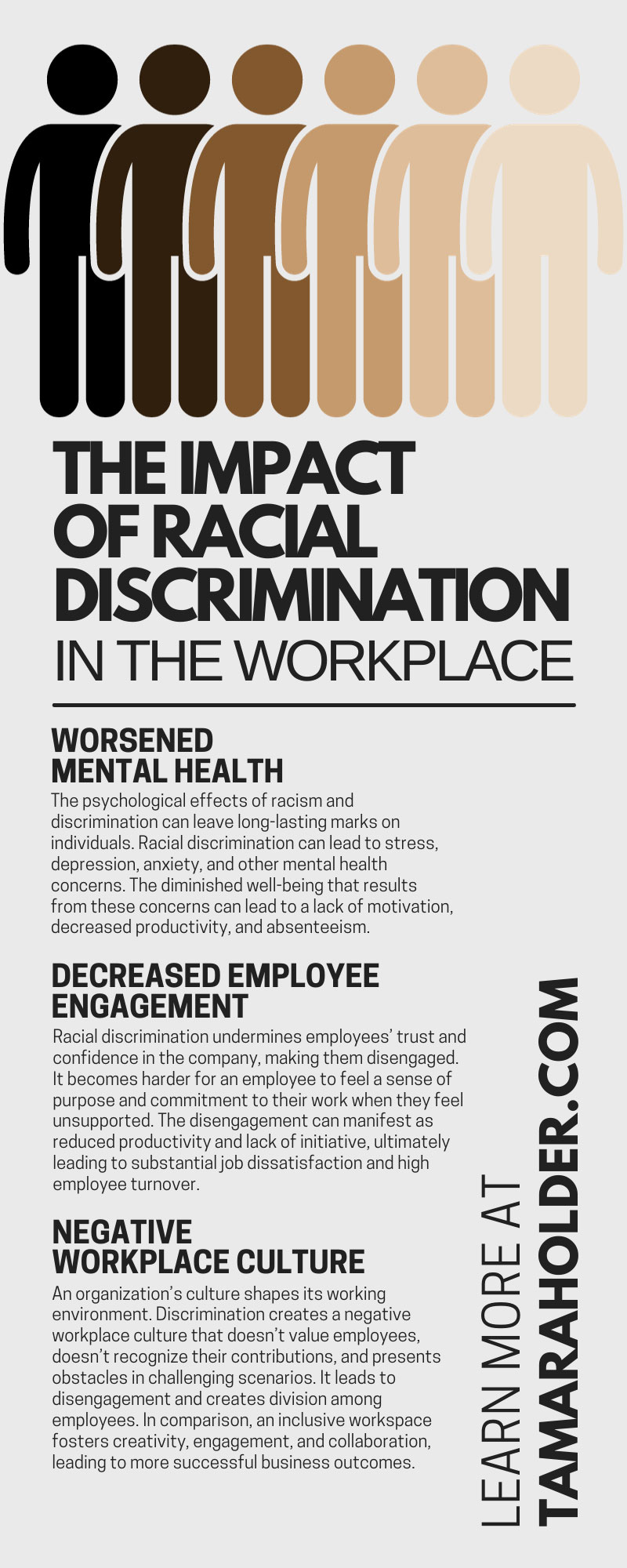
The psychological effects of racism and discrimination can leave long-lasting marks on individuals. Racial discrimination can lead to stress, depression, anxiety, and other mental health concerns. The diminished well-being that results from these concerns can lead to a lack of motivation, decreased productivity, and absenteeism.
Racial discrimination undermines employees’ trust and confidence in the company, making them disengaged. It becomes harder for an employee to feel a sense of purpose and commitment to their work when they feel unsupported. The disengagement can manifest as reduced productivity and lack of initiative, ultimately leading to substantial job dissatisfaction and high employee turnover.
An organization’s culture shapes its working environment. Discrimination creates a negative workplace culture that doesn’t value employees, doesn’t recognize their contributions, and presents obstacles in challenging scenarios. It leads to disengagement and creates division among employees. In comparison, an inclusive workspace fosters creativity, engagement, and collaboration, leading to more successful business outcomes.
The negative effects of racial discrimination can exhaust talented employees, leading to high employee turnover and, consequently, higher recruitment and retraining costs. Unsatisfied employees will leave their jobs to seek alternative employment opportunities, and employers will struggle to recover the talent, skills, and experience of the employees they lose. The more diverse and racially inclusive the workplace is, the more a business can thrive.
Systemic racism often excludes people of color (POC) from job opportunities. The problem usually occurs in the hiring process, in which HR might subconsciously exclude candidates based on their racial backgrounds. Employers need to ensure their hiring process is inclusive and fair to all candidates. Make sure hiring processes are as free of racial bias as possible by using inclusive language and hiring recruiters who focus on diversity.
A microaggression is a subtle behavior or statement that denigrates a person—typically someone belonging to a marginalized group. People commit microaggressions often in good faith, meaning the person making the comment isn’t always aware of the message it conveys. Common examples include making assumptions based on stereotypes or saying things like, “You’re so articulate,” as if it were unusual for a person of a particular race to be well-spoken. Employers need to affirmatively foster environments in which people feel comfortable speaking up about microaggressions and other types of racial discrimination.
Racially biased employers may overlook their minority employees’ promotion aspects compared with their white peers. This happens even when minority employees have the necessary qualifications and experience. By looking strictly at employees’ duties, experience, skills, and educational backgrounds, employers can help weed out racial bias. Companies should emphasize diversity, equity, and inclusion to create an environment where anyone can progress in their career.
The first step in creating a racially inclusive workplace is to provide diversity and inclusion training to all employees. This should be an ongoing process rather than a one-time event. Employees should receive training on issues of racism, privilege, stereotypes, and unconscious bias, among others. This education helps create a common language and understanding around issues of race and diversity.
A diverse workforce is essential in creating a racially inclusive workplace. Employers should seek to recruit people from different backgrounds and experiences. This means creating job postings that specifically target diverse candidates. Employers should also provide the necessary support and resources to retain diverse employees.
To diversify the workforce, employers should consider implementing a diversity hiring program that attracts applicants from different backgrounds. Try to remove any barriers that may deter qualified candidates from applying, such as racially coded job descriptions. By creating a diverse workforce, you bring new perspectives, experiences, and ideas to the table, ultimately benefiting your company and its growth.
Discrimination and biases are unfortunately pervasive in many workplaces. It is an employer’s responsibility to address these issues promptly and appropriately. Encourage employees to report discriminatory behavior by giving them a safe space to address their concerns, and take the necessary measures to address the issue. Also, implementing regular diversity training for employees and management could be an effective way to address and prevent discriminatory practices.
Finally, fostering open communication channels between employees and management can help create a racially inclusive workplace. Encouraging employees to share their experiences and perspectives can help promote understanding and create a sense of belonging. Regular employee feedback sessions and open forums can also help create a supportive, inclusive workspace.
Racial discrimination can impact the workplace in more ways than one, leading to numerous negative effects on individuals and the organization’s success. Employers must care for all staff, and part of that duty includes preventing discrimination in the workplace. Creating a more inclusive culture that values and respects diverse backgrounds and experiences can improve the health, satisfaction, and productivity of employees.
If you’re dealing with racial discrimination in the workplace or your employer isn’t doing what they should to stop racial discrimination, contact the Law Firm of Tamara N Holder today. Tamara Holder is a racial injustice lawyer with years of experience handling sensitive cases like yours and will do everything in her power to get you the compensation and resolution you deserve.
Harassment in the workplace is a serious issue, and employees who suffer from this mistreatment often struggle to address it. Sexual harassment can be particularly difficult for victims who feel powerless and alone in a hostile environment.
Fortunately, legal solutions allow victims of sexual harassment to resolve their cases without going to court—namely, mediation or settlement. Let’s explore what resolving sexual harassment cases through mediation and settlement involves and their advantages over traditional forms of litigation.
In the legal landscape, "mediation" refers to a dispute resolution process where an impartial third party, known as the mediator, facilitates a conversation between conflicting parties. The mediator's role is to help the parties communicate effectively, identify their needs and interests, and explore potential solutions. Mediation is important because it provides a collaborative and agreeable approach to resolving disputes. It allows the parties involved to maintain control over the outcome, often leading to mutually beneficial solutions.
On the other hand, a "settlement" represents the agreement reached by the disputing parties, often with the mediator's help. This agreement is a legally binding contract that outlines the terms to which both parties have agreed. Settlements can resolve all issues in the dispute or specific aspects, depending on the parties' decision. Mediation encourages constructive dialogue and compromise, frequently leading to a settlement that satisfies the needs and interests of all parties involved.
One of the main benefits of resolving sexual harassment cases through mediation and settlement is the potential for a quicker resolution at a lower cost than litigation. This confidential process may be particularly important in cases involving sensitive issues such as sexual harassment in the workplace.
Mediation also hands control over the outcome to the parties involved, allowing them to craft an agreement that suits their needs. This level of control can result in a more satisfactory resolution with results that may not have been attainable through litigation.
Despite its benefits, mediation has drawbacks. In cases of power imbalances, one party may feel pressured to agree to terms they are not comfortable with. This is especially prevalent in cases of abuse, where the victim may have to negotiate with their alleged abuser. Also, the informal nature of mediation may leave some people feeling that justice was not served, especially in serious cases of sexual harassment.
Litigation can provide a sense of justice and closure for victims, particularly in severe cases of sexual harassment. It offers a structured, formal process with a legally binding decision, ensuring compliance from both parties. Additionally, it is the better option for sexual harassment victims who may want their alleged abuser to face criminal charges.
Litigation is often more expensive and time-consuming than mediation, so it’s not accessible to everyone. Furthermore, litigation proceedings are public, potentially exposing sensitive details to the populace. Pursuing mediation and settlement may be a better solution if you want to maintain a private case.
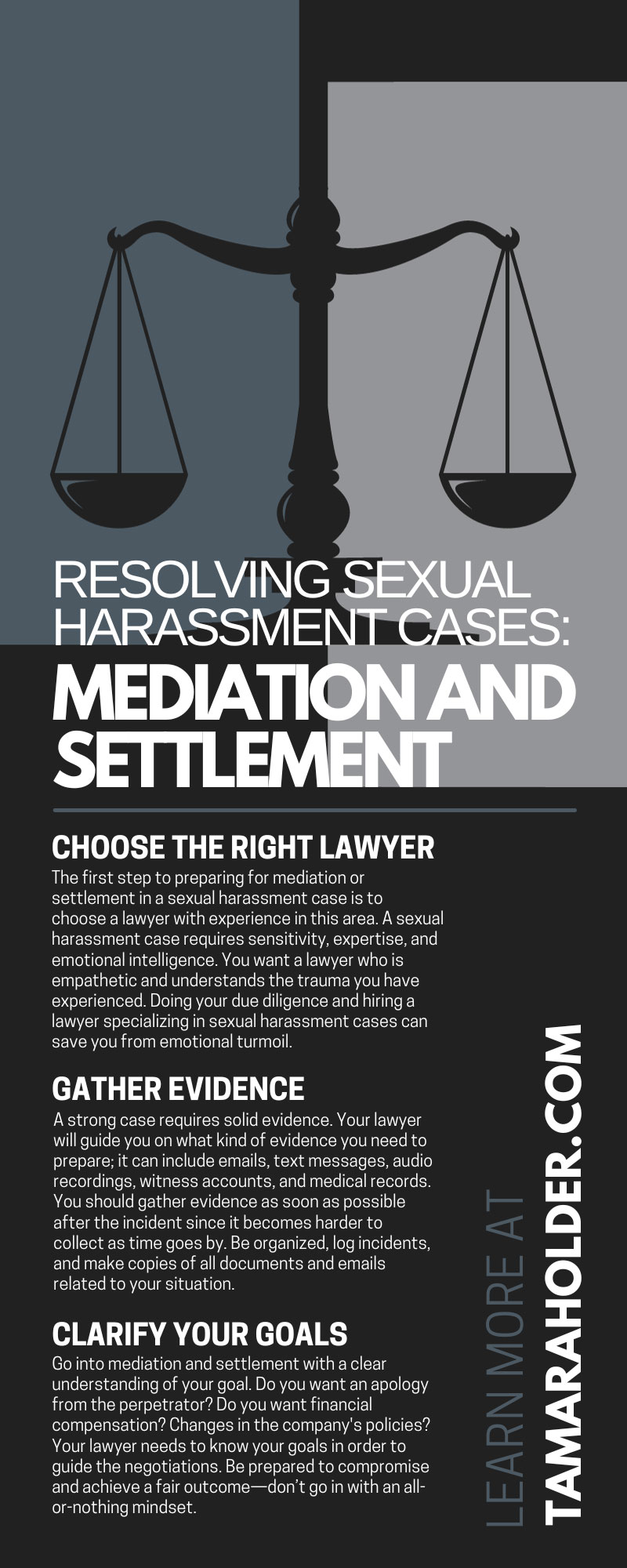
The first step to preparing for mediation or settlement in a sexual harassment case is to choose a lawyer with experience in this area. A sexual harassment case requires sensitivity, expertise, and emotional intelligence. You want a lawyer who is empathetic and understands the trauma you have experienced. Doing your due diligence and hiring a lawyer specializing in sexual harassment cases can save you from emotional turmoil.
A strong case requires solid evidence. Your lawyer will guide you on what kind of evidence you need to prepare; it can include emails, text messages, audio recordings, witness accounts, and medical records. You should gather evidence as soon as possible after the incident since it becomes harder to collect as time goes by. Be organized, log incidents, and make copies of all documents and emails related to your situation.
Go into mediation and settlement with a clear understanding of your goal. Do you want an apology from the perpetrator? Do you want financial compensation? Changes in the company's policies? Your lawyer needs to know your goals in order to guide the negotiations. Be prepared to compromise and achieve a fair outcome—don’t go in with an all-or-nothing mindset.
Be prepared to ask questions to clarify any confusion or uncertainty during mediation and settlement. A lot of legal jargon may be thrown around during the proceedings, so it’s important that you stay in the know through every step of the process. If you don't understand something, don't be afraid to ask your lawyer to explain it in detail. You need to be informed and clearly understand the negotiation process, what's at stake, and your options.
The other party may offer a settlement during negotiations, but you should carefully consider it before accepting. If you take the first offer, you may not receive the compensation you deserve. The alleged harasser or the employer's representatives may try to minimize what happened, and the settlement offer may not reflect the actual extent of what you suffered. Understand the negotiation process, and hold out for an offer that aligns with your expectations.
It's essential to consider future expenses while negotiating for a settlement, especially because the effects of sexual harassment can be long-term and far-reaching. While a settlement award may come as a lump sum, it should last for years. Consider future expenses like therapy and missed workdays due to the harassment you endured.
Sexual harassment or abuse can significantly impact your emotional stability, which is understandable. Nevertheless, emotions can affect the negotiation process. While emotional support and assistance are necessary, try to keep your emotions out of the negotiation. The negotiators may try to leverage your emotions against you, which could result in unfair settlements.
Survivors of sexual harassment understandably focus on compensatory damages, but they should also consider other terms for negotiation. For instance, a defendant may be willing to provide additional training to employees or create a new department for addressing harassment issues if the victim asks for it. These terms can be especially valuable if the victim believes the defendant's culture contributed to the harassment.
If you’re in need of legal representation that will treat your case with professionalism, respect, and care, contact the Law Firm of Tamara N Holder today. Tamara Holder is a lawyer for sexual harassment at work who specializes in handling delicate cases like yours. She’ll do everything possible to ensure you get the compensation you deserve and hold alleged abusers accountable.
Every businesswoman knows that navigating the world of entrepreneurship can be tricky. Your colleagues automatically hold you to higher standards and give you less room to fail. As a result, you need a soundproof business model and a supreme work ethic. However, your business practices and knowledge of workplace law also need to be bulletproof. That’s why we wrote this quick legal guide for women entrepreneurs like you.
Title VII of the Civil Rights Act of 1964 is undoubtedly one of the most foundational and important employment laws in the United States. It prevents discrimination against sexual orientation, gender identity, race, color, ethnicity, religion, and disability in all aspects of employment. An employer cannot hire, fire, promote, demote, offer, or deny raises based on any of these protected characteristics. Title VII ensures that businesses remain impartial and unbiased and treat all their employees with the respect they deserve.
The Fair Labor Standards Act (FLSA) is what establishes the national minimum wage and overtime standards. It also requires that employers keep a strict record of their employees’ wages and hours, outline who they can and cannot cover for overtime pay, and it puts limitations on child labor. Misclassifying an employee, not paying overtime for covered workers, and averaging out workweeks are all violations of the FLSA. Ultimately, this law protects workers from unfair wage practices.
The Occupational Health and Safety Act (OSH Act) protects employees and ensures they have a safe, clean environment to work in. This act sets the standards for different workplace conditions, what an employer can and cannot expose their workers to, and for how long. It requires that the work environment remain free of established hazards such as “toxic chemicals and infectious agents.” It also states that employers must record and report injuries and incidents and ensure employees have access to their rights.
The Equal Pay Act (EPA) is just as it sounds—it ensures that employers pay all their employees the same regardless of gender or sex. Employers must pay two employees the same wage if they are doing substantially equal jobs. Substantially equal does not mean that both jobs must be exactly the same but that the effort, responsibility, and level of skill are similar. However, it does allow employers to pay some employees higher based on merit or seniority.
We hope our quick legal guide for women entrepreneurs helps make running your business and keeping your passion alive a little easier. Let women’s rights lawyer Tamara N. Holder help if you need help making sure your business is legally sound. As a women’s rights attorney with years of experience in employment law, she has the experience and dedication to assist and protect businesswomen like you.
Within the doctor-patient relationship, there’s an inherent power imbalance at play that all medical students learn about during their training. You, the patient, are naturally in an extremely vulnerable position, as your health and even your life are in their hands. That’s why it can be highly shocking when a medical professional is abusive. How could someone who spent so much time, money, energy, and dedication to helping others be so cruel?
The fact of the matter is that some doctors use this inherent power imbalance to mistreat patients and attempt to get away with it. If you’re ready to hold your abuser accountable, let’s take an in-depth look into the legal aspects of medical abuse and how to gather evidence for a doctor-patient abuse case.
We can define patient abuse as intentional negligence and or a failure to act that causes suffering or harm to a patient. While the term “doctor-patient” abuse is the most popular phrasing, it isn’t only doctors who can commit acts of patient abuse. Any caregiver or medical professional caring for a patient can commit patient abuse. But this doesn’t always look like overt violence or physical harm. It can be purposefully withholding pain medication, verbal abuse, purposeful isolation, ridicule, and coercion. Regardless of the action, the result is the same—a distressed patient in mental and or physical anguish.
Doctor-patient sexual assault is a kind of patient abuse, but sexual assault can take on many different forms on its own. Sexual assault can be either verbal, physical, written, or visual, and the legal definition doesn’t limit sexual assault to rape. It can be molestation, inappropriate sexual comments or advances, showing or taking inappropriate pictures, and so on.
However, doctor-patient sexual assault can look different and take on various forms. A medical professional may inappropriately touch a patient under anesthesia or perform unnecessary, invasive tests or procedures. If your specific experience doesn’t fall under these scenarios, that doesn’t mean what happened wasn’t sexual assault. If it was sexual in nature and unwanted, then it’s sexual assault. If a medical professional performed the action, then it falls under patient sexual assault.
When you take a doctor or other health-care practitioner to court, the first thing you must prove is that they had a duty to care for you. All medical professionals have a certain standard of care they must abide by. To prove that they owed you that standard of care, you have to show that there was a patient-provider relationship at the time, which you can easily establish with medical records.
Once you prove that you had a patient-provider relationship, this is where things can get a little tricky. You must prove that your health-care provider breached that duty and standard of care. This means that you would have to prove that a “reasonable or prudent” health-care professional wouldn’t act in such a way. To do so, a health-care practitioner in the same or similar field would need to act as an expert witness.
After establishing a breach of duty, you then have to prove that you have an injury or illness. This doesn’t have to be a physical or visible injury. Additionally, there are many cases where the resulting injury is long-lasting mental anguish, such as depression or post-traumatic stress disorder. However, you will need medical proof of these injuries or illnesses from a separate health-care provider.
The last and most difficult thing you need to prove to win your case is that the health-care provider caused your illness and or injury. Most often, the opposing side will argue that you or other outside factors caused the damage. For example, say a doctor sexually assaulted a patient during a physical exam, and they argue that this resulted in depression and mental suffering. The defendant may argue back that the patient already had mental health issues and that the doctor didn’t cause it. This is where you will need the help of an experienced attorney to link the abuse to your injuries.
When looking over what you have to prove, one of the first and most important things you need is a compilation of all of your medical records. This will help you prove a patient-provider relationship and gather evidence of your other injuries. To access your medical records, you’ll typically have to fill out a request form, but not every practice has the same procedures. Be sure to inquire as to what their procedures are and keep strict records of who you interact with and when.
While you don’t always need physical evidence to prove an abuse or sexual abuse case, it’s helpful to have it. In cases of abuse, you may want to take pictures of any resulting bruises or injuries. Your expert medical witness can attest to whether your injuries are abnormal for the procedure your doctor administered. If you have experienced sexual assault, you should consider going through the process of a sexual assault forensic exam to gather DNA evidence.
As mentioned, you’ll need a medical expert to testify throughout different portions of the court proceedings. However, if there were other medical staff present during the abuse or you had a trusted family member or friend with you, they could act as a witness. If there was a member of the medical staff present, it may be difficult to get them to act as a witness, as the medical professional may have pressured them to stay silent. Remember that it’s not up to you to contact, question, or gather witness testimony. Your lawyer will be able to do that for you, and all you have to do is provide them with a list of names and contact information.
Now that you know how to gather evidence for a doctor-patient abuse case, let the professionals at the Law Firm of Tamara N Holder help you receive justice. Our doctor sexual abuse lawyers have years of experience handling delicate cases like yours and will go to whatever legal lengths necessary to get you the compensation you deserve.

“At-will employment” means an employer can terminate a worker at any time and for any reason. All 50 states recognize at-will employment, and this can be scary for employees who fear that their employers hold total power over them. While the definition states an employer can fire you for any reason, there are illegal grounds for termination, known as wrongful termination. If you’re ready to learn more and take back your power as an employee, check out these facts about at-will employment and wrongful termination.
As mentioned, the definition of at-will employment states your employer can fire you for any reason, and many people believe the definition ends there. However, this isn’t the case. The definition of at-will employment also stipulates that the termination has to be on fair and legal grounds and cannot violate the terms of your employment. If you believe your employer terminated you on illegal grounds, then it would fall under wrongful termination.
Your employer cannot fire you for whatever reason they want, and they cannot dangle your employment and income like bait to manipulate you. Not only would it be disadvantageous for them to do so from a business standpoint, but it’s also illegal. While they may not be forthright about their reason for firing you, it’s generally easy to tell when an employer is firing you for the wrong reasons—trust your instincts.
We know that wrongful termination is the act of an employer firing an employee for illegal reasons, but what are those illegal reasons?
An employer cannot terminate you in retaliation for engaging in a protected act on the grounds of a protected characteristic or in a way that breaches your employment contract. Protected acts include reporting harassment, whistleblowing, and requesting accommodations or time off. Protected characteristics are traits protected under federal employment law, such as race, ethnicity, color, gender identity, sexual orientation, age, religion, or disability. Let’s take a look at some examples.
Say an employer fires you after reporting them for sexual harassment. This is termination on the grounds of retaliation and constitutes wrongful termination. As another example, let’s say your employer fires you after finding out you practice Judaism. That constitutes termination on the grounds of discrimination, which is also illegal.
Keep in mind that an employer can’t fire you in a way that violates your contract. If your employer fired you after a verbal warning, but your contract states you get a verbal and written warning before termination, this is also wrongful termination.
Your employer may not have to give you an explicit reason for firing you, but that doesn’t mean you can’t sue them for suspected wrongful termination. In order to prove wrongful termination, you need to prove intent and a connection between job-related activities and the termination of your employment. You have to be diligent about recording and documenting conversations, gathering witnesses, and garnering evidence, which can be a difficult thing to do alone.
Now that you know the facts of at-will employment and wrongful termination, let the unlawful termination lawyers at Tamara N Holder help you win your case. With years of experience handling delicate employment cases, we’ll treat your case with the respect, dedication, and confidentiality it deserves.
Today, we stand in a world where heterosexuality and cisgenderism remain the dominant forms of sexual orientation and gender identity. While some may argue that this is due more to culture and socialization rather than conscious, educated choice, the point remains in many parts of the world. Despite science treating sex and gender as two different categories, many who are more familiar or comfortable with the sexual and gender “norms” cannot seem to split the two.
Even the law defines sex and gender as two different things—sexual orientation and gender identity can fall into two very different forms of discrimination. Everyone must know the difference between these terms because sexual orientation and gender identity discrimination are still prominent issues that affect numerous LGBTIQIA+ members to this day. Dive into each term’s definition and how discrimination may appear in our modern world below.
Before we can discuss the difference between sexual orientation and gender discrimination, we must understand the difference between sex and gender. We cannot understand gender without first understanding sex. Sex is the biological and psychological traits and characteristics of males and females. These traits can include primary and secondary sex characteristics, chromosomes, and hormones. The trouble here is that science is slowly realizing that categorizing humans into males and females based on their biological characteristics isn’t easy.
People who are intersex don’t neatly fall into these categories as they may have hormonal or physical sex characteristics that don’t fit under the strictly male or strictly female categories. Often, doctors will simply look at their predominant sexual traits and put them under the “appropriate” category. Unfortunately, doing so can lead to feelings of inadequacy or feelings of otherness down the line.
These feelings occur for two reasons. First, these categories are inadequate—categorizing billions of humans into two categories is negligent on a statistical level. Second, people will often tell an intersex person that the sex that is written on their birth chart should also be their gender identity—but what is gender?
Gender is the socially constructed physical and personality characteristics of men and women. Therefore, gender is entirely made up, and the human mind’s attempt to put things into categories. Many stand outside this gender binary of male and female and identify as transgender, two-spirit, gender fluid, nonbinary, and so on. Although humans rarely fall into neat little boxes, if we were to put a bow on the difference between sex and gender, it would be as follows:
Sex is the chromosomes and sexual characteristics you’re born with, whereas gender is an identity.
So, where does sexual orientation fall into all of this if we define sex as the chromosome and sexual characteristics you’re born with? Sexual orientation is a person’s pattern of romantic or sexual attraction to a particular sex or gender and is separate from their gender identity. These include homosexuality, pansexuality, bisexuality, asexuality, heterosexuality, and so on.
While a person can be attracted to anyone, regardless of gender identity, it is important to understand that these are man-made categories. In other words, these labels are fluid. Even though sex, sexual orientation, and gender identity are separate things, they often intertwine beautifully. Let’s look at an example:
Emily is a transgender woman. All her life, she has been attracted to other women. Others, and herself, may have considered her to be heterosexual before she transitioned from male to female. However, after her transition, she still likes women. Now, Emily may identify as a lesbian, and others may view her that way as well.
Now that we can better understand the difference between sex, sexual orientation, and gender, let’s define discrimination to complete our glossary. Discrimination is the prejudicial or unfair treatment of different groups of people. A person may discriminate against someone based on their sex, gender identity, sexual orientation, race, religion, age, and many other characteristics. It’s important to note that all these characteristics receive protection under federal law, and discrimination against somebody because of these characteristics is illegal.
You must prove, at the very least, that you were treated differently because of a certain protected characteristic to prove that someone has discriminated against you. For example, you would have to prove that the discriminatory action or behavior occurred because of your race if you wanted to prove you were being racially discriminated against. Proving such discrimination can be difficult, as most people will lie about their intentions, and intent can be one of the hardest things to prove in court.
As previously stated, federal law protects sexual orientation and gender identity characteristics. Therefore, someone cannot discriminate against you simply because of whom you find sexually attractive or how you identify. However, it is important to note that sexual orientation only applies if a person is attracted to another consenting party. Pedophilia or zoophilia are not sexual orientations, they are crimes. They do not fall under sexual orientation discrimination.
The difference between sexual orientation and gender identity discrimination is simple. Sexual orientation discrimination is when someone treats another person prejudicially, unjustly, or unfairly based on who the other person finds sexually attractive. Gender identity discrimination is when someone treats another person poorly or unfairly simply because of their gender identity.
Let’s look at a few examples of what these forms of discrimination might look like today to get a better idea of the true nuances and differences between these terms.
Avery is genderfluid, meaning they do not have one single unchanging gender—how they identify may change day to day. They put a little pin on their shirt that says he/him, they/them, or she/her depending on how they feel to help others use their preferred pronouns. One day, Avery comes into work with the he/him pronoun pin on. Avery’s boss sees this but continues to refer to him as she. Even after Avery politely corrects his boss, his boss says, “I don’t care, and you shouldn’t bring that nonsense into work.” An employer actively refusing to respect someone’s pronouns and purposely putting them down for not fitting into the gender binary is gender identity discrimination.
Joshua is a cisgender gay man who uses he/him/his pronouns. He recently married his partner, Adam, who is bisexual and a cisgender man who uses he/him/his pronouns. Joshua put a wedding photo of him and his husband on his desk at work. Many at his job, mostly heterosexual couples, also have wedding photos of themselves and their partners on their desks.
One day, Joshua’s boss tells him he cannot have a wedding photo of him and his partner on his desk because their relationship is “offensive.” His boss doesn’t tell other heterosexual workers to take down their pictures. This situation is sexual orientation discrimination because Joshua cannot freely express who he loves and finds attractive like his coworkers.
At the Law Firm of Tamara N. Holder, we understand how difficult intent can be to prove, but don’t lose hope if you’ve faced discrimination because of your sexual orientation. Contact us today, and we’ll put you in touch with one of our sexual orientation discrimination lawyers, who will treat your case respectfully and work tirelessly to get you the compensation you deserve.


