We like to think of the workplace as a haven of harmony, productivity, and respect. Unfortunately, reality often paints a different picture, and some individuals find themselves subject to a hostile work environment. This hostility can take on many faces, from discriminatory remarks to pervasive negativity.
But when does a challenging work environment cross the line into being legally hostile? At what point can you, as an employee, take legal action? To help clear the air, let’s review when and under what circumstances and conditions you can sue for a hostile work environment.
To successfully prove a hostile work environment claim, several key elements must be present. First and foremost, you must prove that you belong to a protected class and that the treatment you're experiencing is discriminatory in nature. This means it targets you based on specific protected characteristics such as race, gender, age, disability, or religion.
You must also prove that the misconduct is pervasive and long-lasting, not just an isolated incident. However, you must keep in mind that the law does not consider minor annoyances or a single instance of rude behavior to be a hostile environment. The behavior must also be severe to the point that it disrupts your ability to work effectively.
Lastly, a link must be established between the hostile conduct and adverse work-related effects. This could include being passed over for a promotion, receiving poor performance reviews, losing your job, or having to quit due to the hostile environment.
Typically, you must file a charge with the Equal Employment Opportunity Commission (EEOC) within 180 calendar days of the day the harassment occurred. However, this timeline can extend to 300 calendar days if a state or local agency enforces a law that prohibits employment discrimination on the same basis.
These deadlines are non-negotiable, and missing them can jeopardize your ability to seek legal recourse. However, once you file the complaint, the Equal Employment Opportunity Commission (EEOC) will investigate other instances of discrimination, even if they occurred before the 180-day timeline.
Now that you know when you can sue for a hostile environment, you can begin looking into how you can sue for a hostile work environment. There are a few steps you need to follow to initiate a lawsuit for a hostile work environment. You must file a formal complaint with the EEOC before filing a lawsuit. This administrative step is essential in demonstrating that you’ve first attempted to resolve the issue internally; this is known as exhausting your administrative remedies.
Once you’ve filed a complaint, the EEOC will begin its investigation. If they conclude that there’s a basis for your complaint, they may elect to sue on your behalf. More commonly, however, they issue a “right to sue” letter, which gives you the green light to proceed with a lawsuit in federal or state court.
Navigating this process alone can be complex, but an experienced hostile work environment lawyer can help you present your case and get you the justice you deserve. At The Law Firm of Tamara N. Holder, our team of skilled employment attorneys can guide you through each step of the process and help you fight for your rights.
Unfortunately, overt racism is not uncommon—the hurling of racial slurs and epithets and hate crimes still occur. However, they are not as prevalent as they once were. More often, racial discrimination is subtle: often unintentional behaviors, remarks, or incidents that communicate hostile, derogatory, or negative racial slights and insults.
These actions can sometimes be difficult to pinpoint, so let’s review some examples of microaggressions to get a clearer picture of what race discrimination looks like.
Unfortunately, many people of color (POCs) can tell you that they have been followed around a shop by the owner or another customer. This comes from the stereotype that people of color are likely to steal. Even when someone isn’t directly accusing a POC of stealing, it’s still hateful and harmful.
Although the person may claim their actions are in the interest of "security," it becomes a microaggression when it's predominantly targeted toward people of color. This subtle act of discrimination contributes to the feeling of not being trusted and a sense of alienation.
This comment sounds like a compliment at first, but when you dig deeper, it’s actually a painful insult to an entire group of people. When someone predominantly says this to a POC, particularly a fully grown adult, the insulation is that the person is surprised a person of color can speak well.
Understand that articulateness is not a characteristic inherent to any racial or ethnic group. You should be aware of any blanket statement given to a group of people, even if you think it’s a compliment.
People of color often find themselves mistakenly identified as workers or staff in public spaces, and this is one of the most common examples of microaggressions. It is prevalent in predominantly white spaces. While it may seem harmless, it reinforces detrimental stereotypes that associate POCs with menial jobs or service roles.
On some occasions, this may occur because the person of color is wearing similar clothes to the workers in a business. Still, it’s best to search for a badge or name tag instead of assuming.
This behavior insinuates that people of color are threats, requiring others to guard themselves or their possessions. This assumption is deeply rooted in harmful stereotypes that associate POCs with violent or criminal behavior.
Again, this is an instance where no one is actively stating people of color are inherently criminals, but the insinuation is still there. While these microaggressions are “subtle,” they are salt in the wounds of people who receive hate because of the color of their skin.
If you believe you’ve experienced racial discrimination or profiling, contact the Law Firm of Tamara N Holder. As a racial profiling lawyer, she understands that racism isn’t always overt and will do everything she can to get you the justice you deserve.
The employer-employee relationship has an inherent power imbalance. Knowledge is power, and for employees, understanding certain aspects of employment law is critical to keeping yourself educated and informed.
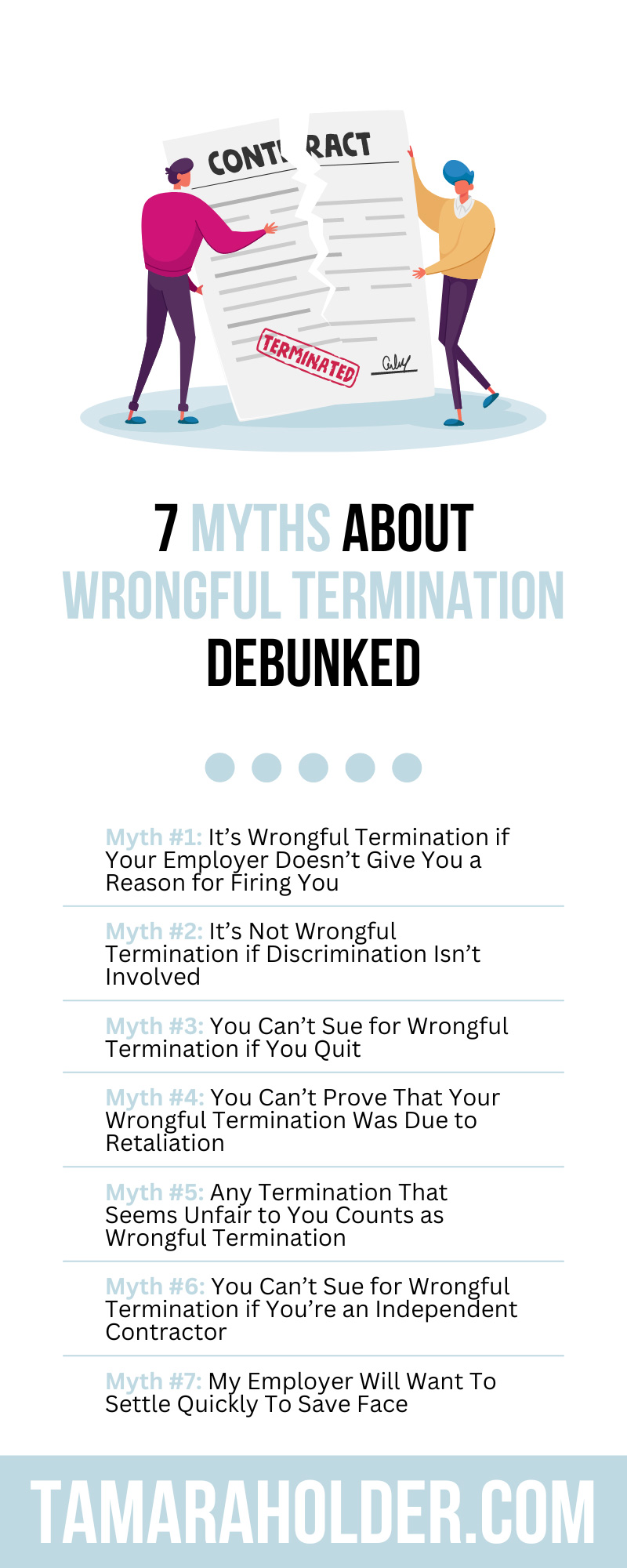
Unfortunately, wrongful termination is a topic shrouded in misconception and misinformation, causing considerable confusion among employees and employers. Below, we debunk seven myths about wrongful termination to clarify the legal parameters.
Wrongful termination, as defined in employment law, refers to an instance when an employer discharges an employee from their position for illegal reasons or in violation of employment agreements. This discharge typically includes discrimination (termination based on race, gender, religion, age, and other protected classes), retaliation for filing a complaint or claim against the employer, or dismissal in breach of contract terms or labor laws. However, the lack of a reason does not mean you were wrongfully dismissed.
Contrary to popular belief, in most states in the U.S., employment is “at will.” This term means an employer can terminate an employee without providing a specific reason unless an employment contract, policy, or statute states otherwise. However, this term does not give employers a carte blanche to dismiss employees unlawfully.
They cannot terminate an employee for discriminatory reasons or in retaliation for the employee exercising their legal rights, such as reporting a crime within the workplace. While termination without a cited cause may seem unfair, it does not, in and of itself, constitute wrongful termination.
It’s true that discrimination—whether because of race, gender, age, religion, disability, or any other protected class—is a common cause of wrongful termination claims, and it’s certainly illegal. However, wrongful termination encompasses more than just discriminatory practices.
It also includes retaliation, in which an employer fires an employee for exercising their legal rights, like filing a workers’ compensation claim or reporting a violation of workplace laws. Additionally, firing an employee in violation of the terms of an employment contract or contradiction to the company’s written policy is also wrongful termination. While discrimination is a prominent aspect of wrongful termination, it’s not the only basis for these claims.
While it may seem counterintuitive, under certain circumstances an employee who resigns can still bring forth a wrongful termination claim. This concept is known as “constructive dismissal” or “constructive discharge.” In such cases, the employee was not explicitly fired, but their working conditions were made so intolerable due to the employer’s actions that the employee felt compelled to quit.
The employee could potentially have a valid wrongful termination claim if the employer intentionally created these conditions to force the employee to resign, and if the Court deems these actions unlawful. However, proving constructive dismissal requires proving intent, which can be challenging and typically requires compelling evidence.
Although proving retaliation can be complex, it is not impossible, and many successful precedents exist. Retaliation takes place when an employer takes adverse action against an employee as a response to the employee standing up for their rights protected by employment laws. This advocacy could include filing a complaint about discrimination or harassment, whistleblowing about illegal employer practices, or claiming rightful benefits such as workers’ compensation.
Consequently, an employer firing the employee, demoting them, or creating hostile working conditions could be indicators of retaliation. The burden of proof lies with the employee to establish a link between their protected activity and the adverse action.
They can show this link through timing (if the adverse action occurred shortly after the protected activity), evidence of changed treatment, or even through company records and witnesses. Proving retaliation as a cause for wrongful termination can be challenging, once again, due to intent and having to prove correlation, but it’s certainly achievable.
While being terminated from employment can be a difficult and emotionally charged event, the fact that a termination seems unfair does not necessarily make it wrongful in the legal sense. Wrongful termination refers specifically to situations where an employer’s actions violate employment laws, statutes, or the terms of an employment contract. This violation includes instances of discrimination, retaliation, breach of contract, violation of public policy, and more.
However, a termination that an employee merely perceives as unjust, without falling under these legally defined categories, may not qualify as wrongful termination. For example, an employer deciding to let go of an employee due to company downsizing, performance issues, or other legitimate business reasons, no matter how harsh it may seem, would typically not fall under the category of wrongful termination. Employees must be aware of their rights, but it’s equally important to understand the distinction between the personal perception of unfairness and what legally constitutes wrongful termination.
Contrary to this common misconception, independent contractors may sue for wrongful termination under certain circumstances. Though employment law does not consider independent contractors employees and therefore does not protect them in some cases, there are exceptions.
For instance, an independent contractor may receive protection under wrongful termination laws if they were categorically misclassified and are an employee based on the nature of their work. Additionally, they could pursue a claim if an employer fires a contractor as a result of discriminatory practices or in retaliation for asserting their legal rights. Although independent contractors don’t receive the same protections as employees, in some cases, they can still take action against wrongful termination.
Some employers might indeed prefer to settle quickly and quietly to avoid bad publicity, but don’t let anyone tell you that this is a given. The decision to settle largely depends on the specifics of the case and the potential risks the employer perceives. Employers may choose to take the case to court rather than settle if they believe they have a strong defense or if they see the lawsuit as a chance to make a point. You must also remember that employers often have access to considerable legal resources, which may make them more inclined to fight a claim rather than opt for a quick settlement. Don’t assume a lawsuit will lead to a quick and easy resolution—each case is unique, and a multitude of factors can influence the outcome.
Wrongful termination is a complex and nuanced legal issue that many often misunderstand. Although we debunked seven myths about wrongful termination above, you may still have questions about what constitutes wrongful termination.
Contact the Law Firm of Tamara N. Holder today if you believe your employer has wrongfully terminated you. As an experienced and devoted employment dispute lawyer, Tamara Holder will do everything she can to ensure you get the legal representation and justice you deserve.
Doctors are human, and like all humans, they’re bound to have biases. This isn’t an excuse nor a pass for discrimination, but it does mean we need to keep a watchful eye for instances where harmful biases can come to light. For instance, sexual orientation bias can have serious and sometimes fatal consequences for those with various sexual orientations.
Sexual orientation bias in healthcare is a multifaceted problem, resulting in disparities in medical care access, quality of service, and overall health outcomes among LGBTQ+ patients. Let’s delve into the ways sexual orientation bias affects medical patients to foster greater understanding and advocacy.
While it may be beneficial for a doctor to know about a patient’s sexual history, under no circumstances does a patient have to disclose their sexual orientation. While no one can truly determine another person’s sexual orientation simply by looking at them, that does not stop medical professionals from passing judgment and making assumptions. These often dangerous biases can make the examination room a dangerous one for LGBTQ+ individuals to step into.
One of the most immediate and distressing ways sexual orientation bias manifests in the healthcare system is through verbal, physical, or sexual harassment. LGBTQ+ patients often confront derogatory comments, inappropriate questions, unnecessarily invasive or revealing procedures, or even outright hostility based on their sexual orientation. These experiences can deter individuals from seeking medical help in the future, exacerbating their health risks and contributing to the disparities in healthcare access for the LGBTQ+ community.
While it is true that there are LGBTQ+ health disparities, including mental health disorders or substance abuse, these disparities can become biases that cloud the judgment of medical professionals. Medical professionals may overlook certain symptoms or neglect to ask relevant questions due to preconceived notions about a patient's sexual orientation. For example, if a lesbian woman comes into the office reporting nausea and abdominal pain, their doctor may refuse or completely forget to ask if there’s a chance they’re pregnant.
Or if a gay man came in with rashes, sores, or fevers, a doctor may forcibly order STI tests even if the patient insists they aren’t sexually active. These assumptions not only delay or hinder proper diagnosis and treatment but can also create unnecessary stress and discomfort for the patient.
Some healthcare providers, driven by personal prejudices or religious beliefs, may refuse to provide necessary medical services to LGBTQ+ patients. This refusal can range from a decline in routine checkups to denial of critical interventions such as gender-affirming surgeries. How is this possible?
In many states, a doctor can refuse to perform procedures or engage with certain patients for religious reasons. For example, in Florida, the passing of the bill HB 747 protects medical professionals who refuse to treat patients based on their religion. The impact is especially severe in areas where there are limited healthcare providers, leaving LGBTQ+ individuals with few, if any, alternatives for receiving the medical care they need.
Although we’re making strides toward an equitable and equal society, sexual orientation bias still affects medical patients. If you’re a part of the LGBTQ+ community and have been mistreated in a medical setting, you have rights. Contact sexual orientation lawyer Tamara N Holder today to fight against discrimination and malpractice.
Sexual assault can leave lasting physical, emotional, and psychological scars on victims—it instills fear in those it impacts. As a result, victims may feel hesitant or frightened to report incidents of sexual misconduct.
While fear or hesitation is understandable, it’s important to understand when your report may no longer hold legal weight. Knowledge is power, and to help you make confident decisions, let’s look into what you need to know about the federal statute of limitations for sexual harassment.
It is typically the timeframe within which a victim can file a legal claim against their alleged harasser. Under U.S. federal law, specifically under Title VII of the Civil Rights Act of 1964, an individual has 180 calendar days from the day the harassment occurs to file a charge. The individual must file these charges with the Equal Employment Opportunity Commission (EEOC).
In states with an agency that enforces laws like Title VII, the filing deadline is 300 calendar days from the date of the harassment. It’s crucial to understand that these laws strictly enforce these deadlines, and missing them often means losing the right to pursue a case under federal law.
The federal statute of limitations for sexual harassment operates on a “last incident” rule. This rule means the clock for the filing deadline starts ticking from the date of the last incident of harassment. For example, the deadline extends with each new occurrence of harassment if a victim continues to experience it. However, an individual cannot include past incidents outside the statute of limitations in their claim. They can only claim incidents that occurred within the legal timeframe.
It’s understandable that you may be afraid to speak out if you find yourself a victim of sexual harassment, but you must act promptly if you can.
Your first task is to document each incident in detail, including dates, locations, what was said or done, and whether there were any witnesses. You should also inform your employer or HR department about the incidents if you feel safe doing so. Most organizations have procedures for reporting and dealing with sexual harassment and must investigate your claims.
Remember, retaliation against an individual for reporting sexual harassment is against the law. Therefore, you should not fear losing your job or facing any form of backlash for speaking up about harassment. Report any retaliation you experience to your lawyer immediately if applicable.
Before making any legal moves, it’s important to consult a professional. Laws surrounding sexual harassment can be complex, but a sexual misconduct lawyer can guide you through these steps with care and respect. They can also help you better understand the statute of limitations and help you file a timely claim.
Taking these steps can be daunting, but it’s crucial to stand up against harassment. You have the right to feel safe.
When we step into a medical facility, we trust and place our lives in the hands of medical professionals. However, when this trust is actively or negligently violated, the result is patient abuse.
Abuse of patients by medical professionals can take many forms—physical, emotional, sexual, and financial. Even the idea of abuse at a place where we go to seek help can be traumatic and prevent patients from ever going back to a hospital. To help patients feel safer, let’s discuss how medical institutions can prevent patient abuse.
Medical institutions must maintain a strict hiring process that includes checking references, conducting interviews, and performing extensive background checks. This isn’t limited to doctors or nurses—it should extend to all staff interacting with patients.
Institutions should be cautious of spotty employment history, unexplained job terminations, or other red flags that may indicate past misconduct. This initial step is a powerful deterrent, ensuring only individuals with high ethical standards gain employment.
Education and awareness are among the top methods medical institutions can employ to prevent patient abuse. Comprehensive training programs should educate all staff members on what constitutes patient abuse, what to watch for, and the steps to take if they suspect abuse. Training should be mandatory and recurring to ensure all employees are current with the latest best practices.
These programs should underscore the importance of patient rights and promote a patient-centered approach to healthcare, where respect for the patient’s dignity, autonomy, and privacy is paramount. By fostering an environment of learning, medical institutions can significantly enhance their capacity to prevent and address patient abuse.
A culture of openness encourages staff and patients to report any suspicion of abuse without fear of retaliation. Additionally, transparency ensures that any misconduct allegations receive the proper investigation and response.
Instituting open-door policies, anonymous reporting systems, and whistleblower protections can facilitate a positive culture. However, these reporting systems must be easily and readily accessible to all. The more difficult or daunting it is for a staff member or patient to report abuse, the less likely they are to follow through.
Establishing stringent policies and response plans is paramount in preventing patient abuse. These guidelines should clearly define what constitutes abuse and outline the process for reporting and responding to abuse allegations.
Medical facilities should also develop a rapid response plan to address abuse cases immediately. This could include instantly isolating the alleged abuser, providing immediate support to the victim, and initiating an in-depth investigation. Moreover, the consequences for confirmed abuse should be severe and nonnegotiable, including potential termination and legal action. These swift and strict actions also deter potential abusers.
If you or someone you love has been grossly mistreated by a medical professional, don’t hesitate to reach out. As a patient sexual assault lawyer, Tamara Holder is well-versed in upholding strict privacy and doing everything she can to deliver swift justice.
Though it has taken many years and hard battles, the world has made tremendous strides in LGBTQ+ civil rights over the past decade. However, discrimination and inequality are still rampant in many countries, including the United States.
It’s crucial to acknowledge the significant advancements in civil rights for LGBTQ+ individuals, but it’s also critical to discuss the ongoing discrimination and challenges that still exist in our society. This continuous discussion gives us the perspective we need to make changes. Let’s take an in-depth look at LGBTQ+ civil rights, its advances and ongoing challenges, to spark conversations geared towards change.
In the past, LGBTQ+ individuals couldn’t legally marry their partners in the US. However, on June 26th, 2015, the United States Supreme Court ruled that same-sex marriage is a fundamental right for all couples.
It allowed same-sex couples to enjoy the same rights and privileges as their heterosexual counterparts, including the ability to file taxes jointly, receive medical insurance coverage from their spouse’s employer, and have hospital visitation rights. It also symbolized a shift toward more inclusive and accepting attitudes toward the LGBTQ+ community.
Despite the legalization of same-sex marriage, many LGBTQ+ couples still face challenges when it comes to adoption. Some states don’t legally prohibit adoption discrimination based on sexual orientation or gender identity.
This lack of legal protection leaves LGBTQ+ couples vulnerable to stigma and bias. For example, you must speak with a social worker if you want to adopt a child, and you’re subject to their biases if you live in a state with formal LGBTQ+ adoption discrimination laws. Social workers may have personal beliefs that prevent them from recommending an LGBTQ+ couple as potential adoptive parents, ultimately hindering the couple’s ability to start a family.
The repeal of the transgender military ban is another relatively recent law the US Supreme Court passed in support of LGBTQ+ civil rights. In 2019, the Trump administration implemented a ban on transgender individuals serving in the military.
However, the public and trans activists hotly contested this policy, arguing that it was discriminatory and unconstitutional. In January 2021, President Biden signed an executive order reversing the ban, allowing transgender individuals to serve openly in the military once again. As a result of this lift, all citizens can serve their country regardless of their gender identity.
While strides have been made in terms of legal rights for trans individuals, violence against this community remains a severe issue. In 2022, at least 41 transgender or gender non-conforming people were killed in the United States.
And it is not a coincidence that many of these individuals were people of color. The intersection of violence is real, and trans people, especially trans people of color and trans youths, are extremely vulnerable. What’s worse is that many of these murders go misreported. General violence is categorized as hate crimes when these heinous actions are clear, thought out, and purposefully directed by the perpetrator.
Bathrooms have always been a battleground for LGBTQ+ rights, as ending up in the “wrong spaces” can be a life-or-death scenario for an LGBTQ+ person. For example, a trans woman can be subject to harassment and violence at the hands of cisgender men if she enters the male bathroom—this is not just conjecture. These crimes are happening today.
However, the world is slowly becoming safer with the popularization of gender-neutral restrooms.
Despite the increasing number of gender-neutral bathrooms in public and private spaces, no federal laws protect their existence. This lack of protection has led to a patchwork of policies across different states and institutions, leaving many LGBTQ+ individuals vulnerable to discrimination and harassment.
Many states ban transgender people from using the bathrooms of their choice in schools, and some government spaces, but one state stands out among the rest: Florida. Florida has completely disallowed trans individuals to use the bathroom of their choice in all schools, universities, and any government-owned building or space. And that does not scratch the surface of Florida’s rampant anti-LGBTQ+ laws.
Conversion therapy, also known as “reparative” or “ex-gay” therapy, is a harmful and ineffective practice that attempts to change someone’s sexual orientation or gender identity. This pseudoscientific practice has been condemned by most major medical and mental health organizations.
As of now, 20 states and the District of Columbia have banned conversion therapy for minors, with more states currently considering similar legislation. This ban is a significant advancement towards protecting LGBTQ+ youth from this dangerous and abusive practice.
While conversion therapy bans are a step in the right direction, LGBTQ+ youth still lack comprehensive legal protections. For example, there is currently no federal law prohibiting discrimination against LGBTQ+ students in schools, leaving them vulnerable to bullying and harassment.
Without proper legal protections, LGBTQ+ youth are at a higher risk for mental health issues and suicide. So, what laws and protections do we have in place for these youths to prevent these crimes from happening in the first place? Our federal and local governments must enact laws to protect children before the damage is done.
In 2020, the Supreme Court issued a landmark ruling in Bostock v. Clayton County, declaring that federal law prohibits employers from discriminating against employees based on sexual orientation or gender identity.
As a result, it is discriminatory for an employer or employee to consistently and actively misgender a trans coworker. While purposefully misgendering a person is cruel on a moral level, this law makes the action punishable in certain spaces. It is vital to continuously show bigots that people will not tolerate their behavior.
Regardless of our strides, much work has yet to be done. While the world and its views are rapidly changing and it’s slowly becoming safer for people to be themselves, LGBTQ+ rights are still being argued globally. We must strive to get to a place where human rights cease to be an argument. With drag bans, book bans, and legal opposition to gender-affirming care—now, more than ever, we must fight to protect our siblings in the LGBTQ+ community.
LGBTQ+ civil rights, despite its advances and amid ongoing challenges, require our attention and support if we’re to create an equitable society.
Our team at the Law Firm of Tamara N. Holder dedicates itself to protecting LGBTQ+ rights and fighting for the laws that have yet to pass. Let our civil rights attorneys help if you believe you’ve been discriminated against due to your sexual orientation or gender identity. We are an indomitable force when it comes to safeguarding and fighting for human rights. Trust us to do everything we can to deliver swift justice.

Retail, nursing, teaching, hospitality positions—these are all jobs now falling under the relatively new term “pink collar jobs.” This phrase refers to positions traditionally held by women, but this isn’t because all women have a propensity for caregiver roles and fall into them simply due to some instinct.
Simply put, Title IX is a federal law that declares that no person shall be discriminated against based on sex in any educational program or activity that receives federal funding. This law has a wide-reaching impact, covering everything from admission and recruitment to athletics and curricula. As a result, Title IX has significantly influenced gender equity in education and beyond.
The lack of women in STEM education and STEM fields and the surplus of men in these positions is known as the STEM gap. Sexist rhetoric may imply that women, particularly cisgender women, have a natural propensity for caregiver roles and do not have the instincts, intelligence, or drive to fill these positions. However, it is these arcane beliefs that feed into the cyclical nature of the STEM gap.
It starts in early childhood. Girls do not naturally prefer to play with baby dolls and kitchen sets, nor do boys naturally prefer to play with chemistry sets or toy construction equipment. Parents brought up with these old beliefs raise and influence their children to fall into these perceived and perpetuated gender roles.
Girls may lack the confidence to break into STEM roles if they grow up believing they cannot excel in these fields or if no one presents these roles to them as career opportunities. Society exacerbates this fear of a lack of ability with the existing surplus of men in STEM. So, why would you try in the first place if you are never given the tools to succeed, and those around you insist—implicitly or explicitly—that you cannot succeed? Thus, the cycle continues.
Title IX promotes gender diversity in STEM education by providing equal opportunities for women seeking to earn a STEM degree and enter a STEM career field. How so? The existence of this law encourages schools and universities to broaden their criteria for certain programs, addressing intrinsic biases. Additionally, the presence of this law discourages the perpetuation of sexist beliefs by providing legal consequences for those who do.
The Law Firm of Tamara N. Holder is dedicated to upholding and protecting Title IX. Contact us if you believe your school or university has violated this indispensable law. We’ll put you in touch with a dedicated and experienced Title IX defense lawyer.
Social media is one of the most powerful communication tools in the world today. People use it for many purposes, like staying in touch with friends and family and networking. Unfortunately, social media can also have negative uses, like cyberbullying and harassment.
We may think of these actions as something that only occurs in petty high-school squabbles, but this isn’t the case. People in your workplace can weaponize social media, and if these behaviors go unchecked, they can lead to a hostile workplace environment, whether it’s a traditional or hybrid workplace. To get a better idea of what this might look like, let’s explore some ways that social media can create a hostile workplace.
A hostile work environment occurs when an employee or employees feel scared, unsafe, uncomfortable, or intimated in their place of work. This often occurs through some form of harassment, whether it’s verbal, physical, or visual.
Employees may use their social media platforms to make disparaging, cruel, or harmful comments about their colleagues. When these interactions make employees frightened or uncomfortable, and maybe even adverse to going to work or using social media, it creates a hostile work environment. Employers must establish clear guidelines about the acceptable use of social media, monitor employee activity, and take action when necessary.
Social media can highlight cultural differences and celebrate diversity. However, it can allow people to mock, ridicule, or spread hate about a culture. Continuous disparaging comments based on a person’s protected characteristic—race, religion, or gender—qualifies as harassment and can create a hostile work environment.
Employers should provide cultural competency training and establish clear policies on what constitutes discrimination based on culture. Additionally, employees should be respectful and inclusive and refrain from using social media to spread hate.
We know that stalking is undoubtedly a form of harassment. It’s a surefire way to make someone feel unsafe, and when done by a colleague, it can create a hostile work environment. By cyberstalking, a person can access their colleague’s personal information, such as their location, interests, and friends. Then, they can use those channels to intimidate, harass, or frighten that person.
Employers should protect their employees by creating a non-cyberstalking policy and training their team to be aware of online activity. It’s also important to teach caution about what employees post online for their professional and personal safety.
When an employer or employee disparages, insults, or ridicules another employee, this is a form of public humiliation and can create an emotionally damaging and hostile work environment. The same goes if an employer or employee uses public social media accounts to humiliate a coworker—especially if their colleagues can witness it.
As mentioned, employers must create clear policies surrounding social media, bullying, and harassment. However, it is equally critical to give employees a safe place to bring harassment to light and for employers to make sure this behavior is dealt with.
Unfortunately, employees and employers can use social media to make a hostile workplace in many ways. If you’ve experienced social media harassment from your colleagues, contact the Law Firm of Tamara N Holder today. We’ll put you in contact with one of our hostile workplace lawyers to represent you and give you the legal guidance you need.


