In today’s complex legal landscape, understanding the profound and complex impact of trauma on individuals is paramount. A trauma-informed approach to legal representation goes beyond traditional legal strategies, offering a more compassionate and effective way to advocate for clients.
This methodology acknowledges the pervasive nature of trauma and its potential effects on behavior, communication, and the ability to engage with the legal process. A trauma-informed law practice has many strengths that can transform legal outcomes and client experiences by fostering an environment of understanding and resilience.
Traditional legal environments can inadvertently trigger distress in individuals who have experienced trauma, especially when they must recall and retell their experiences in detail. This approach carefully navigates a client’s history and emotions, employing strategies designed to minimize stress and anxiety.
For instance, trauma-informed attorneys might introduce pauses during testimony or employ gentle questioning techniques. As a result, this care can make recounting the incident less painful and stressful for the client.
Understanding the impact of trauma helps lawyers adjust their communication style to be more empathetic and patient, which is crucial for building trust. This process might involve using clear, straightforward language, avoiding legal jargon, and actively listening to the client’s needs and concerns.
When clients feel understood and supported, they’re more likely to provide the detailed information necessary for effective legal representation. Ultimately, enhanced communication leads to stronger attorney-client relationships.
A trauma-informed approach also thrives through the power of interdisciplinary collaboration. By working closely with mental health professionals, social workers, and other support personnel, attorneys can draw upon a wealth of expertise and resources to better assist their clients. This coalition ensures a holistic approach to legal representation, addressing the legal aspects as well as the emotional and psychological well-being of clients.
Recognizing and respecting the cultural backgrounds and identities of clients is crucial for providing empathetic and effective legal advice. Attorneys with a trauma-informed perspective take the time to understand the cultural context of their clients’ experiences, which can significantly influence how they perceive and interact with the legal system.
By being mindful of cultural nuances, lawyers can avoid misunderstandings and establish stronger connections with their clients. This cultural awareness facilitates clearer communication and ensures that legal strategies align with the client’s values and needs.
Adopting a trauma-informed approach in law practice has many strengths and presents a revolutionary shift toward a more empathetic, effective, and holistic legal representation. Our women’s rights attorneys are compassionate, experienced professionals who are committed to making the legal system a better place for all individuals who seek justice and healing.
Although many of us have heard of the phrasing “autism is a spectrum,” only now are people beginning to understand the myriad of ways autism affects different people. Since the first coining of the term in 1911 by German psychiatrist Eugen Bleuler, our understanding of this highly inheritable, neurodevelopmental disorder has gone far beyond the descriptor of schizophrenia.
In fact, now, the term has little to nothing to do with schizophrenic conditions at all. Additionally, as it has a clinical history rooted in evaluating mostly cisgender white males, it’s no wonder many allistic people still struggle to understand this diagnosis, especially with the current wave of late-diagnosed women and gender nonconforming people.
However, this isn’t a dive into the complexities of clinical histories and how the spectrum presents itself. Rather, we aim to dive into a relevantly more “modern issue.” With more people on the autism spectrum joining the workforce, we have to take a serious look at the civil rights struggles that autistic employees may face.
Before we discuss the specific challenges autistic employees face, we must define what constitutes a civil rights violation in the workplace. A civil rights violation occurs when an employee receives unfair treatment or discrimination because of certain protected characteristics, such as race, gender, religion, or, in this context, disability. For autistic employees, such violations can manifest in various ways, which we’ll dive into throughout the rest of this article. Because the autism spectrum is so wide, the experiences of high support needs versus low support needs will also widely vary.
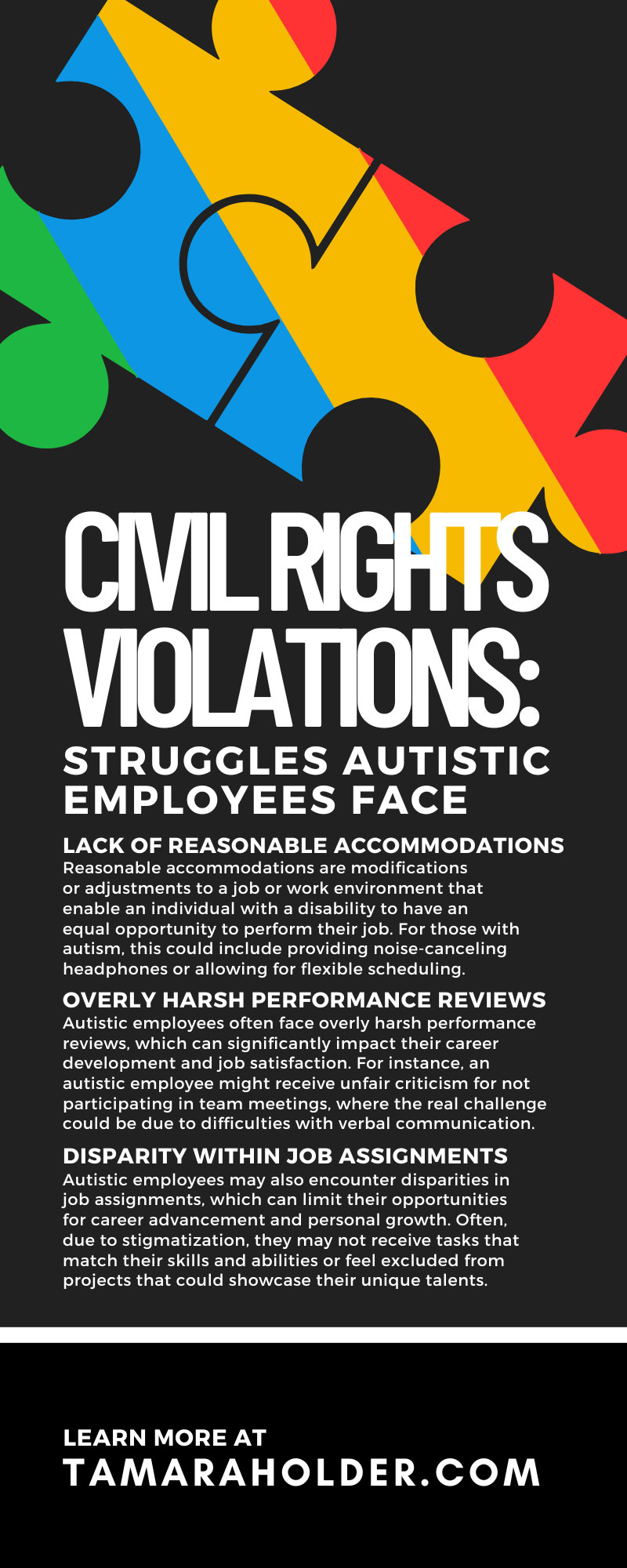
One of the most significant challenges autistic employees face is the lack of reasonable accommodations in the workplace. Reasonable accommodations are modifications or adjustments to a job or work environment that enable an individual with a disability to have an equal opportunity to perform their job. For those with autism, this could include providing noise-canceling headphones or allowing for flexible scheduling. It can also include providing clearly written instructions for tasks instead of relying on verbal communication, which autistic individuals may sometimes misinterpret.
The problem that some autistic individuals face is that their needs don’t always present themselves in a manner that’s obvious or apparent to allistics. As a result, it may be difficult for people on the autism spectrum to communicate these needs, or an employer may deem it excessive or even unnecessary. Without these accommodations, autistic employees may find it difficult to perform to their full potential, leading to unnecessary stress and anxiety. Employers must understand and implement these accommodations, not just for legal compliance but to foster a truly inclusive and supportive work environment.
Another significant issue that autistic employees often encounter is discrimination during the hiring or promotion processes. This discrimination can stem from misconceptions about their capabilities or the stigmatization of autism. For instance, an employer might overlook a candidate with autism for a position due to atypical nonverbal communication during an interview despite possessing exceptional skills relevant to the job.
Similarly, within the workplace, autistic employees may miss the opportunity for promotions because of perceived social or communicative differences. To combat this form of discrimination, organizations must establish hiring and evaluation practices that focus on an individual’s qualifications and achievements rather than subjective assessments of social interaction.
Autistic employees often face overly harsh performance reviews, which can significantly impact their career development and job satisfaction. This issue arises because performance evaluations sometimes don’t account for the unique challenges that autistic individuals may experience in the workplace. For instance, an autistic employee might receive unfair criticism for not participating in team meetings, where the real challenge could be due to difficulties with verbal communication.
Employers must adopt a more nuanced approach to performance reviews, recognizing the diverse strengths and challenges of autistic employees. This could involve setting clear, achievable goals and offering constructive feedback in a way that’s accessible and actionable. By doing so, employers can ensure that performance reviews are fair and productive, encouraging the growth and success of autistic employees in the workplace.
Autistic employees may also encounter disparities in job assignments, which can limit their opportunities for career advancement and personal growth. Often, due to stigmatization, they may not receive tasks that match their skills and abilities or feel excluded from projects that could showcase their unique talents.
This situation undermines the potential contributions autistic individuals can make to their teams and reinforces negative stereotypes about autism. Managers and employers should actively involve autistic employees in a range of assignments and consider their individual strengths and interests when allocating tasks. By doing so, workplaces can become more inclusive and allow all employees, regardless of neurodiversity, to thrive and succeed.
Outright verbal or physical abuse is perhaps the most egregious form of discrimination that autistic employees can experience in the workplace. Such behavior may range from insensitive comments or jokes about one’s abilities to more severe instances of bullying or physical harassment. This form of discrimination creates a hostile and unsafe work environment and significantly impacts mental and physical health.
Employers must establish a zero-tolerance policy toward any form of abuse, ensuring that all employees, including those on the autism spectrum, feel valued, respected, and safe. Also, all staff should receive proper training in autism awareness and sensitivity to foster an atmosphere of understanding and inclusivity. Remember to include the opinions of autistic employees and how they wish for their coworkers to treat them.
Autistic employees may face a myriad of struggles and civil rights violations in the workplace, ranging from a lack of reasonable accommodations and discriminatory hiring practices to outright abuse.
Employers should understand the unique challenges autistic individuals may face and take proactive steps toward fostering an inclusive work environment. By doing so, companies can harness the full potential of their workforce, ensuring that every employee, regardless of neurodiversity, has the opportunity to thrive and contribute to their fullest extent.
If you believe your workplace is discriminating against autistic employees or you’ve been a victim of this form of discrimination, the Law Firm of Tamara N Holder can help. Our team of civil rights attorneys in Washington State works to uphold the rights of every employee.
Title IX, a civil rights law passed as part of the Education Amendments of 1972, signifies a monumental leap toward gender equality in educational programs and activities receiving federal financial assistance. Championed to end sex-based discrimination, Title IX's most profound impact has been in sports, giving rise to increased female sports participation at high school and collegiate levels.
Its significance, however, goes beyond athletics, fostering academic opportunities and safeguarding against harassment and inequality. But what is the history of Title IX, and what is the true scope of its positive impact and outreach?
At its core, Title IX is a brief but potent portion of the Education Amendments of 1972 that succinctly states as follows:
"No person in the United States shall, on the basis of sex, be excluded from participation in, be denied the benefits of, or be subjected to discrimination under any education program or activity receiving federal financial assistance."
Its creation was spurred by a recognition of the prevalent and systemic sex discrimination in educational institutions. Despite the Civil Rights Act of 1964 prohibiting such discrimination, gaps remained, particularly within educational settings. These gaps hindered women's access to higher education and professional fields, where policies and practices often discriminated based on sex. As a result, Title IX was enacted by Congress to ensure every individual, regardless of gender, received equal opportunities in education. It was a necessary step to erode persistent barriers that limited women, ensuring federally funded programs promoted fairness from the classrooms to the sporting fields.
Title IX's history began long before 1972, with women's fight for equality gaining momentum throughout the early 20th century. However, it was the social movements of the 1960s and 1970s, particularly the push for gender equality, that laid the groundwork for Title IX. Women's educational opportunities were markedly limited prior to Title IX, with colleges and universities imposing strict quotas on female admission and offering few athletic opportunities.
The emergence of politicians like Representative Patsy Mink and Senator Birch Bayh, who spearheaded Title IX legislation, was pivotal in bringing gender disparities in education to the national forefront. Their advocacy underscored the urgency of such a law, leveraging the zeitgeist of civil rights activism to propel Title IX's passage. Upon its signing by President Richard Nixon, Title IX became an instrumental policy for enforcing gender equality.
Its implementation faced challenges, evolving through regulations and significant Supreme Court decisions, such as Grove City v. Bell (1984) and Franklin v. Gwinnett County Public Schools (1992), which shaped and reaffirmed Title IX's application and enforcement. The ongoing efforts of policymakers, educators, and activists continue to refine and protect the law's legacy, ensuring its positive impact endures.
Now that we have a better understanding of Title IX and its history, we can explore how it has positively impacted the educational field in America. The most widely recognized change lies within women’s athletic opportunities.
Before the enactment of Title IX, female athletes faced few opportunities in sports with minimal funding or support for women's athletic programs. Title IX mandated equal treatment and benefits for all, regardless of gender, essentially forcing educational institutions to expand and support women's sports. As a result, there has been a dramatic surge in the number of female athletes at the high school and collegiate levels.
Post-1972, schools and universities began to seriously invest in these programs, creating a network of opportunities for female athletes. Title IX not only leveled the playing field in terms of accessibility but also placed a spotlight on the need for equity in funding, resources, and media coverage. It became the responsibility of the institutions to offer comparative athletic scholarships to female athletes, hire coaches, invest in training facilities, and schedule games in prime times to boost attendance and viewership. This holistic improvement of women's athletic programs has not only forged pathways for women in professional sports but also transformed cultural attitudes, leading to greater respect and recognition for women’s athletic achievements.
Another significant triumph of Title IX has been the creation of a more inclusive education environment for all genders. Beyond athletics, it’s been a catalyst for change in academic settings, promoting gender balance in traditionally male-dominated fields like science, technology, engineering, and mathematics (STEM).
With how critical diversity is to innovation, gender equality is vital to our future as a society. Universities and colleges now actively recruit female students and faculty in these areas, which has contributed to an increase in the number of women pursuing STEM degrees and careers. Additionally, Title IX has facilitated the establishment of policies against sexual harassment and violence in educational institutions, recognizing such acts as forms of discrimination that impede a person's access to education.
By obligating schools to address complaints and provide prevention programs, Title IX has contributed to a safer and more supportive learning environment. These strides have paved the way for a future where educational excellence is not predicated on gender but on talent and hard work, allowing for a diverse and dynamic academic community.
One of the most striking contributions of Title IX is the culture of accountability and fairness it has instilled within educational institutions. This is the result of rigorous compliance requirements that schools must meet to receive federal funding. Consequently, schools are compelled to enforce policies that ensure equal treatment and opportunities across all activities and programs.
This comprehensive approach has been crucial in driving systemic change, addressing biases, and establishing a level playing field for all students. Title IX compliance reviews and grievance procedures provide transparent and formal channels for addressing complaints, ensuring all students have the right to an education free from discrimination. This accountability extends to all corners of educational policy and culture, ensuring equity is not only expected but deeply woven into the fabric of the educational experience. Such measures have fostered a sustained commitment to fairness, prompting educational institutions to routinely evaluate their practices and make meaningful progress toward gender equality.
The enactment of Title IX stands as a beacon of progress in the ongoing quest for gender equality. At the Law Firm of Tamara N Holder, our Title IX attorneys are dedicated to protecting this beacon and defending the rights of students, faculty, and staff impacted by sex discrimination. We’re committed to ensuring educational institutions adhere to Title IX, promoting an equitable and inclusive learning environment for all.

When inappropriate behavior, misconduct, or harassment creates an atmosphere that’s intimidating, hostile, or offensive, the law recognizes this as a hostile work environment. When allegations of a hostile work environment emerge, they carry significant weight and implications for both employees and employers.
However, employment law is complex, and the air of mystery surrounding the examination of these claims can make it intimidating for employees to seek legal recourse. To demystify these proceedings, let’s take a close look at how hostile workplace allegations are investigated.
Before we dive into how hostile workplace allegations are investigated, we have to review how to actually file a complaint. Typically, it begins with understanding the internal policies and procedures of the organization. Before taking it up with your employer or supervisor, you should consult your employee handbook or HR department for the proper channels to file a complaint.
Be sure to document all instances of the alleged hostile behavior with dates, times, witnesses, and a detailed description of each incident. After compiling this information, you’ll typically have to submit a formal written complaint to HR or a designated official within the company.
Larger organizations may have an online portal or dedicated hotline for such grievances. If the internal processes don’t lead to a satisfactory resolution, or if you feel unsafe addressing the issue within their company, they may choose to file a complaint with the EEOC.
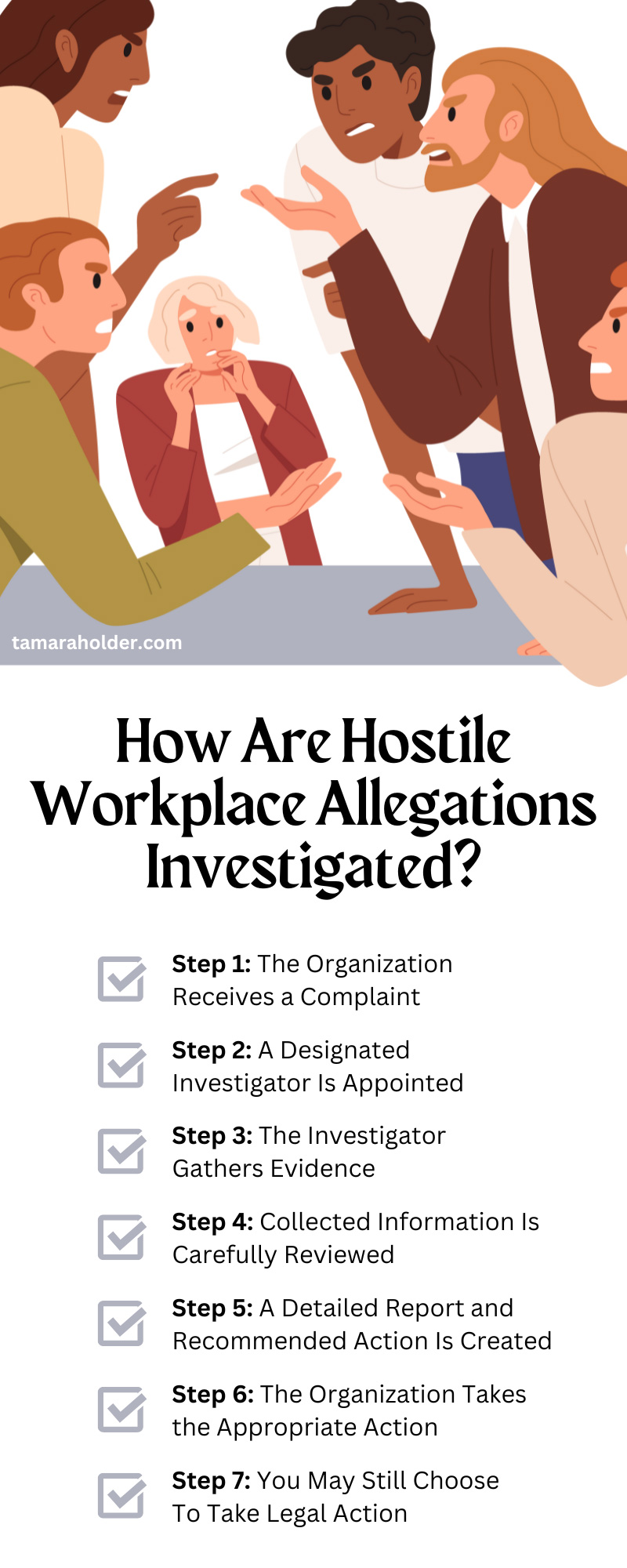
Upon receiving a complaint, the organization must take immediate action to acknowledge it and ensure they will take it seriously. The company then designates an investigator, typically someone from human resources or an external specialist, to ensure objectivity. This step is critical to assessing the initial credibility of the complaint and protecting the rights and confidentiality of all parties involved.
The designated investigator will begin by reviewing the complaint in detail to understand the nature of the allegations and determine the scope of the investigation. This phase lays the groundwork for a structured investigation process, focusing on impartial fact-finding to ascertain the validity of the complaint.
The designated investigator, on appointment, steps into a critical role that involves delving into the specifics of the allegation and maintaining the highest standards of confidentiality and impartiality. Their principal task is to conduct interviews with all concerned parties—including the complainant, the individual or individuals accused, and any witnesses identified.
While interviewing, they use a consistent set of questions to ensure fairness and thoroughness and take detailed notes that can be vital throughout the investigation. This step will likely also involve reviewing any relevant documentation, such as company policies or previous complaints, to support the investigation.
In this crucial step, the investigator meticulously collects and reviews all relevant evidence to the complaint. This can encompass a wide array of materials, such as company files, email exchanges, personnel records, and any documented communication that pertains to the case.
Physical evidence, when available, can also play a significant role. This may include security footage or photographs that capture instances of the alleged hostile behavior. Digital forensics may also examine electronic records, uncovering even deleted or concealed files. As the investigator gathers the evidence, they catalog and preserve it, all as a part of building a comprehensive understanding of the circumstances surrounding the allegations.
Upon gathering all necessary evidence, the investigator proceeds with careful examination, scrutinizing the information to detect consistencies and discrepancies. They weigh every piece of evidence for its credibility and relevance to the allegations, taking into consideration the context of each incident and the workplace environment as a whole.
The investigator also assesses whether the conduct in question is severe or pervasive enough to constitute a hostile work environment. This review often involves comparing statements from the involved parties and witnesses, analyzing any documented evidence against the alleged timeline of events, and determining if there’s a pattern of hostile behavior. They may look for evidence that either corroborates or contradicts the claims made, including any actions taken by management or HR with prior knowledge of the situation.
At this juncture, the investigator compiles all the findings from the evidence review and interviews into a comprehensive report. This report details the investigative process, outlines the evidence collected, and provides an analysis that leads to conclusions regarding the allegations.
Additionally, the investigator will recommend action based on the seriousness and substantiation of the allegations. These can range from targeted training and betterment programs to disciplinary measures or discharge against the individuals involved.
Once the organization reviews the report and the recommended actions considered, they must proceed with appropriate measures. They make decisions on disciplinary actions based on the gravity of the findings and in accordance with company policy and legal guidelines.
The employer must also ensure that any action taken is consistent with past practices to avoid any perception of unfairness or bias. Moreover, the employer should communicate the outcome of the investigation to the relevant parties involved, taking care to protect privacy and adhere to legal requirements.
Even after the investigation concludes and the organization has taken steps to address the complaint, you may decide that the actions taken are insufficient. In this case, you may want to take legal action as your next step. For example, if part of your hostile environment claim includes sexual harassment, sensitivity training or dismissal isn’t enough.
However, before getting started, consult with a hostile work environment lawyer skilled in this practice area who can assess the merits of your case. They will guide you on whether to file a charge with the EEOC or a state agency.
Additionally, an attorney can help to ensure that you meet all procedural requirements and that your case is as strong as possible. During litigation, you and your lawyer can use evidence from the investigation, and additional discovery procedures may uncover more information. Through legal action, you may be able to receive monetary damages for lost wages and suffering, reinstatement of employment, changes to company policies, and coverage of legal fees.
After taking an in-depth look at how hostile workplace allegations are investigated, you may decide you need legal representation to help you win your case. Trust the lawyers at The Law Firm of Tamara N. Holder to provide you with the proper guidance and support in your legal journey. We prioritize the protection of our client’s rights and work tirelessly to achieve the best possible outcome for their case.
In the intricate realm of employment law, wrongful termination claims stand as a beacon of recourse for employees who believe they have been unjustly dismissed from their positions. However, because a large part of proving wrongful termination relies on proving intent—which can be difficult—many employees who have a claim are often afraid to pursue legal action. To protect your rights and ensure you get the compensation you deserve, it’s important that you understand how to build a strong legal case and prove wrongful termination.
An experienced employment attorney can provide crucial guidance on the collection and preservation of evidence that supports your claim. This often includes documentation related to your employment history, such as performance reviews, email correspondence, and any communications related to your dismissal.
However, it’s equally important that legal experts can offer insights into the specific statutes and case law that are relevant to your situation. This ensures your claim is grounded in substantive legal principles, giving your case firmer ground to stand on. They also serve as vigilant advocates who can adeptly navigate the complexities of the legal system, help you understand your rights and options, and represent your interests.
It’s critical for an employee to record all relevant details that might illustrate the wrongful nature of their dismissal. This includes keeping a detailed record of events leading up to the termination, such as dates of significant meetings, specifics of conversations, and any disciplinary actions taken.
Additionally, compiling a comprehensive list of witnesses—colleagues or supervisors who can corroborate your account—is invaluable. Physical evidence, like letters of commendation or awards that contrast with the reason for termination, can also play a crucial role.
Employees should meticulously note instances of unfair treatment that may signify discrimination as soon as possible, noting the who, what, when, and where. They should also document any retaliatory actions taken after they’ve engaged in protected acts, such as filing a sexual harassment complaint or being a whistleblower.
An employee’s ability to present a clear and chronological account of such discriminatory or retaliatory actions can strongly support your argument. This helps prove that the termination was not merely unjust but also a violation of federal or state anti-discrimination laws.
Employees should closely analyze the terms of their contracts, which might contain specific clauses on termination procedures, notice periods, and severance pay. It’s equally vital to examine the company's handbook or written policies to determine if the termination adhered to the company’s outlined processes.
Often, deviations from established procedures or inconsistent policy applications can provide evidence of wrongful termination. A detailed examination of contractual and policy-related documents can yield discrepancies that fortify a wrongful termination claim.
Building a strong legal case to prove wrongful termination is a nuanced approach that marries a deep understanding of employment law with incisive strategic execution.
However, the start of a strong legal case begins by partnering with a knowledgeable attorney. At the Law Firm of Tamara N Holder, our wrongful termination lawyers specialize in helping employees navigate the complexities of employment law to secure the justice and compensation they deserve.
It’s part of an employer’s responsibility to create and maintain a safe space where all employees feel respected and valued. This responsibility includes protecting employees from sexual harassment.
Sexual harassment in the workplace not only creates a toxic environment but also undermines the integrity of an organization, affecting employee morale, productivity, and retention. But what exactly are an employer’s responsibilities in addressing sexual harassment? Let’s explore the key ways employers can address sexual harassment in the workplace and provide a safer environment for their employees.
One fundamental responsibility for employers is the development of a comprehensive anti-harassment policy that clearly defines what constitutes sexual harassment and outlines the procedures for reporting it. It’s crucial that the policy is communicated effectively to all employees through employee handbooks, training sessions, and regular meetings to ensure everyone is on the same page.
Employers must ensure employees understand the serious nature of sexual harassment and are aware that all complaints will be investigated thoroughly and promptly. Moreover, the policy should emphasize the company’s commitment to maintaining confidentiality and protecting all involved parties from retaliation.
Effective training should help employees recognize and understand what sexual harassment looks like, including subtler forms such as quid pro quo and hostile work environment scenarios. Training programs should also inform employees about their rights and the proper course of action if they witness or experience harassment. Additionally, it's essential for leadership and management to partake in this training to lead by example and understand how to handle reports of harassment appropriately.
When an employee comes forward with a claim of sexual harassment, it’s the employer's duty to promptly and thoroughly investigate the allegations. This means taking immediate action to assess the complaint while ensuring the process upholds the dignity and privacy of all concerned.
Throughout this process, it’s vital that employers remain neutral, providing an equal opportunity for all parties to be heard. The investigation should conclude with a timely and decisive resolution, taking necessary actions that may range from mediation or counseling to disciplinary measures, including termination.
Beyond addressing incidents of harassment, it's paramount that employers offer comprehensive support to employees who have experienced or reported sexual harassment. This support can take various forms, including access to counseling, providing accommodations such as changes in work schedule or location, and ensuring they’re aware of resources inside and outside of the organization.
Employers should also uphold measures that protect individuals who have reported harassment from retaliation by supervisors or peers. It's critical for employers to foster an environment in which employees feel safe to voice concerns because they trust that their well-being is a priority.
Employers hold a critical responsibility in addressing sexual harassment to foster a work culture that strongly repudiates sexual harassment.
If you want advice on how to better protect your employees from sexual harassment, need help reviewing your policies, or are a victim of sexual harassment, we’re here for you. At The Law Firm of Tamara N Holder, our sexual harassment attorneys are dedicated to ensuring you receive the respect and support you deserve.
Equal pay audits are a critical tool for employers to ensure workplace fairness and equity. These audits are meticulous examinations of an organization's pay practices to verify compliance with equal pay laws and identify any disparities that may indicate pay discrimination.
By proactively analyzing and correcting these issues, companies can comply with legal standards and foster a culture of transparency and equity. Let’s explore a selection of important tips for conducting an effective equal pay audit to assess pay practices for legal compliance.
At the core of equal pay audits is the principle that individuals should receive comparable compensation for performing comparable work. This is more intricate than it appears, requiring an in-depth analysis of the organization's job roles, responsibilities, and functions.
To assess equivalence in work, auditors must consider factors such as required skills, effort, levels of responsibility, and working conditions. A reliable job evaluation system to rank positions in a manner that is both systematic and non-discriminatory helps employers make objective comparisons between roles to uncover unjustifiable pay variances.
Job descriptions can inadvertently contain biases that influence pay scales and advancement opportunities. Auditors must evaluate the language and criteria outlined in job descriptions for subtle signs of bias, such as gender-coded words or excessive prerequisites that could disproportionately disqualify certain groups.
It’s also essential to assess whether the stated job requirements are actual necessities for job performance or arbitrary qualifications that contribute to systemic inequality. This scrutinization helps identify and subsequently eliminate any embedded discriminatory practices to ensure a level playing field for all employees.
Organizations must collect and analyze detailed compensation data, including base pay, bonuses, overtime, and benefits, across various demographics within the workforce. The goal is to identify any patterns of pay disparities linked to gender, race, ethnicity, or other protected characteristics.
By applying statistical methods, such as regression analyses, auditors can control for job-related factors and isolate the effect of discriminatory variables on pay. Only through this detailed analysis can organizations hope to expose the root causes of pay gaps and take decisive steps to address them.
Transparent practices involve clearly communicating to employees how compensation is determined, including the factors influencing pay decisions, such as education, experience, performance, and market rates. It also means making the pay range for their role within the organization available to employees.
This level of openness demystifies how salaries are set and empowers employees to understand and engage in conversations about their compensation. Additionally, transparency in pay practices discourages discrimination, as it subjects pay-setting protocols to broader scrutiny.
Employers should also stay abreast of changes in equal pay legislation and adjust their practices accordingly. Internal monitoring should be supplemented with external benchmarking against industry standards to ensure competitive and non-discriminatory pay rates and compensation packages.
Implementing equal pay audits to assess pay practices is more than a compliance exercise. It represents a strategic imperative for organizations aiming to thrive in an increasingly diverse and inclusive business environment.
If you believe discriminatory pay practices are occurring within your workplace, or you want to ensure your practices are compliant, let us help. Our pay discrimination lawyers are devoted to promoting equitable work environments so that businesses like yours can embrace diversity.
Whether you’re a seasoned professional or someone seeking to break out into new fields, your age may come into play as you try to broaden your horizons. Though it is illegal, age discrimination can be a significant hurdle in job searches. While The Age Discrimination in Employment Act of 1967 protects workers ages 40 and older, that doesn’t mean there’s a zero percent chance you’ll run into discriminatory practices.
What does this mean for workers, and what can they do to overcome age discrimination in job searches? While you can’t uproot age discrimination on your own, there are things you can do to rise above.
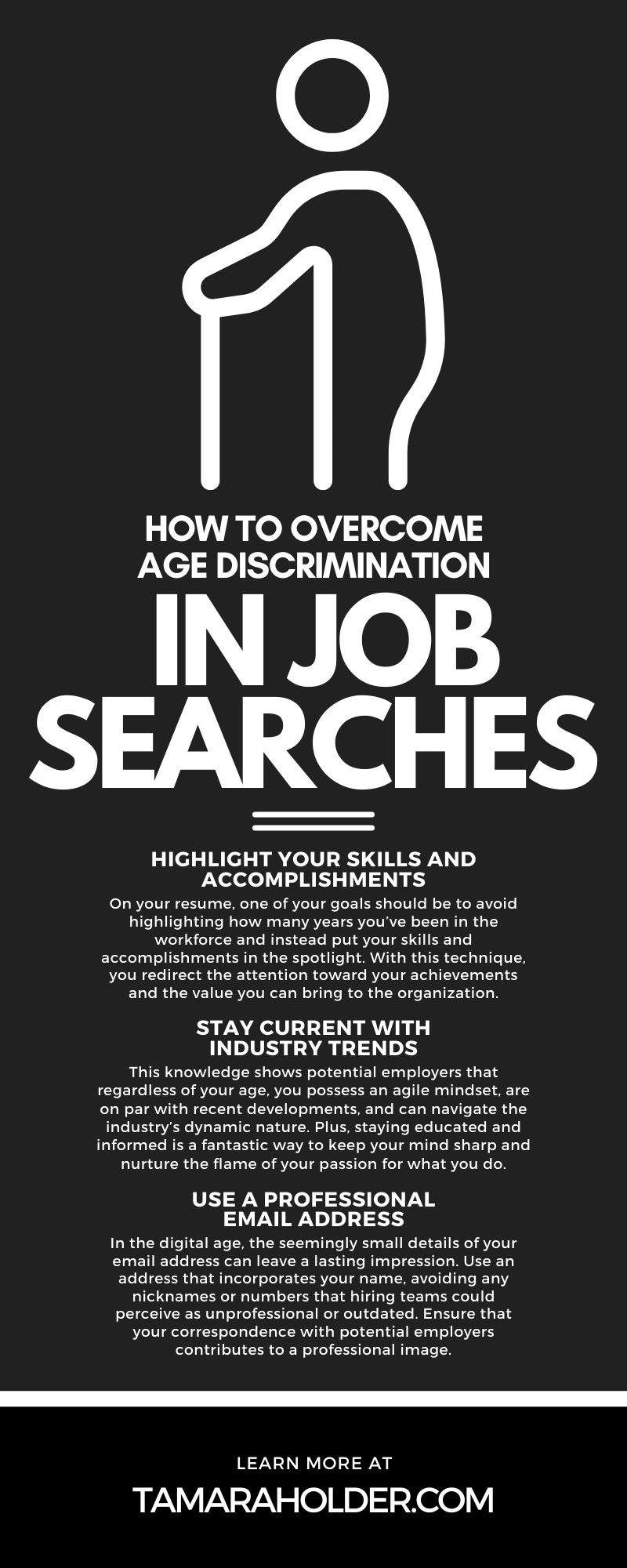
On your resume, one of your goals should be to avoid highlighting how many years you’ve been in the workforce and instead put your skills and accomplishments in the spotlight. With this technique, you redirect the attention toward your achievements and the value you can bring to the organization.
Don’t shy away from mentioning projects you’ve led, problems you’ve solved, and the tangible results your efforts have produced. It’s your chance to demonstrate that your years in the field translate to expertise and value.
Making an effort to remain at the forefront of technological advancements or strategic shifts in your sector is an effective way to dispel the stereotype of “being out of touch.” You can do this by regularly engaging with relevant industry journals, attending webinars, and participating in professional networking events.
This knowledge shows potential employers that regardless of your age, you possess an agile mindset, are on par with recent developments, and can navigate the industry’s dynamic nature. Plus, staying educated and informed is a fantastic way to keep your mind sharp and nurture the flame of your passion for what you do.
In the digital age, the seemingly small details of your email address can leave a lasting impression. Use an address that incorporates your name, avoiding any nicknames or numbers that hiring teams could perceive as unprofessional or outdated. Ensure that your correspondence with potential employers contributes to a professional image.
Additionally, using a mainstream email provider such as Gmail or Outlook can signal your comfort with technology and modern communication tools. Your provider might be a minor detail, but every element of your application shapes the employer’s perception of you.
While your educational background is undoubtedly important, the specific years are not necessarily relevant to your ability to perform a job. Excluding your graduation dates on your resume can be an effective strategy to negate age bias.
By excluding these dates, you prevent potential employers from calculating your approximate age based on the year of graduation. Instead, focus on the relevance of your degree to the position and any significant coursework or academic achievements that highlight your qualifications. Allow hiring managers to assess your resume based on your qualifications and skills rather than age. After all, it’s your competency and how well you fit the job requirements that truly matter.
Adopting a modern resume format is an effective way to present your professional history in a contemporary and visually appealing manner. In a modern resume, you place emphasis on your skills and experiences rather than the chronology of your employment. This style allows you to strategically present your most relevant experiences at the top, drawing the hiring manager’s attention to your qualifications rather than your age.
While crafting your resume, remember to use active language, concise bullet points, and industry-relevant keywords to effectively communicate your capabilities. Keep the layout clean, organized, and easy to scan. By modernizing your resume, you send a clear message to potential employers that you are in tune with current professional standards and expectations.
In today’s digital era, having a strong online presence is no longer optional, and this holds true regardless of age. You can leverage platforms such as LinkedIn, which has become indispensable for modern job seekers and recruiters alike. However, you can’t simply create an account and expect recruiters to come rolling in. You must maintain a polished, professional, and up-to-date LinkedIn profile, highlighting your skills, experiences, and achievements.
Familiarity with technology can counteract any preconceived notions of technological incompetence often unfairly associated with older age. The more you embrace technology, the more you prove to possible employers that you’re adaptable, irrespective of your age.
Networking is not just about attending events or collecting business cards—it’s about forming meaningful connections with professionals in your field. Strategic networking can open doors to unadvertised opportunities and provide insider information about potential job openings. Remember that networking is a two-way street; while you seek assistance from your connections, be ready to offer your own expertise and resources.
As you stay current with industry trends by attending industry-specific conferences or professional associations, you drastically increase your chances of building your network. By demonstrating your proactive nature and continuous involvement in your field, you can counter potential age bias, showing potential employers that age has not diminished your passion or professional involvement.
During an interview, it’s possible you may face questions or situations that subtly hint at age-related concerns. While it can undoubtedly be shocking and off-putting, it’s crucial to address these concerns confidently and tactfully. Showcase your enthusiasm for the role, emphasizing your adaptability, lifelong learning, and eagerness to embrace new challenges.
However, if that doesn’t work, and you don’t feel comfortable with the company culture this interview signals, don’t waste your energy on people with mindsets that won’t budge.
While overcoming age discrimination in job searches can be intimidating, never forget that the depth and breadth of knowledge, experience, and skills that older workers bring are invaluable. Your worth is determined by your skillset, work ethic, and the unique perspective that you bring to the table, so let your experience shine, remain confident, and persevere.
However, if you’re being unfairly discriminated against at work because of your age or running into illegal and discriminatory interview practices, don’t hesitate to seek legal help. At the Law Firm of Tamara N. Holder, our age discrimination lawyers are dedicated to uprooting ageism and protecting your rights. We’re here to help you hold discriminatory employers accountable.
Believing that people should receive compensation for their work is a nearly universal sentiment. In the United States, for the most part, workers are compensated fairly for the jobs that they do, but are they always paid equally? The answer, unfortunately, is no.
Pay discrimination may seem like a preposterous term at first glance—how can anyone get away with not paying their workers equally in this day and age? Throw the term intersectionality in there, and you may turn more than a few heads. These terms and concepts can be a lot to swallow, and understandably so. That’s why this article will break these ideas down so you can understand the intersectionality of pay discrimination.
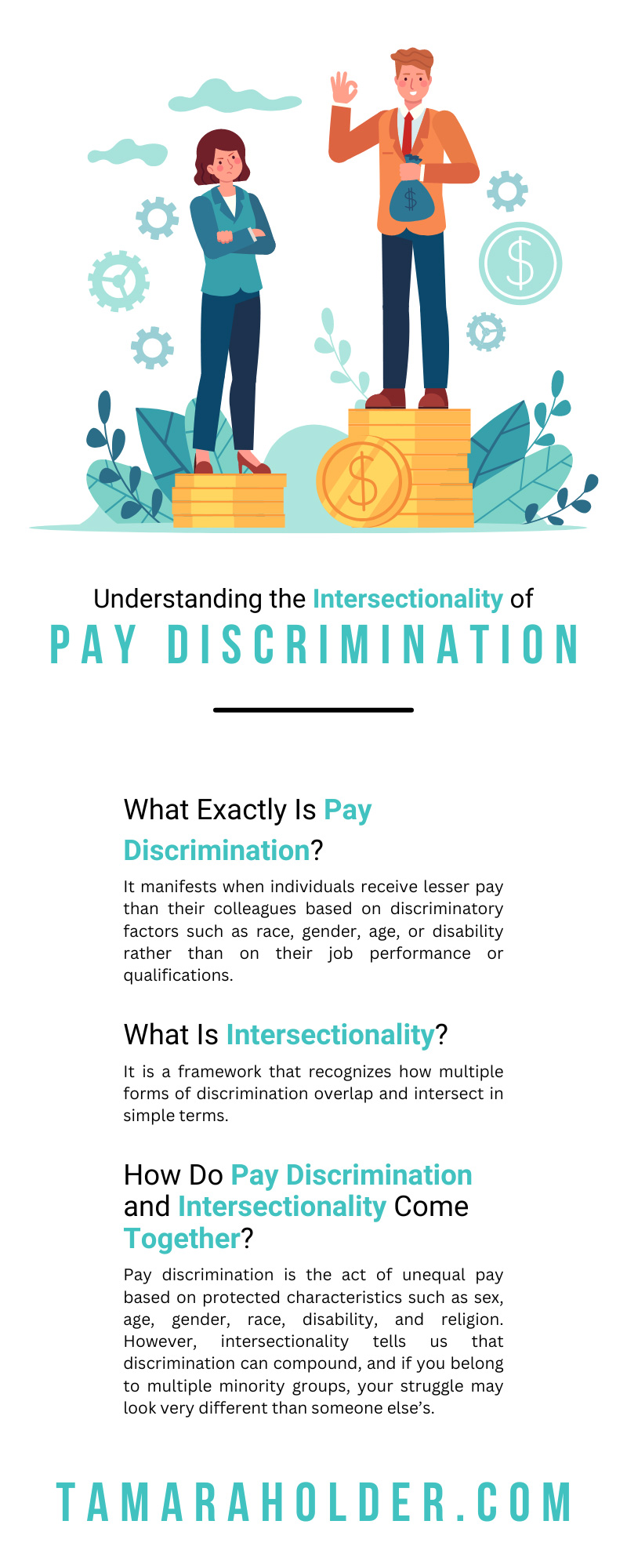
It’s important to note that pay discrimination is specifically a legal term. It manifests when individuals receive lesser pay than their colleagues based on discriminatory factors such as race, gender, age, or disability rather than on their job performance or qualifications. Therefore, pay discrimination can happen to absolutely anybody, and while it certainly can, that’s not where things tend to skew.
A popular term many confuse as synonymous with pay discrimination is the “gender pay gap” or the “gender wage gap.” However, these terms refer to a specific issue and are not necessarily phrases you’ll see within the legal field. The wage gap falls under the umbrella of pay discrimination but specifically refers to the financial disadvantages presented to women.
Understandably, this term may sound very strange. How are employers simply allowed to pay women less? Well, very rarely, if ever, is this term referring to an active choice by an employer to pay a woman less. This term refers to the socioeconomic factors that put women in a position to make less money than men across jobs and industries.
Women, due to a slew of sociocultural factors, tend to have fewer opportunities than men and may find themselves in lower-paying jobs. How? Let’s look at the STEM field as an example. We know that positions in the STEM field tend to pay favorable wages. However, due to the prevailing yet outdated view that STEM is a “man’s” field, women are sometimes too intimidated to participate.
Women end up in lower-paying jobs due to a lack of access to education in some cases. Once again, this may seem strange to some working under the idea that universities are outright refusing women. This belief isn’t true either. A woman may lack access to education because she may have to care for her relatives or her baby, cutting her educational career short.
Whatever the case may be, these factors put women at a disadvantage. While women may work hard to climb the ladder to qualify for higher-paying jobs, education, time, effort, and experience may still not be enough. Though it is illegal—and considered pay discrimination—in most states, some employers will look at past salary history to set your pay. Therefore, you may never have the chance to broaden your horizons, no matter how hard you work, if you’re not immediately starting on the right foot. Given the circumstances discussed, women have a harder time jumping over these hurdles, and many do not.
Scholar Kimberlé Willliam Crenshaw coined the term intersectionality in 1989. It is a framework that recognizes how multiple forms of discrimination overlap and intersect in simple terms. Just as a road map shows the numerous, interlinked paths between different locations, intersectionality offers a way to view how various social hierarchies, such as race, gender, and class, compound.
For example, a woman of color might face discrimination that is both sexist and racist. This complex web of discrimination is not simply the sum of sexism and racism but a unique struggle that stems from the intersection of these identities. We can get a more holistic and nuanced view of social inequality by looking at discrimination through intersectionality.
Understanding the intersectionality of pay discrimination requires one to define intersectionality and pay discrimination as separate terms first, then we can further our understanding by determining how they come together. How do they intertwine and affect the broader spectrum of social inequality?
Pay discrimination is the act of unequal pay based on protected characteristics such as sex, age, gender, race, disability, and religion. However, intersectionality tells us that discrimination can compound, and if you belong to multiple minority groups, your struggle may look very different than someone else’s. Depending on the group someone belongs to, they may be more at risk of pay discrimination or experience it more severely. Let’s look at a hypothetical example to better understand how these concepts intertwine.
Aaliyah Osman is a 32-year-old Muslim woman and second-generation immigrant whose parents were born in Senegal, Africa. She speaks fluent American English, received good grades throughout her primary education, and is on track to attend medical school to become a successful doctor, just as she and her parents dreamed of.
However, one day, Aailyah’s mother, Sadaf, becomes very ill, and her father, Faisal, cannot take care of his wife because he works full-time and must provide for the family. As a result, Aaliyah must put her education on pause to take care of her mother.
Years pass, and Sadaf passes away from her illness, but during that time, Aaliyah found a husband, got married, and is now raising their child. She still dreams of becoming a doctor, but as a stay-at-home mother, she doesn’t have as much time. However, she does find an online nursing program that allows her to improve her education from home, and after some hard work, she earns her nursing degree.
However, Aaliyah is now in what is known as a “pink collar” job, and instead of being a doctor and getting paid more, she is in a service role that requires caring for others. With her new life, it will become much harder for her to become a doctor than it would have been if she could focus solely on school, but it doesn’t end there.
Aaliyah is not just a Muslim woman; she is a Black woman and is much more likely to encounter discriminatory employment practices. Not only must she work harder than others to reach her goal—as she is at an educational and financial disadvantage due to life events—but she must also overcome the hurdles of systemic racism. Aaliya will have to fight general pay discrimination and the gender wage gap. According to data gathered by the United States Census Bureau, the wage gap for women of color is much larger, with Black women being paid $0.64 for every $0.79 that white women make.
While this example aptly shows how intersectionality and pay discrimination intertwine, it doesn’t include the roles that disability, age, national origin, and genetic information also play. Society must conduct more research to truly understand the complexities and nuances of this issue.
However, one thing remains clear. The Law Firm of Tamara N Holder is here to help if you believe you are a victim of pay discrimination. We’ll put you in touch with one of our dedicated equal-pay lawyers to ensure you receive proper compensation for your hard work and never have to live in fear of discrimination.